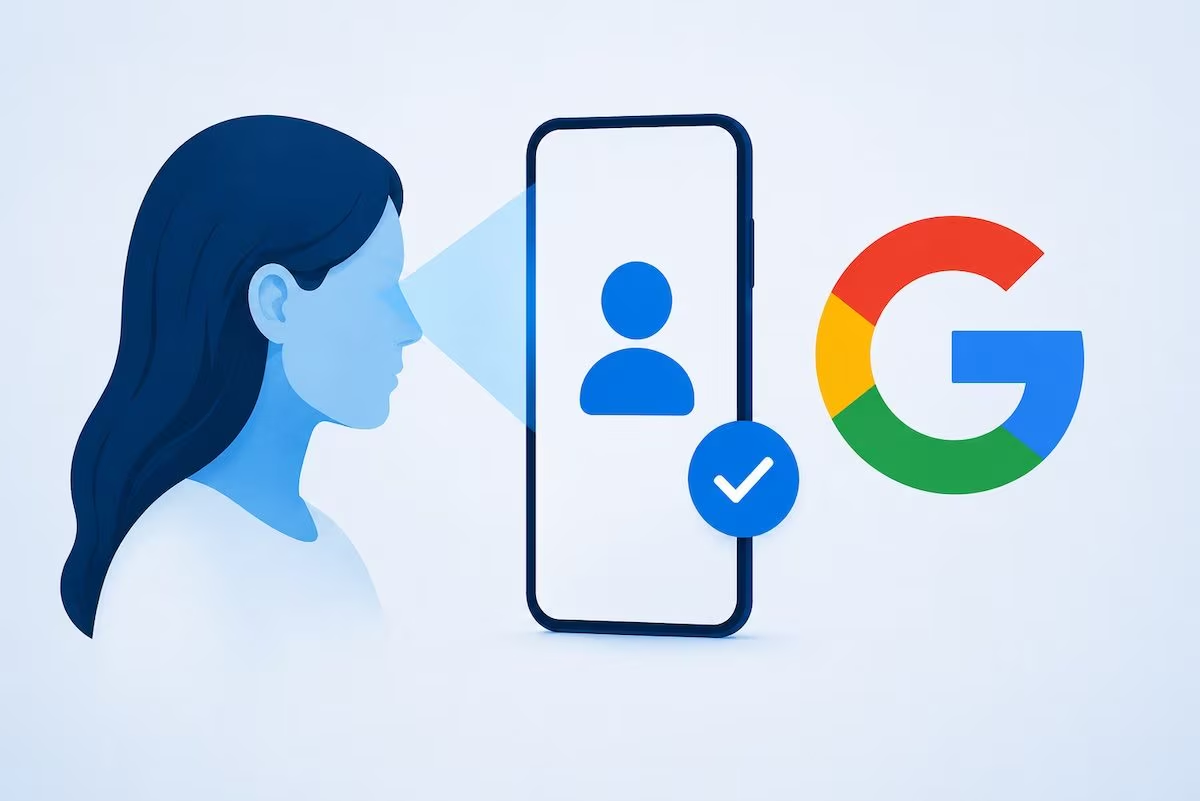
To recover a Google account, in some cases, it may now be enough to look at the camera and move your head following the instructions on the screen. From 23 July 2026 the company has in fact started to make available a system based on a video selfie recorded in advance, to be used as proof of your identity when you are no longer able to log in, for example because you have forgotten your password or you don’t have your usual smartphone or computer.
This does not mean, however, that to open Gmail or Google Photos it will be necessary to show your face every time. The novelty is an optional and backup method, which joins the already existing solutions, such as passwords, passkeys, telephone numbers, recovery contacts and devices considered reliable.
How to record selfie video to recover Google account
The video selfie, a short film of yourself shot with your device’s camera, must be set up before experiencing access problems, using a mobile device equipped with a camera and connected to a Wi-Fi network.
To check if your account is eligible and set up the function, proceed as follows:
- reach the Selfie Video page of your Google account and log in, if necessary;
- if the option is available for your profile, start the configuration and follow the instructions shown on the screen;
- look at the camera and make some guided head movements, so as to shoot your face from multiple angles.
During recording, your eyes, nose and mouth must be clearly visible. The company also recommends removing sunglasses, masks and hats and making sure there are no other people or images of faces in the background. Once completed, the resulting video is associated with the account and stored as a reference for possible future verification.
If the user later has difficulty signing in, Google can ask them to make a new short video. The system compares it with the one previously saved and, if it recognizes the same person, confirms the identity, allowing the owner to re-enter the account.
The function is not available for everyone: the ability to configure it may vary based on the geographical area, the type of account and the device used.
How Google tries to understand if there is a real person in front of the camera
The comparison between the two shots is not the only control foreseen. The required movements also serve the so-called liveness detection, i.e. to verify that there is a person physically present in front of the camera at that moment.
The goal is to prevent a stranger from getting through the passage by showing a photograph, a pre-recorded video or manipulated content. Google says it applies multiple layers of security to detect impersonation attempts, including deepfakes, alongside regular systems intended to block suspicious logins.
The company, however, has not detailed which facial features are analyzed nor has it published data on the accuracy of the method. It is therefore not possible to know which algorithms are involved, whether a three-dimensional model is reconstructed or how effective the verification is in all light conditions and with cameras of different quality.
Where facial recognition video is stored: control and privacy
Collecting footage used to confirm identity inevitably brings up the issue of privacy. According to Google, the selfie video is captured and stored only with the user’s consent and when on its systems it is protected by encryption.
By default, the content is to help the owner log in. However, it is possible to authorize its use, together with linked data, to develop and improve technologies such as facial recognition, age estimation and other verification methods based on physical characteristics or movements. This permission can be revoked from the settings.
The video can also be deleted, but deletion is not necessarily immediate. In fact, the company specifies that it could be retained for a short period as a security measure and, in case of violations of Google’s policies, kept longer to apply the relevant policies.
The solution therefore differs from biometric systems in which the face model remains only on the device. In this case, however, the recording is stored in the Google account, so that it can be used even when the usual smartphone or computer is not available: it is precisely this feature that makes it useful for recovery, but also raises questions about the management of such delicate information.
What are the advantages and limitations of Google’s video selfie
The option can offer a way out especially in case of loss or theft of the phone, or when normal verification tools are not usable. However, it does not make the account inviolable and does not replace other access and recovery tools, such as passwords, passkeys, backup codes or associated contacts. In fact, Google recommends preparing multiple alternatives, so as not to depend on a single proof of identity.
However, the system cannot help those who have already been excluded from their profile without having activated the option. Furthermore, real performance remains to be evaluated in the presence of strong changes in appearance, poorly lit images or cameras that are not particularly sharp.
In essence, the video selfie transforms the face into a sort of digital backup key. If the mechanism works as intended, it could simplify recovery when other options are unavailable. It is therefore up to the user to evaluate whether the greater ease of recovery compensates for the sensitivity of the data entrusted to Google.