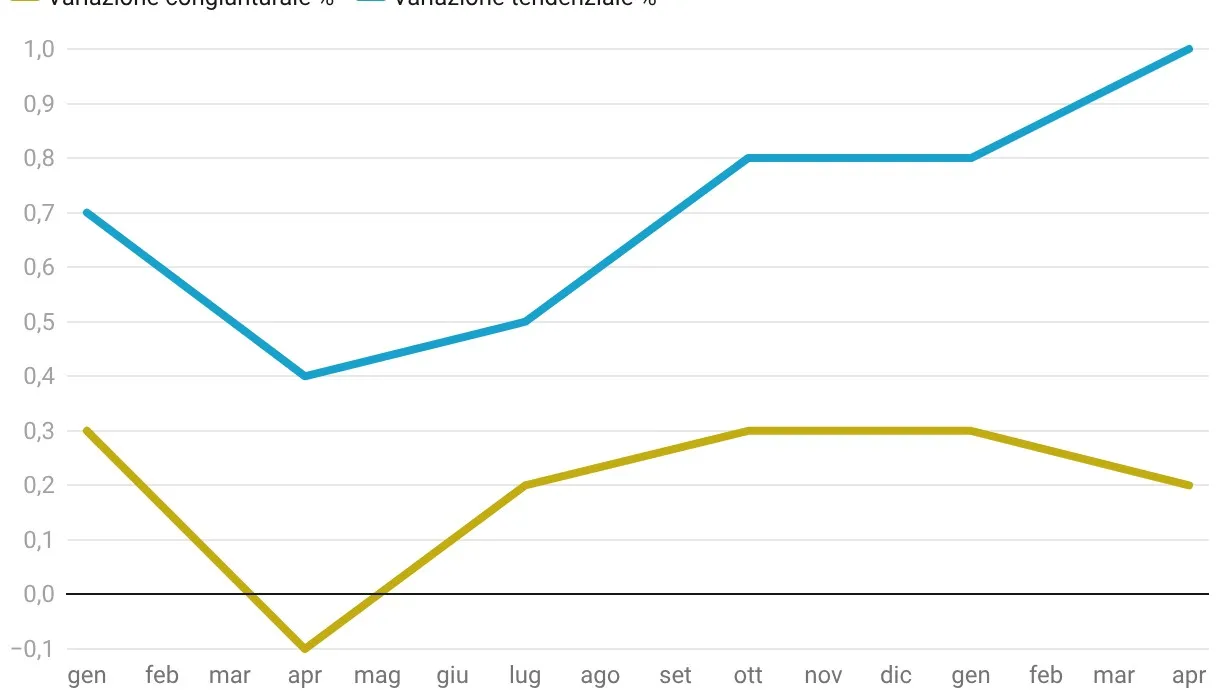
The Italian economy continues to expand also in the second quarter of 2026. Istat’s flash estimate indicates an increase in GDP of 0.3% compared to the first three months of the year and of 0.8% on an annual basis. Even more significant is the growth achieved, already equal to +0.7%: it means that, even if GDP remained unchanged in the second half of 2026, the year would still close with growth of 0.7%. But today Italy’s problem is not so much avoiding a recession as being able to increase the pace of growth.
Continuous growth, but without acceleration
The 0.3% increase in the second quarter follows the +0.2% recorded between January and March. If we broaden our gaze to the last six quarters, we observe how the Italian economy constantly fluctuates between 0% and +0.3% on the economic cycle, without real accelerations but also without significant setbacks. It is a very different dynamic from that observed in the two-year post-pandemic period, when GDP showed significantly larger variations.
According to Istat, growth continues to be supported above all by the services sector, while industry remains weaker. A picture consistent with the other economic indicators. Industrial production, for example, continues to move with difficulty, while the labor market remains at historically favorable levels, with an unemployment rate of around 5%.
However, growing by 0.2-0.3% per quarter means increasing GDP, but with a limited speed, which from a real point of view manifests itself in the difficulty of sustaining wage growth, investments and public finances in the medium term.
The real challenge is to increase growth potential
The data published by Istat confirms that the Italian economy continues to avoid a recessionary phase, but also shows a limit that is now evident. With growth achieved of +0.7% in the middle of the year and quarterly variations that have long fluctuated between 0.2% and 0.3%, the country seems to have found a balance. The problem is that this is a low-speed equilibrium.
In economic terms, growth of this magnitude is sufficient to keep GDP on a positive path, but is unlikely to be enough to significantly increase per capita income, accelerate private investment or reduce the burden of public debt on GDP.