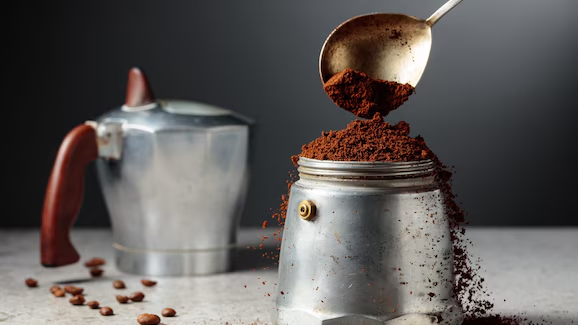
The moka prepares coffee using the pressure generated by the steam: the water, when it boils, releases steam which, expanding, passes through the filter in which the coffee powder is positioned. Before the mocha, coffee was prepared by direct infusion (i.e. by placing the ground beans in boiling water) or with other tools, some of which still exist today. The moka, which takes its name from the city of Mokha, in Yemen, was invented by an Italian engineer, Alfonso Bialetti, in 1933. Italy remains the country in which it is most widespread, but the coffee maker is also popular in other countries, often thanks to the presence of Italian emigrants. In total, it is estimated that there are around 320 million examples of the mocha in the world.
Why it’s called a moka and how it works
The name of the coffee maker comes from the city of Mokha, in Yemen, which is one of the most renowned areas for coffee production and in the past was the main port from which imports to Europe departed.
The moka, as we all know, is a coffee maker for domestic use. It is made up of three main elements: the kettle, located in the lower part; the filter where the coffee powder is placed, which is in the center; the collector, or jug, at the top.
The moka works by exploiting the thermodynamic pressure of steam: when the water is placed in the kettle. comes to the boil, releases steam; the increase in pressure pushes the steam upwards, making it pass through the filter with the ground coffee and extracting the aroma, until it is collected in the upper part. In this way the coffee “goes up” or “goes out” (the verb changes depending on the region).
There are approximately 320 million examples of moka pots in the world. The dimensions vary: from the single cup moka to the largest on the market, which allows you to prepare 18 cups of coffee (and there are even larger collector’s models).
The original moka has an octagonal shape, but there are also imitations on the market, based on the same principle, with a different shape.
How coffee was prepared before: the first espresso machines
Before the mocha, coffee was mainly prepared by direct infusion, that is, pouring water over the powder and bringing it to the boil (as Turkish coffee is made today). In some cases rudimentary filters were used to eliminate the dust that settled at the bottom of the container.
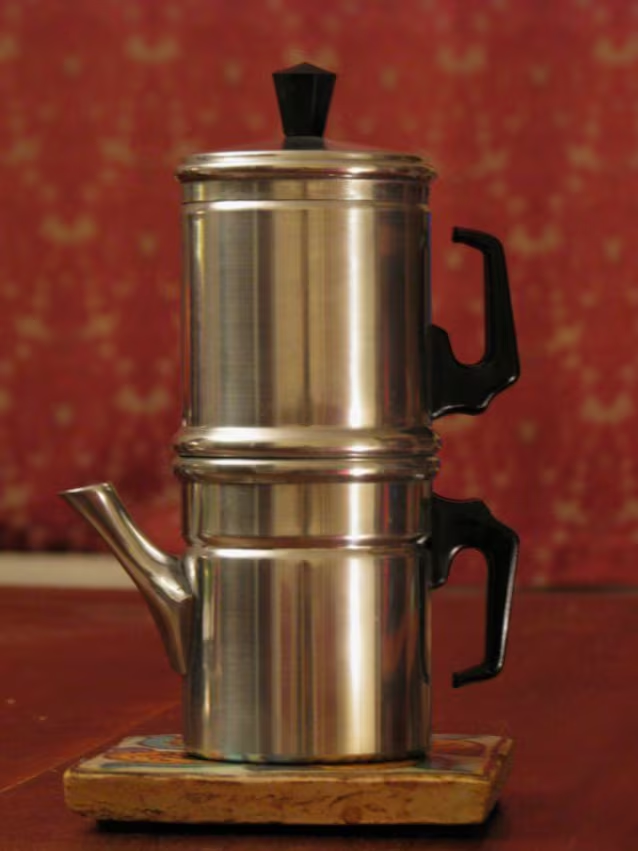
An alternative was the Neapolitan coffee maker, invented in France in 1819 and perfected in Naples in subsequent years. Unlike the moka, the Neapolitan is based on the principle of gravity: the boiling water is placed above the coffee powder (the coffee maker must be turned upside down when the water reaches boiling) and, as it falls, causes the infusion.
Furthermore, at the end of the 19th century, the first espresso coffee machines were introduced, but they were only perfected after the Second World War.
The moka was invented by Alfonso Bialetti in 1933
The moka was invented in 1933 by Alfonso Bialetti, an engineer who owned a company that produced aluminum objects. The success was immediate: the new coffee maker, thanks to the quality of the coffee it prepares, quickly spread first in Italy and then in some foreign countries. The success was also facilitated by the fact that the production of aluminum objects was encouraged by the fascist regime, with the aim of limiting the use of steel (which had to be imported from abroad), and by the increase in coffee consumption.
Furthermore, Alfonso Bialetti proved to be skilled in publicizing his invention. The first slogan read: “At home, an espresso like at the bar”.
After the war, the Bialetti company came under the control of Renato Bialetti, Alfonso’s son, who started industrial production. The moka was now very popular and other companies also started manufacturing it.
Since then, production has never stopped. Today the moka has to face competition from domestic espresso coffee machines, which are increasingly widespread but, nevertheless, continues to be present in the homes of millions of people. As we have seen, there are more than 300 million copies in circulation in the world. The diffusion of the moka, however, is not homogeneous throughout the world: the coffee maker is very popular in Italy (it is estimated that 90% of families own at least one) and is also widespread in the Iberian Peninsula and in many countries where flows of Italian emigrants have headed, in particular to the American continent. In the rest of the world, however, it is less widespread.