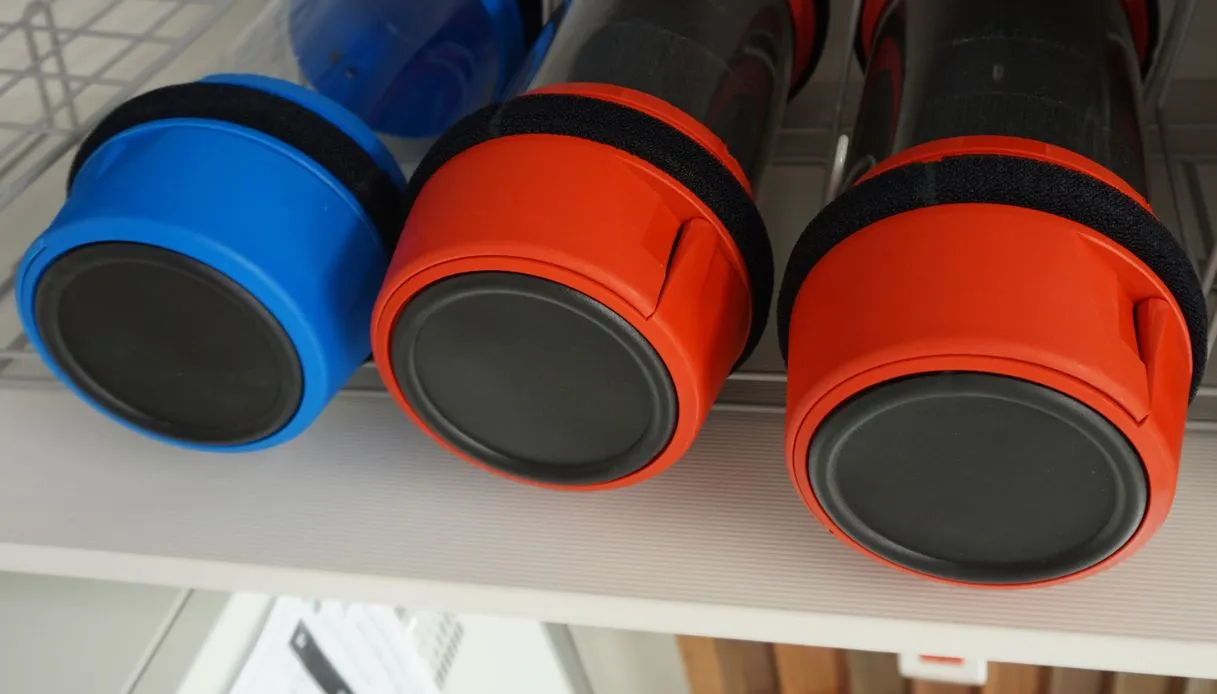
In an Italian steel mill, the time needed to send a sample of incandescent material from the furnace department to the laboratory can go from 20 minutes to 2 minutes, thanks to the adoption of an internal pneumatic mail system. No worker anymore has to interrupt their work or face risky routes with hot loads: a protected capsule travels in the tubes and delivers the sample almost in real time to its intended destination.
In a modern pharmacy a patient and his medicine are on two different levels. The pharmacist requests the medicine stored in the warehouse on the lower floor and in less than 30 seconds the package travels up the tubes, arriving directly in his hands. The great thing is that no one had to move: the pharmacist doesn’t abandon the customer and the customer doesn’t stay waiting.
These concrete examples illustrate how smart automation such as pneumatic mail can revolutionize internal logistics, reducing downtime and fixed costs. We are not talking about science fiction, but about a technology tested and updated to today’s paradigms, capable of integrating into existing flows and generating a return on investment that can be measured almost immediately.
Automatic mail: a smart infrastructure
We think of a pneumatic post system as the circulatory system of a manufacturing building.
Just as blood flows through arteries and veins, documents, samples or components travel in sealed capsules along a network of pipes, propelled by compressed air.
The sending/receiving stations act as joints (the “capillaries” where operators insert or remove the cases or capsules) while the Heart of the system is an intelligent control unit that controls the thrust and suction motors. This control unit supervises each shipment, monitoring the route and tracking the objects sent in real time (also via barcodes and management software).
In practice, pneumatic mail creates a smart infrastructure within the company: it connects different departments, different floors or distant buildings with an invisible but efficient network.
The beauty is that all this fits together without distorting what already exists. The pipes can run in the attic, in the shafts or along the walls, adapting to the existing structure. Integration with management systems is natural: the system can communicate with the internal software or function autonomously, integrating into the digitalisation of internal processes without interfering with current operations.
In other words, the pneumatic post enhances the efficiency of internal flows without requiring structural revolutions or complicated reconfigurations: a “plug & play” infrastructure that makes the factory (or hospital, or pharmacy) more connected and responsive.
Tangible data: reduced time and immediate ROI
When speaking to a Plant Manager, Operations Manager or CFO, it’s the numbers that count.
And the pneumatic post numbers speak for themselves, showing significant improvements and an ROI (return on investment) surprisingly fast. Here are some:
- Drastic reduction of internal times: in industrial contexts, cuts in internal transfer times of up to 90% are observed – as seen, operations from 20 minutes drop to 2 minutes, freeing up precious man-hours every day.
- Faster deliveries in healthcare retail: in pharmacies served by systems Aerocomthe delivery times of medicines from the warehouse to the counter are reduced by 30–50% according to surveys on real installations, significantly improving customer service.
- Cutting internal transport costs: by eliminating continuous manual movements, the cost of internal handling of samples and materials can drop by up to 70%. Fewer staff dedicated to acting as “couriers” between departments means fewer unproductive salaries and lower costs of vehicles (forklifts, etc.) and consumables.
And the ROI data confirm the value of this technology. For example, in a hospital a system with more than 40 sending/shipping points, initial cost of €500,000 and annual maintenance of €30,000 guarantees, over a ten-year horizon, an ROI of 102% with a payback of approximately 5 years.
These data demonstrate that the pneumatic post is not a luxury for the few, but an accessible and high-impact efficiency lever even for medium-sized companies.
Contrary to the cliché according to which “automation = large initial expense, return only in the long term”, here we are talking about modular investments (from compact point-to-point systems to extended multi-point networks) and immediately measurable benefits in terms of hours saved, errors avoided and reduced costs.
The result? Streamlined internal processes and concrete economic savings, which make it easy to justify the investment to management.
Solutions for every sector and every need
Every industry has its challenges. For example: very high temperatures and dust in the steel industry, the distribution complexity in a hospital, or small spaces with continuous flows of customers in a pharmacy.
Over the years, Aerocom has developed a unique range of solutions on the market to meet each of these needs. The Italian branch, Aerocom. Here are some of the main solutions offered, designed for different sectors:
- Aerocom ST: the solution steel dedicated to the steel and metalworking world. Robust components resistant to intense heat and dust combine with an advanced electronic brain: the result is a system that withstands extreme environments but guarantees the intelligence and traceability of an advanced transport system. It is ideal for steelworks, foundries and forgings, where it eliminates the risks of manual handling of dangerous materials and speeds up previously slow operations (for example, sending hot samples from the oven to the quality laboratory now takes a few minutes instead of half an hour).
- Aerocom AC3000: a modular and flexible system, suitable for complex routes or multi-department structures. It is the perfect choice for large hospitals, chemical-pharmaceutical plants and complex manufacturing companies. Thanks to multiple diversions and advanced software management, AC3000 optimizes internal logistics like no other: laboratory samples, blood bags, documents or components travel quickly between distant departments, 24/7, with complete traceability. The result is an efficient and synchronized internal logistics network, fundamental in contexts where every minute counts (think of a hospital in emergencies).
- Aerocom Aeropharma: the solution designed for modern pharmacies with a high customer flow. Connect the automated warehouse (storage robot such as Apostore, BD Rowa, Gollmann, etc.) with the sales counters. In practice, when the pharmacist at the counter requests a drug, the robot takes it and inserts it into a case which delivers it to the counter in a few moments. Concrete advantages? Zero downtime for the pharmacist (who no longer has to move away from the customer), more time to dedicate to advice and sales, compact installation also suitable for small sales outlets, and very fast deliveries (reduction of lead time at the counter up to 50%). All this translates into greater efficiency and also into a measurable increase in turnover, because a pharmacist who stays with the customer can offer more products and offer a better service.
- Aerocom Rapid: intelligence and ergonomics in a small format, for point-to-point transport. It is the system designed to connect, for example, a warehouse to the sales counter (in retail) or a production department to the analysis laboratory (in industry) when a direct and fast connection is needed between just two points. Rapid created for those who have limited space or limited budgets but still want to benefit from automation: it has a compact design, transparent pipes and small and ergonomic sending/receiving stations, easy to use.
Thanks to this wide offering, Aerocom can satisfy all needs and all budgets: from the small shop to the large hospital or metallurgical company, there is a suitable pneumatic post system.
Each project is studied ad hoc with detailed design based on the customer’s needs, so that the solution integrates perfectly into the specific context and produces maximum benefits.
Why is the pneumatic post a strategic lever?
Automating internal transport with a pneumatic mail system does not just mean “doing some operation faster”: it means strategically rethinking the use of company resources. Freeing up resources and reducing fixed costs is the first big advantage.
Every minute an operator doesn’t spend walking between departments with a sample in hand is a minute they can dedicate to productive or higher-value activities. On an annual scale, the hours recovered by staff translate into thousands of euros of efficiency gained – or into staff that can be reemployed elsewhere, avoiding new hires to grow.
Furthermore, fewer staff around to act as “internal transporters” also means fewer recurring fixed costs: some manual tasks can be streamlined or eliminated, reducing the staff dedicated only to handling.
From the point of view of managementinvesting in this intelligent automation is a strategic move because it offers a clear competitive advantage. Faster and safer internal processes translate into greater speed of response to the market (products coming out sooner, faster quality analyses, customers served in less time).
All this enhances operations without increasing costs proportionally. A CFO or CEO attentive to cost saving and efficiency will recognize in pneumatic mail a project with a clear cost/benefit ratio: easy to approve because the benefits can be quantified in euros (and in a short time), with a positive impact on various company KPIs – from productivity per employee to the accident rate, up to end customer satisfaction.
Innovation and other advantages
Aerocom has been able to evolve pneumatic mail into a cutting-edge service, in line with the principles of sustainability. Current systems are equipped with sophisticated electronics, control software with intuitive touch interfaces and network connections that allow remote monitoring and predictive diagnostics. They are smart systems in all respects, which integrate with corporate digital infrastructures and contribute to the seamless digitalization of internal processes.
Innovating, however, does not mean complicating: Aerocom adopts pragmatic innovation, aimed at concrete results. For example, the pipes and casings are made with special materials (including antibacterial for healthcare environments) and with ecological air recovery systems that reduce energy waste.
The thrust turbines are designed to activate only when needed, ensuring energy efficiency and silent operation. An Aerocom system does not significantly burden electricity consumption, indeed it can help reduce it if compared with alternatives such as continuous travel by lift or internal vehicles.
From a “green” point of view, fewer internal manual movements also mean less waste (think of sending documents digitally instead of paper copies via the system) and more orderly management, in line with company ESG objectives.
A further strong point is the reliability of the service. Aerocom has been present in Italy since 1983 not only as a supplier, but as a partner rooted in the territory. The Italian Aerocom business unit counts on a 100% Italian, highly specialized team and on collaborations with local electro-mechanical companies for widespread assistance. Design, installation and maintenance are managed internally: this means maximum care at every stage and rapid response times in case of need.
With over 35,000 systems installed worldwide (almost 1,000 in Italy alone), Aerocom has accumulated high-level know-how, becoming a smart transformation partner for many customers rather than a simple technology supplier. Those who choose pneumatic mail acquire efficiency, not just tubes and capsules, having the certainty of being able to count on a reliable system and continuous support over time.









