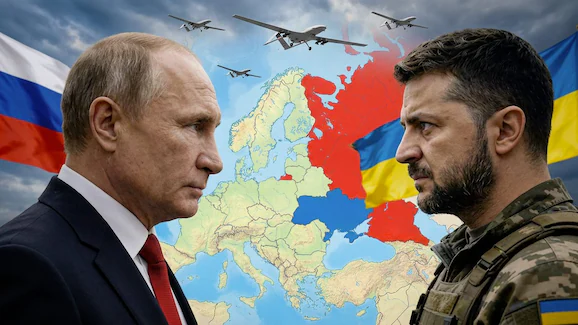
Since the conflict between Russia and Ukraine began, with the invasion of the latter by Russian hands, the global balance has been upset and every day we read news about the continuous drone attacks and raids by both sides: today it is a conflict of attrition and high technology, which however has historical roots and tools that are not as recent as we might think. The use of drones of various classes and sizes by Russia is in fact nothing new, given that its precursors date back to the Soviet period.
However, it is true that, in the approximately thirty years following the end of the Cold War, the Russian military high echelons proved very reluctant to the massive introduction of drones as new tools of offensive warfare. These reserves quickly fell with the start of the war, which broke out on the night between 23 and 24 February 2022, during which Moscow found economic but very effective tools in “unmanned aerial vehicles” to fight “conventional wars of the 21st century”.
More recently, drones have also been used, together with more traditional means, to test the capabilities of the rapid response and reaction systems of the military device of the so-called “eastern flank” of the Atlantic Alliance and the European Union, in the event that the geostrategic balance were to definitively collapse and the “Cold War 2.0” were to turn into a full-fledged “hot war”.
War between Russia and Ukraine: the drone revolution
When, on the night between 23 and 24 February 2022, Russia began its large-scale invasion of Ukraine, the Armed Forces of the Russian Federation were not among the top in the international rankings for the use of drones: they were vastly outclassed both from a numerical and technological point of view by countries such as the United States of America, Israel, China, Iran and Turkey.
The lesson that the war has taught has caused a sidereal change in the approach to the use of drones – both on the Russian and Ukrainian side – and the massive investments directed towards the purchase, development and production of new remotely piloted systems (in addition to the updating of existing ones) has completely reversed the rankings, which now see Russia and Ukraine firmly in first place.
Although the war events have not yet concluded, and certainly in the coming months and years the battlefields will continue to reserve new surprises for us, what we can already say with certainty is that the Russo-Ukrainian War represents the first ever example of generalized use of drones, a bit like the Vietnam War certified the first generalized use of helicopters.
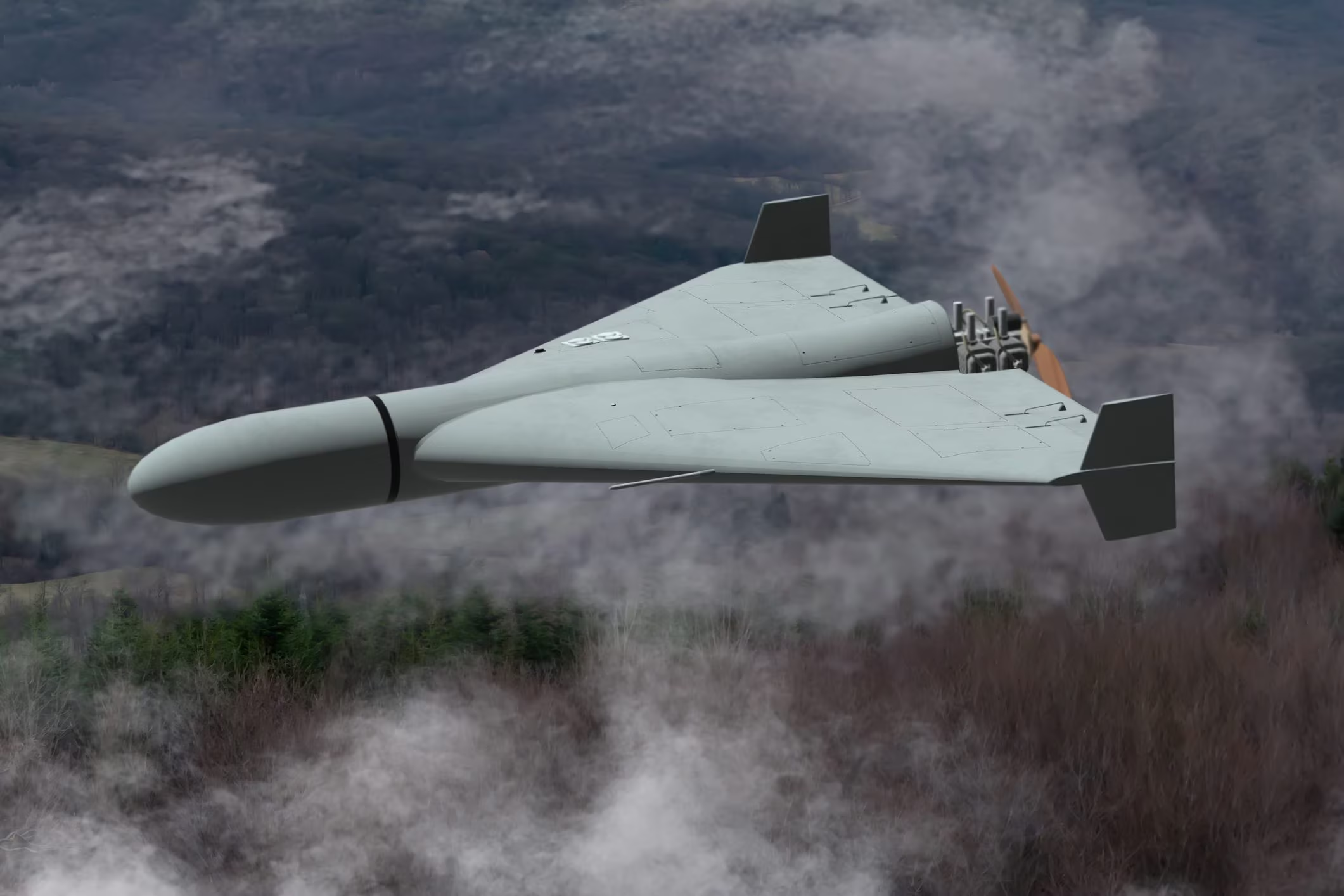
Russia in particular is pursuing a layered strategy that involves the use of drones at both a tactical and strategic level, not to mention the boom that the so-called “circuiting munitions” (also known by the English term loitering ammunition) and, more recently, also the FPV gifts (an acronym that stands for “first person view”which can be translated into Italian as “first-person view”) in a context of progressive but inexorable attrition of the Ukrainian forces carried out by the Russians through increasingly extensive, elaborate and violent attacks from the air. In fact, these types of bombs do not have a specific target at the time of launch, but are programmed to fly over a certain area, identify a target during flight and attack it autonomously or guided by a specially trained operator.
The importance that unmanned systems are now having in Russian military strategies is such that it has led to the creation of a new branch of service within the Armed Forces called Войска беспилотных систем, translatable as “Unmanned Systems Forces”, which according to the expectations of Russian military planners should grow to reach the 168,000 men by the end of 2026.
Violations of European and NATO airspace
However, Russia has not limited itself to deploying its drones only in the Ukrainian context, but has begun to use them for overflight missions aimed at violating the airspace of NATO countries. Originally, these violations (which began at the same time as the invasion of Ukraine, but did not arouse particular interest in the Western press) had the aim of carrying out reconnaissance missions on well-defined areas of the territories of Poland, Slovakia and Romania, important hub of concentration of Western war material headed for Kiev.
Subsequently, however, and especially during this year, the Russians raised the bar of conflict and began to violate the skies of the Baltic countries, the Nordic countries and several Eastern European countries (in addition to those already mentioned previously) more and more often. These incursions have caused the closure of airports, with consequent disruption of air traffic and considerable economic damage, as well as generating alarm and a sense of panic in the public opinion of the states involved. It is interesting to note that Russian provocations become more intense every time the possibility of an increase in military aid to Kiev is raised at the top of the European Union and NATO, an element that blatantly recalls the strategy of “pressure”.
Is a Western “anti-drone shield” really sustainable?
At the outbreak of the war, and in light of Moscow’s massive use of drones, numerous voices in the Old Continent were raised to suggest the rapid development and use of a “European anti-drone shield” (or at least NATO). At the moment, however, it is not clear whether this initiative can truly be implemented in a short time frame and whether the costs will be justified in light of the final performances, on which we can currently only speculate.
The Gordian knot of the issue lies in the now evident gap between the costs of the means of attack versus those of defense. In fact, a defense based on very expensive missile batteries and equally expensive high-performance aircraft, which would be used to shoot down drones worth a few thousand euros, is not sustainable in the long term.
We must also add the fact that the European and US defense industries have not yet managed to increase the production of defense systems in an appreciable manner, while the Russians manage to churn out Geran drones at a rate of hundreds per day (170 according to estimates dating back to the summer, equal to a theoretical total of over 62,000 per year and with the objective of 100,000 to be reached by the end of 2026), and it is just one of the many types of drones that the Russians they are producing.
Faced with the prospect of swarm attacks involving thousands of drones in multiple waves, the risk is that, by pursuing the wrong technological and operational approach, European countries will end up creating a modern equivalent of the famous Maginot Line, which could prove to be a colossal failure just as the French defensive line of the same name was at the beginning of the Second World War.
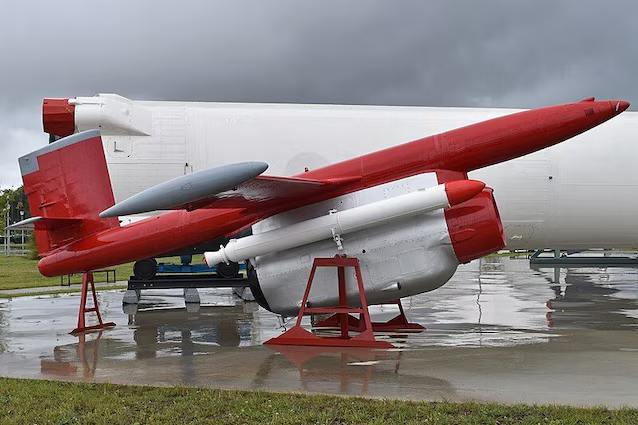
The relationship between Russia and drones is a completely new one, in fact it has lasted for over 70 years. In 1953 the then Soviet Air Forces tested and then introduced into service the Lavochkin La-17, a primitive target drone subsequently developed in several enhanced variants, destined for a long career not only in ex-Soviet environments but also in Syria and China.
Subsequently, in 1964 the Tupolev Tu-123 “Yastreb” was introduced, a strategic reconnaissance drone of colossal dimensions, powered by a Tumansky KR-15 engine (a variant of the same engine as the Mikoyan-Gurevich MiG-25 “Foxbat” interceptor fighter), capable of carrying both photographic equipment and SIGINT (Signal Intelligence) equipment and characterized by a potentially capable of covering the whole of Western Europe.
Over the decades (and despite the not always rosy budget availability), Moscow has gradually deployed new and more performing drone models which, however, have always suffered from a marked disadvantage compared to their Western, Israeli and Chinese counterparts. As already stated, it was only the beginning of the Russo-Ukrainian War that created the conditions for Russia to make the leap in quality and, judging by its investments, it seems determined to maintain this primacy in the future as well.