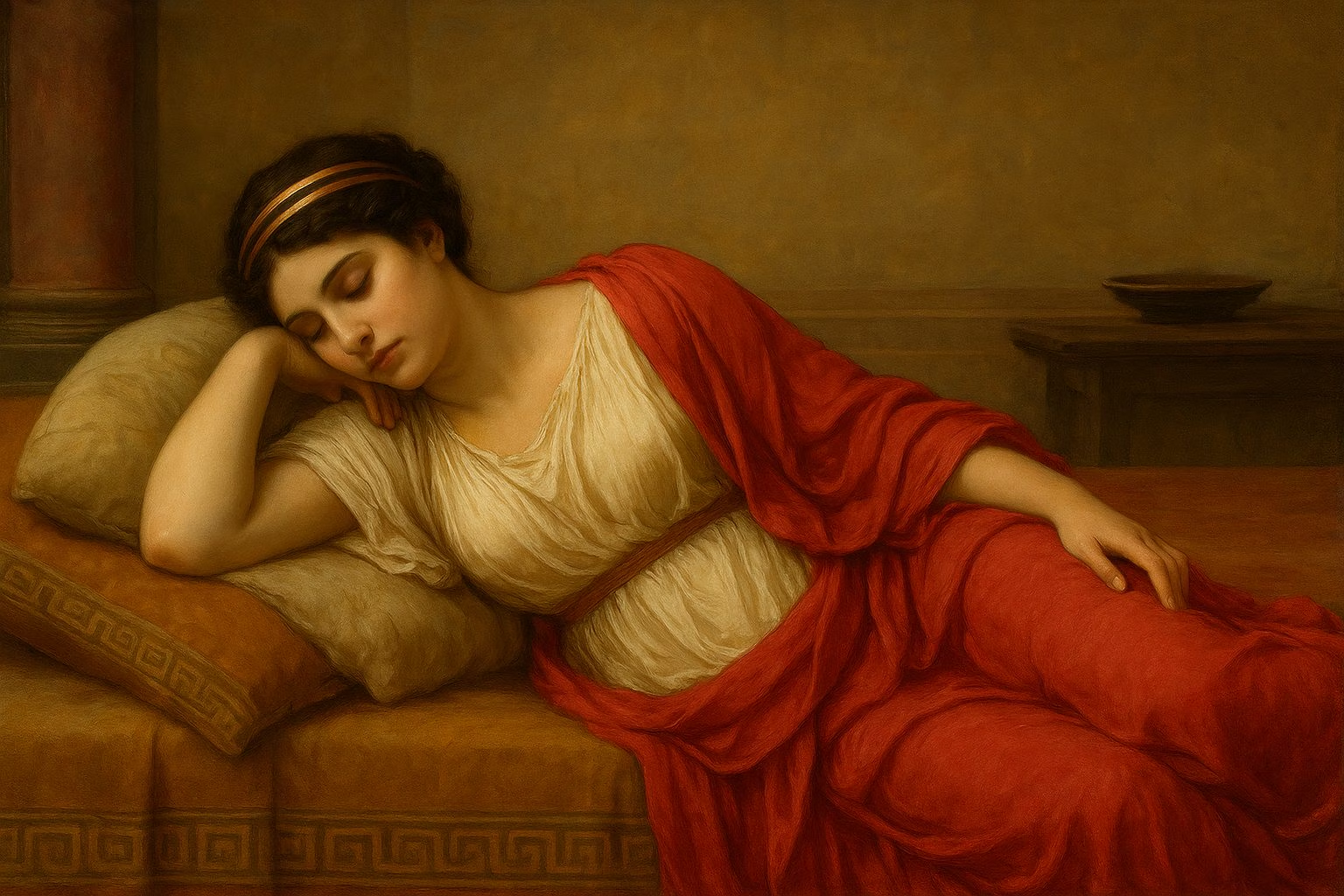
The ancients reasoned differently than ours, which is why historians have widely wondered if they dreamed the same way we doand if some dreams that we have on a recurring basis – such as trying to grab something and not succeeding, losing teeth, dreaming of flying – were also part of thedream activity in ancient times. Thanks to the abundant documentation of dreams narrated in Greek epics, and to the presence of ancient texts on the meaning of dreams, we know that yes, the ancients dreamed like usand they often dreamed of things that we also dream of.
In ancient times, however, we also had dreams that we no longer have today: for example, people often dreamed of the Gods who formulated premonitions, and decisions were made based on what was revealed, and even dreaming of nudity was not frequent, because the sense of modesty was very different. This change occurred because our social references and deep cultural beliefs have changed, which over time have influenced our unconscious, which we now know is the basis of the brain activity that generates dreams.
Dreams that the ancients had and that we still have today
Between the recurring dreams we have today and that they were also dreamed millions of years ago there is for example try to run or escape and faila dream in which we feel a will come to life inside us, but we are powerless. We have documentation of this in canto XXII of theIliadin the particularly dramatic moment preceding Hector’s death:
“Every time Hector tried to rush up to the Scaean gates under the solid towers, if ever they gave him help from above with arrows, Achilles, anticipating him, pushed him back towards the plain, always close to the walls. Just as one cannot catch a fugitive in a dream, one cannot reach the other, so, Achilles could not catch him in a run and the other could not escape”
Another recurring dream today as well as in ancient times is that of flying, as we find from the treatise on dreams written by Artemidorus of DaldiGreek writer and philosopher who lived between the 1st and 2nd centuries AD Gli Oneirocriticism (in Greek Ὀνειροκριτικάfrom oneiros and criticism, literally “criticism of dreams”), are five books in which Artemidoros collects and studies writings on dreams dating back to the previous seven centuries coming mainly from Asia, Greece and Italy: the text was also considered authoritative by Freud, who studied it to write “The Interpretation of Dreams”.
In paragraph 68 of book II, Artemidorus speaks precisely of dream of flyinganalyzing the different types of flight and giving a possible interpretation for each; and again extensively describes the dream of loss of teetha dream activity that is very widespread even today.
Another thing that often happens to some people is having so-called lucid dreams, that is, dreaming knowing you are dreaming. Also Aristotlein his treatise De Divinatione in Somnis – written in 44 BC – talks about this condition, which is also subsequently described by Saint Augustine in the text De Genesi ad litteram (414 AD) and since Saint Thomas Aquinas In the Summa Theologiaewritten at the end of 1200, in a section of the treatise dedicated to dream activity.
Dreams that we no longer have today: what are they and why?
Then there are dreams that were recurrent in the past and that today, however, we no longer have: this depends on a different social and cultural approachand therefore also unconscious, to certain themes, aspects and habits that define our way of living and interpreting reality, and therefore of dreaming. For example, in the treatise of Artemidorus there is no reference to dream of being nakeda rather frequent dream nowadays: this is because, in ancient times, nudity was considered differently than now, with less modesty.
The dreams of the ancients were then very often populated by apparitions of the Gods who made prophecies and gave indications, in some cases even deceptive, to support their human protégés or modify reality according to their wishes. This happened because, as we know, the cult of the gods was connected in every way to practical daily life, political choices and, in general, to the order of the ancient world.
To cite a few examples of the many that populate the epic poems, the second book of theIliad opens with a deceptive dream that Zeus sends to Agamemnon to induce him to attack Troy, and in book IV ofOdysseyAthena appears to Penelope in a dream to console her about the fate of her son Telemachus, taking the form of her sister. And again, the Sumerian king Eannatum Ion the throne around 2500 BC, dreamed of the storm god Ning̃irsu who predicted that he would triumph in a war, and therefore decided to proceed with war activity.