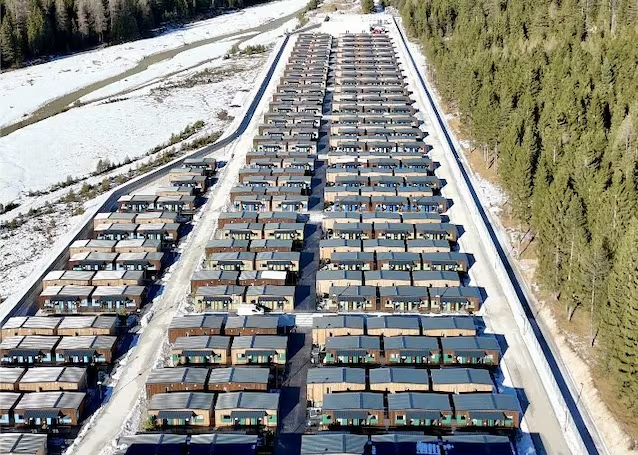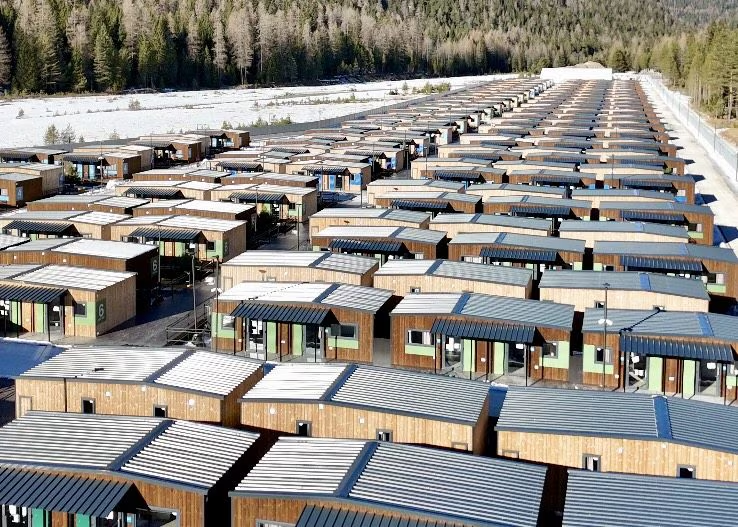
With the closing ceremony of the Milan-Cortina 2026 Olympics, the first major phase of the Games ends. But the lights of the Olympic and Paralympic Village in Cortina remain on, ready to welcome the athletes of the upcoming Paralympics. Designed by SIMICO – the Milan Cortina Infrastructure Company which is responsible for the construction of works and infrastructures linked to the Games – and located in Fiames, the Village is a completely temporary settlement which is among the 98 works connected to the Milan Cortina 2026 Olympic Games. In particular, it is part of the 31 works linked to the Olympic event, and not the so-called legacy ones which include the permanent infrastructures which will remain as a legacy to our country.
In this case the meaning of temporary However, it does not represent a compromise, but a complex project, in which architecture, systems and logistics were designed from the beginning to answer a key question: how do you build something that must function like a city, but only for a few weeks?
An entire city “resting” on the ground: characteristics of the village
The village is located in Fiames, a town located about 4 km north of Cortina, in the area where the small Cortina airport stood, built following the 1956 Winter Olympics to guarantee very short-range air connections with Venice, Milan and Bolzano, but closed already in 1976 after some tragic accidents.
There was no permanent infrastructure work to build the village. The area was chosen precisely because it was already marked by past use and therefore suitable for hosting a temporary intervention without consuming new land. The objective is not to redevelop by creating something stable, but to use an abandoned space without changing its nature, consistently with the idea of total reversibility that guides the project.
The village is able to host up to 2,000 people at the same time including athletes, technical staff and delegations. It is made up of 377 mobile homes for a total of 1,400 beds and approximately 15,000 square meters of modular structures for common services, connected by a continuous system of elevated paths approximately 70 centimeters above the ground, which do not just represent an element of accessibility: they are the true hidden infrastructure of the village. In fact, under the walkways runs a large system backbone that distributes water and energy to the entire settlement. The same backbone connects the village to a specially installed purifier, which then channels the water into the city’s sewer system.
In this way everything needed to make the “city” function remains invisible, integrated, but above all removable, without excavations or permanent foundations. Cables, pipes and systems are simply placed on the ground. Energy management also follows the same logic, without any permanent infrastructure. The village is served by a low environmental impact thermal power plant powered by liquefied natural gas (LNG), equipped with a regasifier. A solution chosen to guarantee reliability, continuity and thermal comfort during the Games, with a system capable of supporting the loads of a large and international community, but destined to be dismantled once the event is over.
377 mobile homes: the living heart of the village
The residential heart of the Olympic village is represented by the mobile homei.e. prefabricated residential units. Each maxi caravan measures approximately 8.60 by 4.50 meters and is organized into two rooms, each with two beds, for a maximum capacity of four people.
A central element of the project is inclusiveness: one of the two rooms of each mobile home it is completely accessible, which means that approximately 50% of the total beds can be used by Paralympic athletes, despite the fact that the Paralympics involve the participation of approximately 5 times fewer athletes than the Olympics. There are no separate areas or special solutions: accessibility is integrated into the entire living system.
To avoid visual flattening and mitigate the impact of the village on the Dolomite landscape, the houses have different external colors, which recall the different shades of wood. Likewise, they were positioned asymmetrically to each other to break the typical regularity of prefabricated settlements. It is a purely design work that has no technical implications, but is fundamental to making the village less invasive and more coherent with the natural context.
How the city and daily life works for athletes
Village life does not end in housing. At the center of the settlement, in the easiest point to reach for all athletes, there are two large pavilions dedicated to common services, organized chromatically to make them easy to read. The red pavilion hosts the food & beverage area, with a huge canteen active 24 hours a day capable of satisfying the culinary needs of athletes who come from all over the world.
The green pavilion has instead been dedicated to meeting rooms, essential for delegations that need to define the final details with their athletes before the races, but also includes gyms, laundries, personal service spaces, places for religious worship. In fact, the arrival of athletes practicing at least 6 different religions is expected.
The operating system supports the entire system logistics compound, the area that manages flows, operations and essential services. This is where supplies, maintenance and daily activities are coordinated, allowing the temporary city to function without interruption. But it is also the place that serves as a department store and where in the weeks preceding the Olympics the various federations sent the materials necessary for the athletes to compete in the Olympic races, such as bobsleigh, sleds and skis.
What happens after the Olympic Games: the model for future events
Once the Games are over, the village will be completely dismantled. The Fiames area will be returned to its original conditions, without permanent buildings or invasive infrastructures. The mobile homehowever, they will have a second life: they will return to the open air hospitality market or can be reused in social settings, with the definitive intended use to be made official in the weeks following the end of the Paralympic Games. In this way, the value of the project does not end with the event, but extends over time, changing shape.
The Olympic and Paralympic village of Cortina d’Ampezzo, designed to be dismantled without leaving a trace, is not only an infrastructure designed and created for the Milan Cortina 2026 Games, but a global case study in terms of sustainability linked to major events.