
The Rorschach test is a famous projective psychological test invented in 1921 by the Swiss psychiatrist Hermann Rorschach, among the most iconic and at the same time controversial in psychodiagnostic practice. Through 10 standardized tables featuring symmetrical inkblots, the psychological structure of the subject is assessed, analyzing their adherence to reality, the management of affective-relational balance and cognitive functioning, including the possible presence of dysfunctional nuclei of thought.
What are projective tests to study an individual’s personality
The definition of “projective technique” was given for the first time in 1939 by Lawrence K. Frank, who described it as a method for studying the personality of an individual by placing him in front of ambiguous situations. In these conditions, the person tends to respond by attributing to the stimulus the meaning it has for them, reflecting their own way of feeling and their own experiences.
Projective tests are therefore halfway between the psychoanalytic vision of the mind and the attempt to make the study of personality more systematic and close to the criteria of scientific research. Unlike objective tools (based on numerical scales or closed answers), these tests do not look for a “right” answer, but observe how the subject organizes undefined information.
From a psychological point of view, they are based on the mechanism of projection: an unconscious process through which the individual attributes contents such as:
- Emotional needs
- Mode of thinking
- Internal conflicts
- Aspects of one’s personality
In essence, the subject’s response does not describe the stain, but represents the manifestation of his internal world and the way in which his mind structures the experience.
A test with 10 tables: administration method
The test was born in 1921 from the mind of the Swiss psychiatrist Hermann Rorschach. Since he was a boy, Hermann was passionate about klecksography, a game that consisted of folding sheets of paper with ink stains to create undefined images. Rorschach noticed that patients with schizophrenia interpreted these spots drastically differently than psychologically healthy people. He dedicated years to selecting the 10 definitive plates that today make up the standard set, publishing the method in his book Psychodiagnostik: a series of symmetrical inkblots created by folding a sheet of paper in half, with the idea that the way people interpreted these images could reveal profound aspects of their mind.
Rorschach died shortly after publication, but the test continued to spread, becoming one of the most widely used diagnostic tools in clinical psychology.
The Rorschach Test can be administered as early as 3 years of age and is used in various contexts, not only clinical but also legal and organizational. It allows an overall assessment of the personality and is particularly effective in investigating central aspects such as adherence to the level of reality, the functioning of thought, emotional-relational balance, as well as identifying any dysfunctional traits.
In particular, it is a useful tool for exploring:
- ability to imagine;
- relational methods and empathy;
- emotional and cognitive resources;
- anxiety levels and stress response;
- psychic tension;
- concern for psycho-physical health;
- ability to synthesize and form concepts;
- perceptual functioning and possible distortions;
- anomalies and distortions of thinking;
- presence of critical contents, such as suicidal ideation.
The administration and interpretation of the Rorschach Test require specialized training: the professional must have clinical experience, scientific preparation on the psychometric structure of the instrument and a solid knowledge of personality traits.
Method of administration
The Rorschach Test is made up of 10 different plates depicting an ink stain: 5 monochromatic plates, 2 two-color plates and 3 colored plates.
The administration and evaluation process consists of six main phases:
- Administration: this is the initial phase in which the 10 tables are presented, one at a time. The subject is simply told: “Now I will show you some pictures. You will have to tell me everything you see in them. There are no right or wrong answers. You have all the time you want and when you are finished you can give them back to me.” The answers are free and unguided, so as to encourage the spontaneous emergence of personal contents.
- Additional tests: if some answers are unclear or incomplete, the specialist can propose additional questions to delve deeper or better clarify what was said, without suggesting contents.
- Investigation: in this phase we go back to each answer provided to better understand its characteristics. The subject is invited to indicate where he sees what he has described and what led him to interpret the image in that way.
- Coding: the answers are translated into codes according to standardized systems (such as the Exner system). Various aspects are analyzed including localization, determinants (shape, color, movement), content and latency time before the response.
- General computation of data: codes are organized and quantified; this phase allows us to identify recurring indices and patterns, useful for a more objective evaluation of psychological functioning.
- Interpretation: the data are integrated within an overall clinical picture; the specialist interprets the results in light of the person’s clinical history and any other diagnostic tools, avoiding isolated or simplistic conclusions.
Why is it so criticized
Despite its fascination, the test has been at the center of heated debate within the scientific community for decades. The main criticisms concern:
- Subjectivity in interpretation: for years, interpretation has depended too much on the theoretical orientation of the psychologist; furthermore, responses may be assessed differently by different clinicians, raising doubts about the objectivity of the resulting profile.
- Validity and reliability: many critics argue that the test tends to “pathologize”, that is, to determine disorders where in reality there are none; at the same time, some research indicates that the Rorschach often fails to consistently identify psychopathological conditions (e.g. depression, anxiety) or specific traits (e.g. impulsivity).
- Reproducibility: unlike a blood test, the results can vary depending on the context or the relationship between clinician and patient, or depending on the psychologist himself.
Initially, the definition of “test” was, according to some (and still is today), not totally adequate as it had weak psychometric properties: many scholars believe that the more correct term would be that of “Rorschach test”, as subjective responses in the face of new and ambiguous stimuli are investigated. In fact, very often it is useful to combine the Rorschach with other personality tests such as the MMPI, which could help in providing a more comprehensive image of the psychic system under investigation.
In any case, to respond to psychometric problems, over time more standardized coding systems have been developed (such as the Exner system), which attempt to make the analysis more objective and rigorous, recovering credibility in the forensic and clinical fields. However, the debate remains open: for some it is a useful tool if used correctly, for others it has limited value compared to more structured psychometric tests.
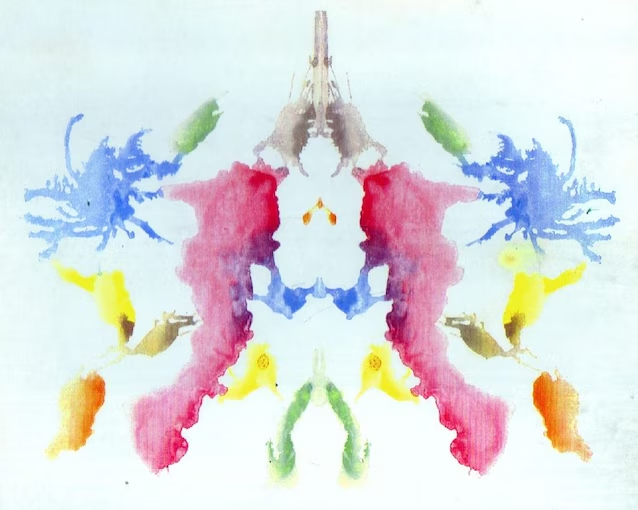
A practical example: what happens in front of a table?
To better understand how the test works, let’s imagine a simplified situation (and for purely informative purposes). This is just an illustrative example: in real practice, the Rorschach Test can only be administered and interpreted by qualified professionals.
The specialist shows a table and asks: “What could this figure be?”
The subject replies: “it looks like a bat with its wings open… or two animals facing each other.”
The professional elaborates: “Where do you see the bat? And what makes you think that they are two animals?”.
The subject points to the entire patch for the bat and the two lateral parts for the animals, explaining that “they seem to be facing each other, as if they were about to attack.”
Analytics is not just about what is seen, but how it is seen:
- Localization: uses the entire image → good ability to integrate the stimulus.
- Determinants: the response is guided by the form, an indicator of good anchoring to perceptive reality.
- Content: animal (frequent response), plus conflictual relational scene (dynamic element).
- Organization: the description is coherent and structured.
Two interesting aspects could emerge in this example:
- The presence of a common response that adheres well to the form (“bat”) suggests adequate perceptual functioning and good contact with reality;
- The spontaneous introduction of a conflict scene (“two animals facing each other”) can indicate a particular sensitivity to relational themes and conflict dynamics.
Alone, this response would not allow any diagnosis. However, if content linked to conflict, tension or opposition frequently appears in the other tables, the specialist could hypothesize a way of reading the world centered on conflict or intense relational dynamics. On the contrary, if the subsequent responses were varied, flexible and well organised, this scene could simply represent a momentary free association, without particular clinical significance.
The Rorschach Test does not work for “universal symbols” (seeing a bat means nothing in itself). What matters is the overall configuration of the responses, their formal quality and their internal coherence. It is the set of data, not the single image, that builds the profile of psychological functioning.