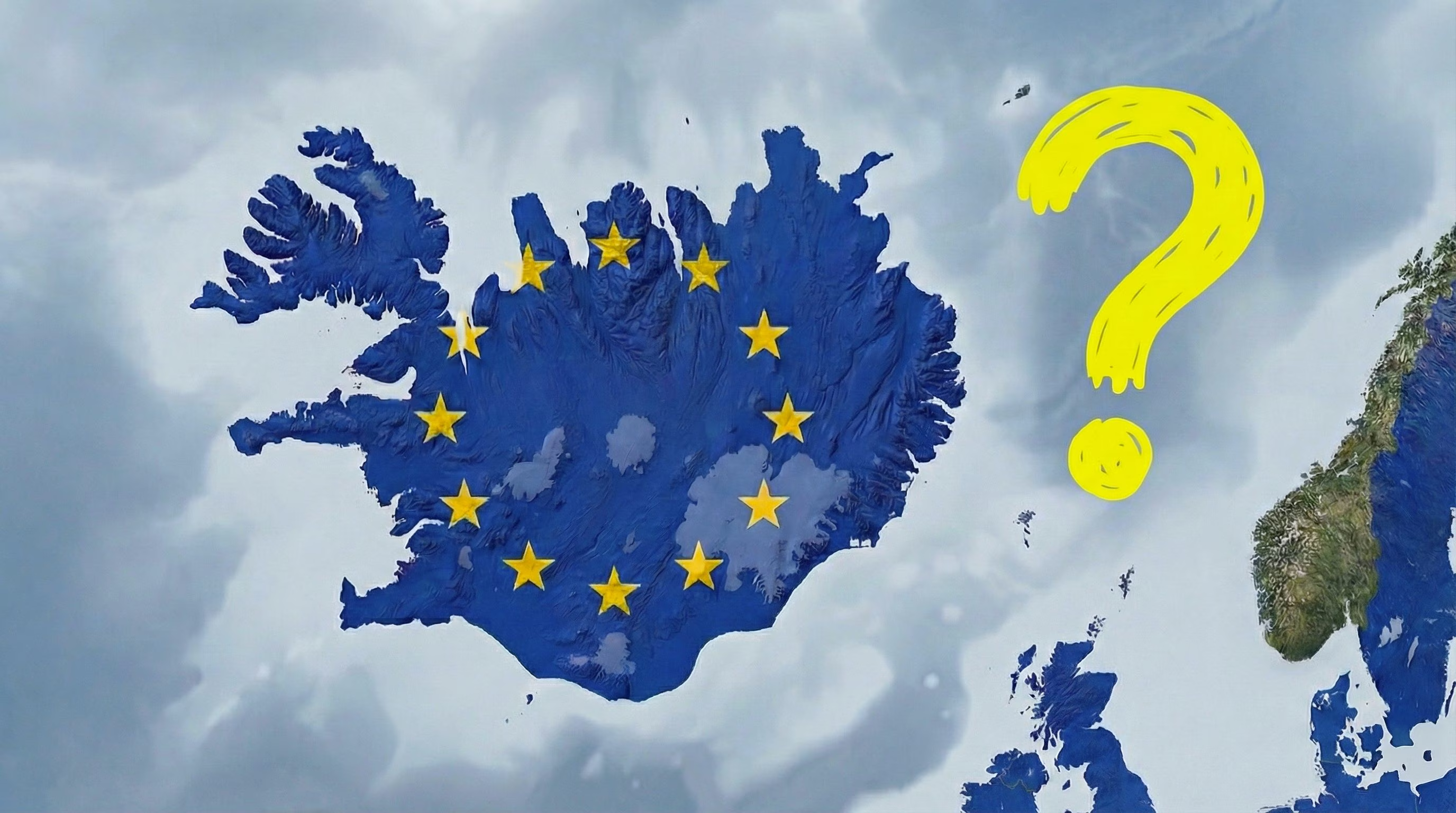
Iceland will organize a referendum to decide whether to apply to join the European Union: the decision was confirmed by Icelandic Prime Minister Kristrún Frostadóttir, who had included it in her political program for the 2024 elections. The government of the volcanic island, in reality, had already applied to join the EU in 2009, after the effects of the financial crisis that broke out the previous year had damaged its economy. The request, however, was withdrawn in 2015 by the then Prime Minister, with the country being eliminated from the list of candidate states by the European Commission.
Given the growing tensions in the Arctic region – due to Donald Trump’s aims on Greenland – the current government has decided to put the decision back in the hands of Icelandic citizens, who in the coming months will be asked to express their opinion on possible membership of the European Union.
Relations between Iceland and the European Union: what is the European Economic Area
Despite not being a member state, Iceland has always enjoyed a special relationship with the European Union: just like Norway and Liechtenstein, Iceland is also deeply integrated with the European market through the European Economic Area (EEA), of which it has been part since 1994. The EEA groups together the 27 member states of the European Union and these three states (which are members of the European Free Trade Association, EFTA) in a single market subject to the same rules.
In practice, this means that Iceland implements the four fundamental freedoms on which the European Union has been based since its creation: freedom of movement of goods, capital, services and people. At the same time, the country is also subject to rules relating to competition and state aid, as well as common policies relating to various subjects, such as energy and transport.
In short, EU membership would be easier for Iceland than for other candidate countries, by virtue of the preferential relationship it has enjoyed for over 30 years.
How to join the EU: the Copenhagen criteria
Despite this special relationship, if the outcome of the referendum is positive, Iceland would still have to stick to a rigorous accession procedure, which could last several years. But how does it work?
First, the membership application is submitted to the Council of the European Union, which asks the EU Commission to assess whether the candidate state is able to meet 3 essential criteria, known as Copenhagen criteriawhich are divided into:
- Political criteria: the country must have stable institutions that guarantee respect for the democratic values on which the EU is founded, namely democracy, the rule of law, human rights and respect for and protection of minorities.
- Economic criteria: the existence of a reliable market economy capable of coping with competitive pressure within the Union market is necessary.
- The ability to comply with the acquis communautaire: the country must demonstrate that it is able to accept the obligations deriving from membership and to effectively implement EU laws and policies, colloquially defined community acquis.
Based on the Commission’s recommendations, the European Council decides whether or not to grant candidate country status: this decision, however, must be approved unanimously by the EU member states.
If candidate status is approved, then negotiations begin: the Commission monitors the progress made by the candidate country and informs the Council and the European Parliament through regular reports and communications.
This phase is the longest and most complex, as it requires nations to implement a series of internal policies and reforms to adapt to European standards. Today most of the candidate countries (such as Albania, Montenegro, Ukraine and North Macedonia) are going through different stages of negotiations.
Once the negotiations are concluded, the Commission gives an opinion on the country’s preparation to become a Member State. If the Commission recommends that the candidate country is ready, then an accession treaty is drawn up, which must be approved by the European Parliament and subsequently signed and ratified by all EU member states and the candidate state.
At this point, the country officially becomes part of the Union when the accession treaty comes into force.