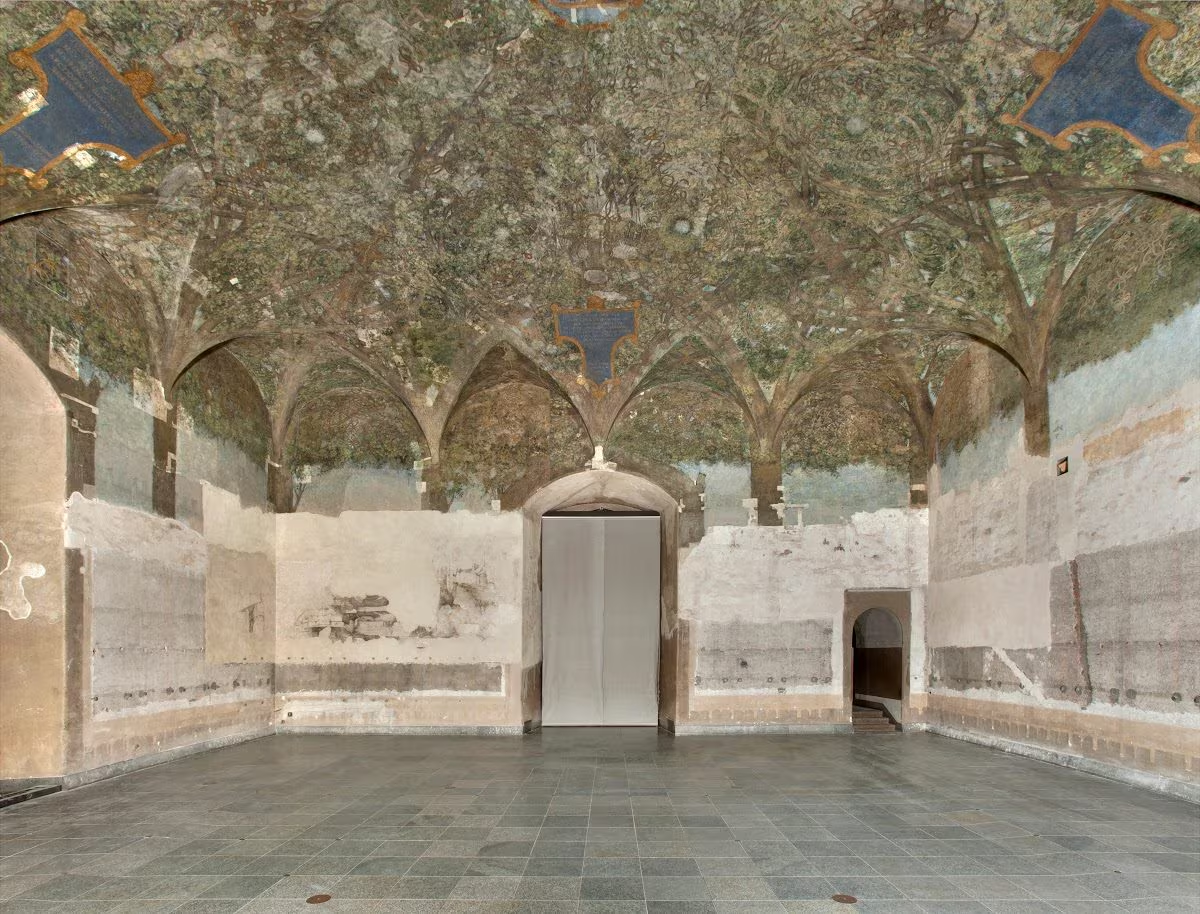
Everyone knows theLast Supper by Leonardo da Vinci, the famous fresco preserved in the convent of Santa Maria delle Grazie in Milan. However, not everyone knows that the city preserves a second proof of the skill and influence of the Tuscan painter and inventor: the frescoes in the Sala delle Asse in the Sforzesco Castle. On the occasion of the Milan-Cortina Winter Olympics, guided tours were organized in the room on the ground floor of the Falconiera tower on the north-eastern side of the Castle.
Leonardo’s frescoes in the Sala delle Asse: the decoration
We are in the north-eastern corner of the Castle, at the foot of the Falconiere tower, and the year is 1498: we are under the rule of Duke Ludovico il Moro and Leonardo da Vinci is working on a fresco dedicated to the Duke himself. There is not much historical documentation on the Sala delle Asse, but we have some significant letters dating back to the period of Sforza rule, which specifically cite a “magistro Leonardo” as the author of the decoration of the room.
Once the wooden planks that covered the walls had been removed to protect the rooms from the cold and humidity (a characteristic to which we owe the name by which it is still known today), Leonardo began work. What the artist created is a grandiose fresco on the vault of the Hall, which depicts a pergola of mulberry trees.
The pergola, starting from the large trees painted along the walls, develops to cover the entire vault in a tangle of branches and golden ropes. In the cartouches of the vault the inscriptions recall the marriage of Bianca Maria Sforza (Moro’s niece) with the emperor Maximilian (1493-94), the ducal investiture of Ludovico (1495) and the journey with Beatrice to ask for Maximilian’s help in the war with Charles VIII (1496). The fourth, unfortunately illegible, recalls the victory of the French king Louis XII over the Moor. Behind the mulberry tree trunks, which had to reach almost to the ground, the territory of Ludovico il Moro had to open up as far as the eye could see towards the horizon under a big blue sky.
In the center of the ceiling we see the shield with the coats of arms of the noble Sforza and Este families, while on the walls of the north corner of the room there is the famous “monochrome”, a large part of a preparatory drawing which depicts the roots of a mulberry tree insinuating themselves into the ground, splitting rocks and boulders. The composition framed the mouth of the large fireplace present in the room at the time of Ludovico il Moro, to whom the work is dedicated: the mulberry trees, also called “moroni”, were chosen in reference to the duke due to his nickname “Moro”, but also to pay homage to his political wisdom through the symbolism of the time.
Unfortunately, Leonardo never completed the work: with the fall of the duke and the arrival of the French in September 1499, he quickly abandoned Milan.
The restorations of the Sala dell’Asse and the extraordinary opening of the Castello Sforzesco
The paintings are currently undergoing a long restoration, a necessary intervention given the treatment they have received over the centuries: under various dominations, the Sforzesco Castle was used for military use. The Sala delle Asse, in particular, was used as a shelter for horses: for this reason the frescoes were covered in white lime on several sides.
This torment fortunately ended in 1893, when the Castle was handed over to the Municipality of Milan. In that same year the first restoration began, under the direction of the architect Luca Beltrami, with pictorial interventions by the restorer Ernesto Rusca. In 1902 the room was opened to the public, but they didn’t like it: the colors were too bright, and therefore very far from the “shaded” original by Leonardo. After the Second World War, with the major renovation of the Castle following the damage suffered in the bombings, it was decided to return to restore it: on this occasion the famous monochrome was brought to light.
Given the general deterioration of the Hall over the years, a new campaign of diagnostic investigations was started in 2012 to restart the restoration, during which a portion of ancient plaster still hidden under many layers emerged: once removed, new traces of preparatory drawings emerged.
Just think, only at this point were the experts able to understand the general design of the fresco!
Although the works are still in progress, the Hall has been opened several times on an exceptional basis: even during the 2026 Milan Cortina Olympics, a program of guided tours on the scaffolding was inaugurated, which allowed Leonardo’s work to be seen up close.