In emergency situations, such as a fire, “those who are informed tend to recognize the danger signs first”: this is why the culture of safety, today more than ever, plays a fundamental role in making human behavior more effective in the face of emergencies. The ability to immediately identify danger, not to underestimate it and not to be blocked by the fear of a false alarm makes people more reactive, even when they find themselves in critical situations.
This is what the Arch explained to us. Martina Bellomia – fire prevention professional and author of a simulation on the Crans-Montana fire –, who in this interview spoke to us about her new analysis (always of technical-scientific and non-legal value) on human behavior in emergency situations and on escape systems, the paths that allow the safe and rapid evacuation of the occupants of a building in the event of danger, such as a fire or an explosion.
Arch. Bellomia, let’s start from the beginning: what are the factors taken into account when designing an escape route system?
The escape route system must be designed in a unitary way, taking into account the distribution of exits, the characteristics of the routes, their recognizability even in critical conditions and their width. The sizing of the escape routes depends on the maximum conceivable crowding: this value is calculated by applying the densities foreseen for the specific activity to the surface of the rooms and relating the result to the flow capacity of the routes and exits, in order to guarantee safe evacuation.
These aspects are accompanied by the evaluation of the environmental conditions that develop during an emergency such as the presence of smoke, reduction of visibility, increase in temperature, noise and psychophysical stress, which significantly influence the speed of movement and decision-making processes of the occupants.
In general, an evacuation system can only be considered effective if the time available (ASET) is greater than the time it actually takes people to evacuate (RSET). Otherwise, even small delays can seriously compromise the possibility of reaching a safe place.
How crucial is the pre-movement phase, the phase in which a potential danger is perceived but the evacuation has not yet begun?
The pre-movement phase is the most complex aspect to evaluate, because it concerns the time necessary for the occupants to carry out a series of activities that precede the actual movement towards the safe place. The literature shows that this phase often occupies the most significant part of the total exodus time.
Numerous studies show that, when a potentially dangerous situation arises, most people do not react immediately, but tend to first observe the environment, wait and seek confirmation on the real level of risk. In the meantime, you continue what you were doing, you look at the behavior of others and you remain still. This type of response is normal and is widely documented in the literature on human behavior in emergencies.
In the case of rapidly developing fires, however, even a few seconds lost at the beginning can make a big difference. In many cases, therefore, it is precisely the time lost in the initial phases that has a decisive impact on the outcome of the evacuation.
How important is the psychological and behavioral impact of people on evacuation?
In the early stages of an emergency, the brain tends to minimize the danger: it is a natural defense mechanism. Until we see obvious signs or reactions in others, we struggle to recognize the gravity of the situation.
Consequently we observe the behavior of the group. If no one runs, we stay still. If others appear calm, we feel calm too. When it then becomes clear that the risk is real, other mechanisms come into play. Many people look for their own group, wait for friends, try to help someone and avoid getting separated. In the literature this is described as affiliative behavior: in fearful situations we look for people to whom we are attached, because being together makes us feel safer.
Another very strong effect is the tendency to follow the crowd. Even when there are multiple exits available, we tend to go towards the one used by the majority, because it is perceived as more reliable. In an emergency, however, this can quickly generate traffic jams and congestion: in these conditions, collective behavior can become a risk factor as much as a physical obstacle.
And how can this phenomenon be taken into account in simulations?
Knowing these mechanisms is a form of safety culture that has a direct impact on people’s behavior. Those who are informed tend to recognize the danger signs first, not to underestimate them and not to get stuck by the fear of a false alarm. Training and information do not serve to create alarmism, but to make people more clear-minded and reactive when they find themselves in critical situations.
His study also proposes a series of evacuation scenarios: how much does the presence of 2 or more emergency exits have an impact compared to cases in which there is only one?
The comparison between the simulated scenarios shows very significant differences between the configurations with a single exit and those with multiple escape routes.
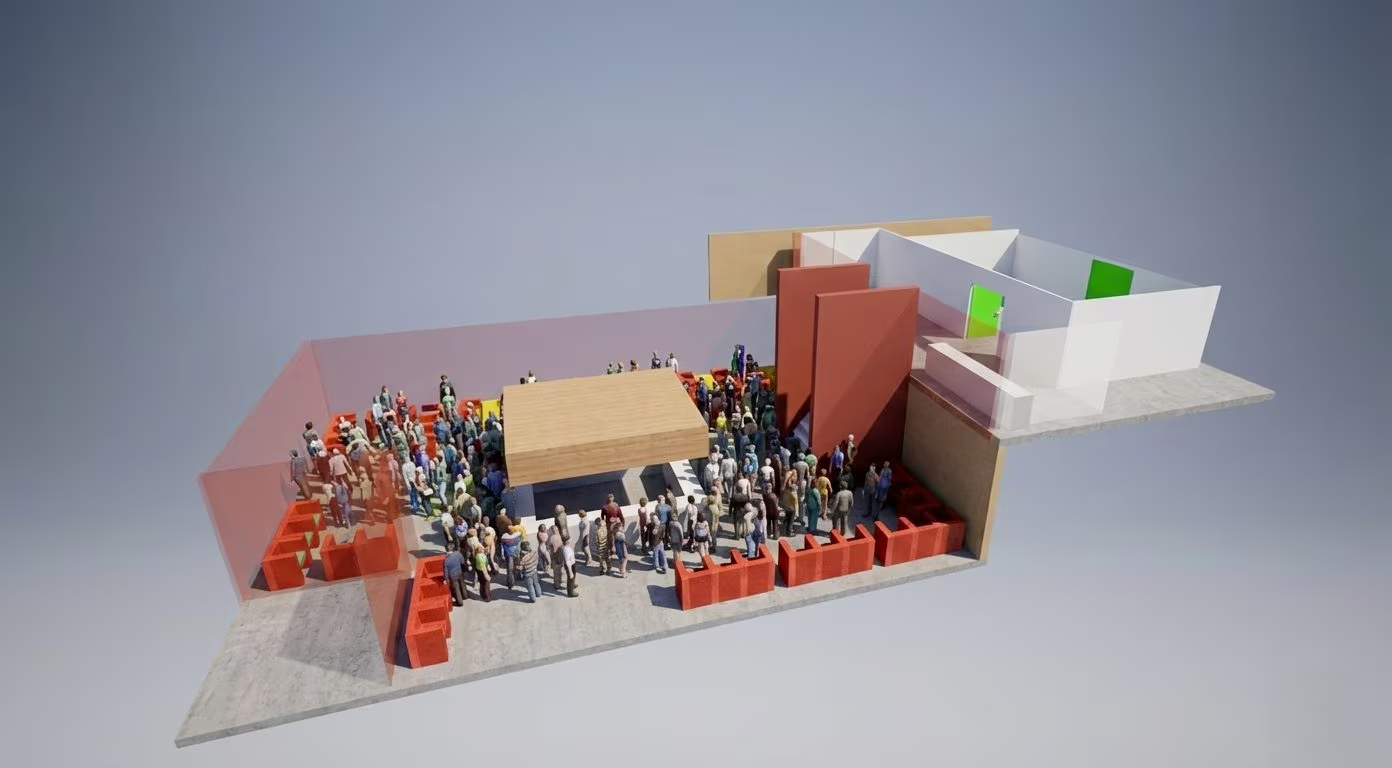
With a single exit 1.20 meters wide, even assuming very favorable conditions, it takes over six minutes to get around 200 people out. Congestions form almost immediately, density increases rapidly and the speed of movement is reduced. After three minutes, only half of the occupants managed to escape to safety.
Even by increasing the width of the single exit to three metres, the situation only partially improves, because everyone continues to converge towards the same point. In this case, complete evacuation still requires more than three minutes and is strongly conditioned by the “bottleneck”.
However, when two outputs are available, the flows begin to distribute themselves in a more balanced way. Congestion is reduced, times improve significantly and around half of people are able to leave in less than a minute.
With three exits the system becomes even more efficient and the evacuation is completed in just over two minutes, without the formation of prolonged queues and without dominant bottlenecks.
It should also be remembered that these times represent an optimistic estimate, because they presuppose an immediate start of the exodus: in reality, hesitations, disorientation and group dynamics would make the scenario even more critical. The data therefore confirms that the presence of multiple independent routes represents a determining factor in ensuring effective evacuation even in non-ideal conditions.
What are the conclusions of your study, with particular reference to the configuration of the Le Constellation venue in Crans-Montana?
The study was conducted with exclusively technical-scientific and informative purposes, based on publicly available information and specific modeling hypotheses, and does not constitute an official reconstruction of the event nor a judgment on responsibilities.
The study made it possible to analyze both the development of the fire and the dynamics of the exodus in an integrated way, highlighting how, in the scenario considered, the environmental conditions worsened very quickly, with a significant reduction in visibility, a rapid increase in temperatures and the achievement of flashover conditions in a few minutes.
This resulted in a particularly short time available for evacuation (ASET), leaving people with a very limited margin to react and reach safety.
The simulations show that, in scenarios with a limited number of routes, bottlenecks and accumulations of people develop more easily, with a significant increase in outflow times. On the contrary, the presence of alternative paths helps to make the system more robust with respect to delays, hesitations and behavioral uncertainties.
The main result of the study is therefore that the outcome of the evacuation cannot be traced back to a single element, but to the combined effect and interaction between multiple critical factors, which together drastically reduce the available safety margin.