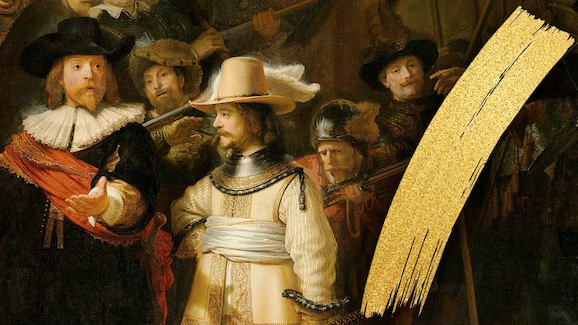
Night patrol (1642) is one of the masterpieces of the Flemish painter Rembrandt, as well as the main work exhibited at the Rijksmuseum in Amsterdam, the most important museum for local history, which has the largest collection of paintings from the Dutch Golden Age (between the end of the sixteenth century and the beginning of the eighteenth century).
The painting, also known as “Night Watch” or “The Civic Guard on the March”, represents the Guild of Amsterdam Arquebusiers, and is a true national symbol: it is so important that in 1934, to allow it to be hidden in case of emergency (such as fires or floods), a trap door was built under it to allow it to be quickly evacuated from the museum and hidden.
But let’s take a step back to explain why this painting is so important to the history of the Netherlands. After the secession of Belgium from the kingdom in 1830, the Netherlands needed a work that represented their national art and this monumental oil on canvas was chosen (we are talking about a size of 359×438 cm).
The central subject of the work is Captain Frans Banning Cocq, flanked by his guild of arquebusiers and lieutenant Willem van Ruytenburgh: it was the captain himself who commissioned the work from Rembrandt in 1639, when Mary de’ Medici arrived in Amsterdam with great fanfare, already queen of France as second wife of Henry IV (from 1600 to 1610) and then exiled in Brussels for some years for an attempt of conspiracy. The painting – which, unlike all the other works, is not owned by the State but by the city of Amsterdam – has however become famous because it is one of the best ever created by the famous artist.
For this reason, when the architect Pierre Cuypers was commissioned to design the museum building in 1876, he took particular care of the Night patrol. The museum was given the appearance of a cathedral, and the high altar was this painting: visitors enter its gallery through an imposing atrium, reaching the canvas as if it were a relic.
The room that houses it, however, has an unusual feature: there are several joints in the parquet floor in front of the painting. To understand why we need to go back to a time of great fear and pain in the Netherlands: 1934, a year after Hitler came to power in Germany, the Netherlands feared invasion. The museum management then had a trap door built in the floor, a sort of enormous crack and mailbox shape that would allow the work to be evacuated in the event of an emergency.
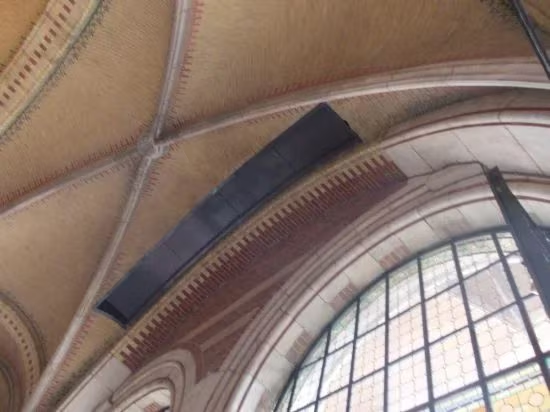
This cut in the floor would have led to the ceiling of the tunnel under the museum, now used as a passage for bicycles. And in fact even today, going to look into the tunnel, you will find the exit of this ingenious trap door.
But was it ever used? Yes, due to the threat of war, the canvas was brought to safety through this emergency exit in 1939 and for much of the Second World War, it was stored in caves beneath Sint-Pietersberg, near Maastricht.