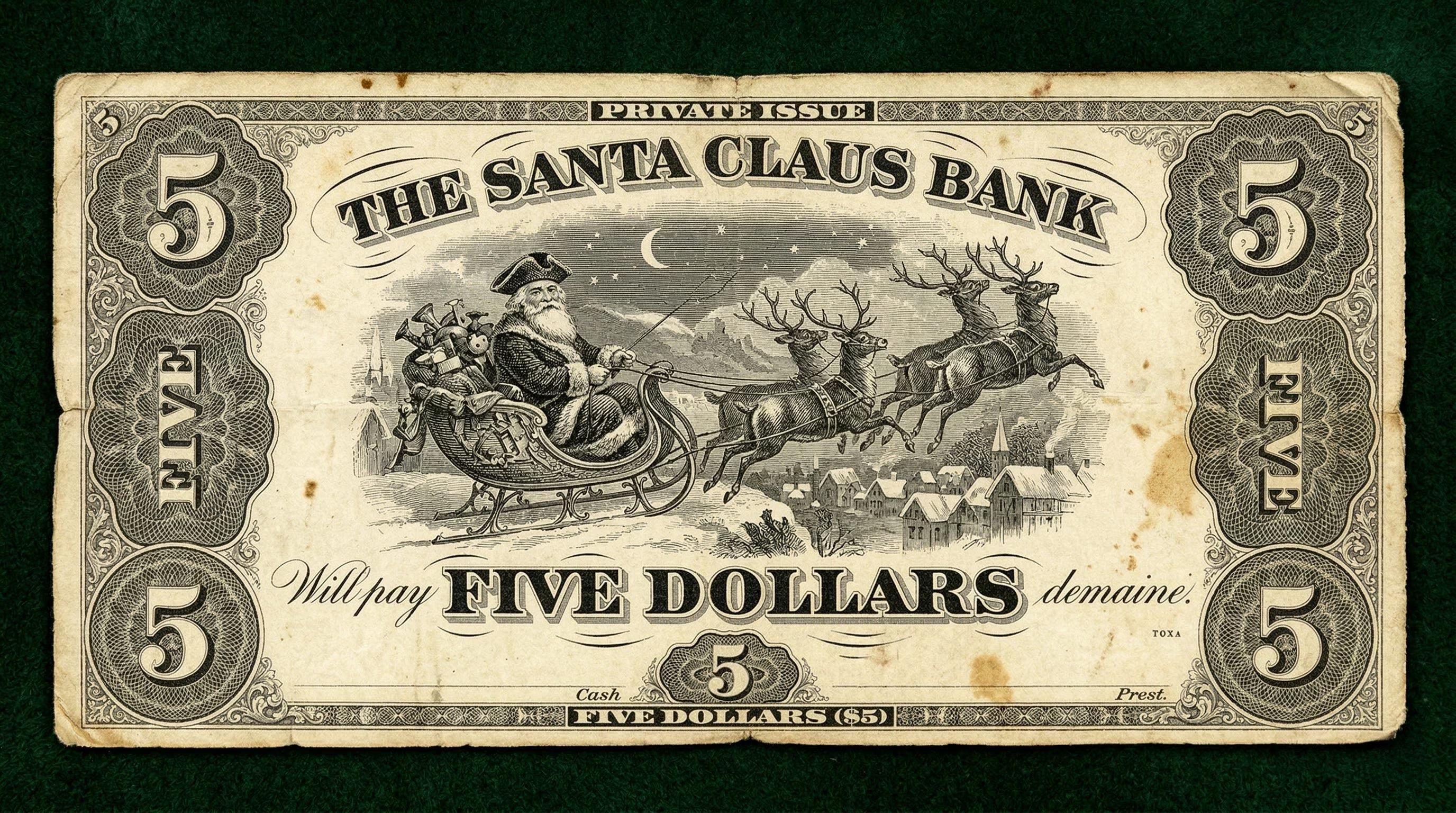
If today you are used to seeing American dollars with portraits of some of the most important US presidents – from George Washington to Abraham Lincoln – you should know that, until the mid-1800s, characters of all kinds appeared on US banknotes, including Santa Claus!
But how is this possible? It all depends on the way US banknotes were produced until the 19th century: while today it is the Federal Reserve that centrally manages American money, until the 1860s things worked differently.
In that historical period, in fact, each private bank could issue its own banknotes, with the possibility of choosing, in full autonomy, the illustrations and style of paper money.
Here, therefore, some banking institutions decided to dedicate a banknote to the figure of Santa Claus, but not by chance. In the USA, in fact, Christmas was only declared an official holiday in the mid-19th century: at that point, several banks decided to celebrate the new holiday with a dedicated currency. Among these there was also the Howard Banking Company of Boston, Massachusetts, which issued a 5 dollar bill which, in the center, depicted Santa Claus with a tricorn hat, aboard his sleigh driven by reindeer.
However, the possibility for each private bank to issue its own banknotes caused numerous problems, especially if we consider the enormous size of the United States (about 9,867,000 km² of surface area): the value of the banknotes, in fact, no longer depended on the number reported above, but also on the place of issue of the currency (often the value decreased as one moved away from the place where they were issued), on the bank that had produced it (a more stable bank meant a greater value) or even on regulations local.
The situation, thus, got totally out of control and almost 10,000 different versions of US dollars began to circulate in the country: at that point, in 1861, the US Treasury Department was granted the exclusive right to issue money. Today banknotes other than the official ones – including Santa Claus’s – are considered obsolete and have lost all value, other than that of collector’s items.