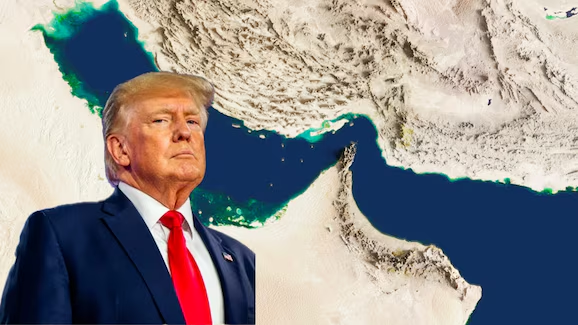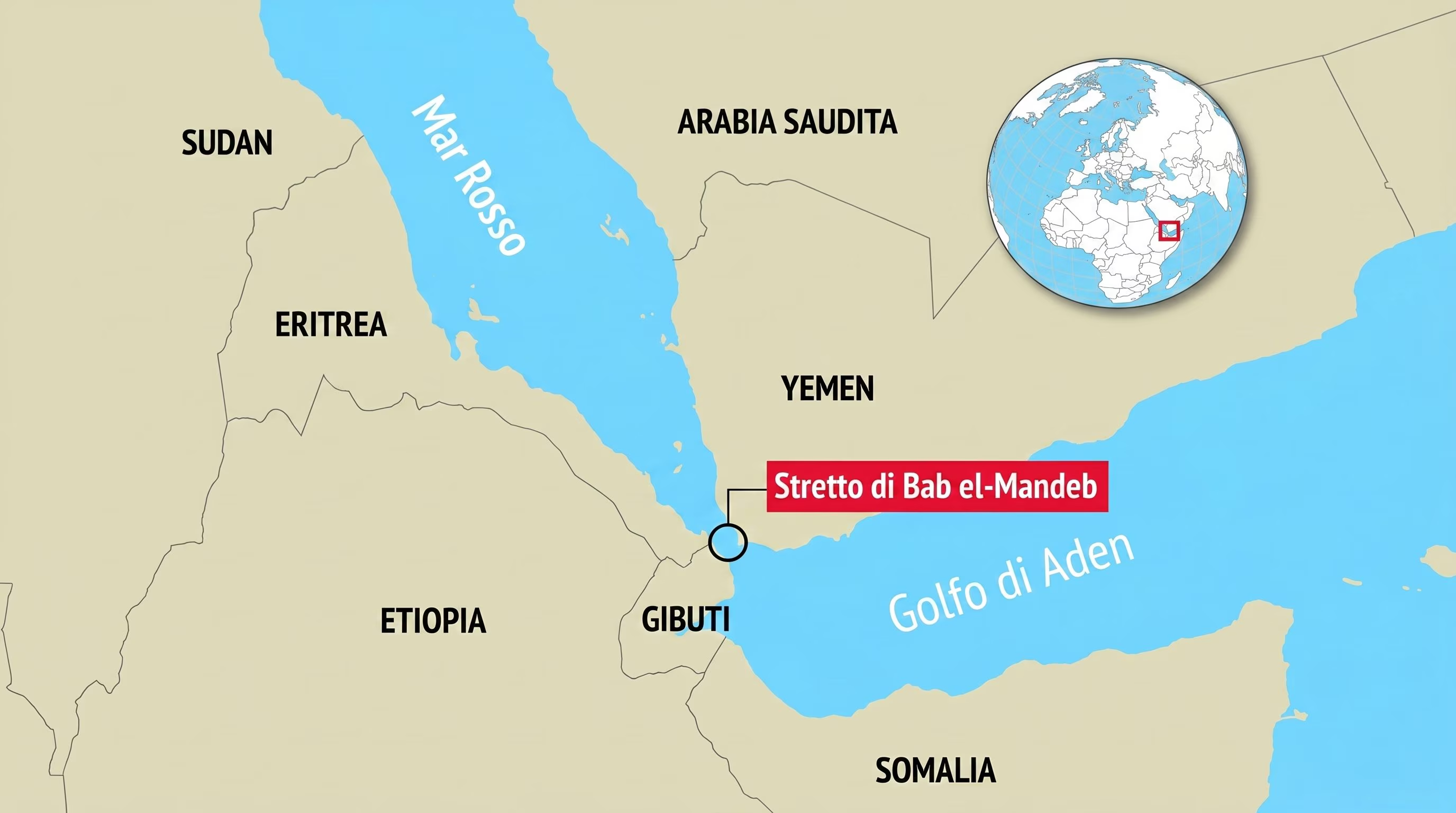
After the United States imposed a naval blockade on the Strait of Hormuz – already closed since the beginning of the Middle East war between Iran, the USA and Israel – Tehran threatened to block naval traffic also in the Red Sea, preventing access to the Strait of Bab el-Mandeb. The strait represents one of the three chokepoint essential parts of the Middle East (together with the Strait of Hormuz and the Suez Canal) which connects the Red Sea to the Indian Ocean through the Gulf of Aden, located between Yemen, Djibouti and Eritrea.
It is therefore a crucial maritime hub for global trade, through which several thousand container ships and oil tankers pass every day, headed mainly for Europe through the Suez Canal, which allows direct access to the Mediterranean.
However, unlike Hormuz, part of which is under the direct control of Iran, the Bab el-Mandeb Strait is under the sphere of influence of Yemen’s Houthis, the pro-Iranian armed group part of the so-called “Axis of Resistance”, who had already intensified attacks against transiting commercial ships in 2023 as a response to the Israeli invasion of the Gaza Strip.
A possible closure of both Middle Eastern straits would block approximately a quarter of global energy supplies, with particularly heavy repercussions especially on Europe. If the maritime hub were in any way obstructed, the ships would in fact be forced to circumnavigate Africa passing the Cape of Good Hope, lengthening the times weeks of travel, with heavy repercussions on prices.
Where the Bab el-Mandeb Strait is located and why it is important for global traffic
The Bab el-Mandeb (which in Arabic means “Gate of Tears”) is a strait that connects the Red Sea with the Gulf of Aden and, from there, with the Indian Ocean. It is located between the western coast of Yemen, located northeast of the Strait, and the coasts of Djibouti, in the Horn of Africa, located to the southwest. From the point of view of geographical conformation, the strait is naturally divided into two channels by the island of Perim: international maritime traffic mainly passes through the western channel, about 26 km wide and about 200 meters deep. The eastern canal, however, which reaches just 30 meters deep and 3 km wide, is used for local traffic and small boats.
The strategic importance of the Bab el-Mandeb Strait grew enormously after the opening of the Suez Canal in 1869, which allowed maritime trade between Asia and Europe to avoid circumnavigating Africa by passing directly through the Red Sea and, from there, directly entering the Mediterranean.
Today, the Bab el-Mandeb is considered the third busiest chokepoint for global oil trade, after the Strait of Malacca (located between Malaysia and Indonesia) and the Strait of Hormuz. According to what was reported by the US Energy Information Agency (EIA), the volume of oil in transit through the Strait of Bab el-Mandeb went from 5.7 million barrels per day in 2020 to as many as 9.3 million barrels per day in 2023. After the start of the Houthi attacks in the Strait, the transit of crude oil in this checkpoint instead fell, falling to 4.1 million barrels per day in 2024 (about 5% of the global total) and to 4.2 million barrels per day day in the first half of 2025.
The possible consequences of a blockade of the Bab el-Mandeb Strait
A hypothetical closure of both the Strait of Hormuz and the Bab el-Mandeb would constitute an unprecedented scenario on a global level, risking compromising, if not actually paralyzing, naval traffic towards Europe.
Considering that around 20% of global crude oil passes through the Strait of Hormuz – when open – if Bab al-Mandeb and Hormuz were closed at the same time, around 1/4 of global oil supplies would be blocked. The problems, however, do not only concern oil: around 10% of global trade also passes through the Bab el-Mandeb Strait, with numerous containers arriving from China, India and other Asian countries and headed towards Europe.
Naval traffic, even today, has not been restored to 2023 levels, with the Houthis declaring in recent weeks that they have “the military capabilities necessary to protect the Bab el-Mandeb Strait”. In this case, the Houthis could physically block access via military ships or, as in the case of Hormuz, undermine the Bab el-Mandeb Strait, effectively making navigation dangerous.
But what would be the economic consequences in the event of a possible closure of this maritime hub? Fuel prices would immediately increase significantly due to the lower supply, with a cascade effect on bills, food and consumer goods. Shipping companies would then be forced to reroute routes around Africa, lengthening delivery times and increasing shipping and fuel costs. The risk, then, would be that of a further escalation of the conflict, with the possible involvement of Saudi Arabia, whose oil exports now depend enormously on this maritime stretch.
As for the possible effects on global trade, just think of the damage caused in 2021 by the grounding of the Ever Given ship in the Suez Canal, which in just 6 days had caused losses of around 9 billion dollars a day.
How real is the risk of a blockade of the Bab el-Mandeb Strait
In recent weeks, some major shipping companies have already diverted their ships’ routes to the Bab el-Mandeb Strait and the Suez Canal during the early stages of the war between the US, Israel and Iran. Not surprisingly, even Saudi Arabia, which until now had relied on the Strait of Hormuz to export its oil, has increasingly begun using the Red Sea port of Yanbu to ship crude oil through Bab al-Mandeb, effectively diverting exports from the Persian Gulf to the Red Sea.
Making the possibility of a blockade of the Bab el-Mandeb Strait concrete is the fact that the Houthis have already demonstrated their ability to interfere with traffic at this chokepoint in the past. Starting from 2023, in fact, the Yemeni group had intensified attacks against commercial ships transiting the strait, in response to the Israeli invasion of the Gaza Strip: the consequence was a collapse in traffic, halved compared to the usual capacity, with numerous companies forced to divert their routes by circumnavigating Africa passing around the Cape of Good Hope, in South Africa.