Two of the four bodies of the Italian divers who lost their lives during a dive in the Maldives have been recovered: an international team of divers – including the three Finnish divers who came specifically to the site – is working to bring to the surface all four bodies of the victims, who were stuck at 60 meters deep (that of the instructor Gianluca Benedetti, in fact, had already been recovered on the same day of the accident) and located yesterday in the deepest segment of the Thinwana Cave Kandu, located in Vaavu Atoll.
The mission involves the recovery of only two bodies today, May 19, while tomorrow the experts will descend to the depths for the remaining two victims: the operation, in fact, is technically very complex and must be conducted in different phases (each lasting a maximum of approximately 3 hours) to guarantee maximum safety of the divers, especially after the death of the rescuer Mohamed Mahudhee following the dive.
In the meantime, the issue of the causes of this tragedy still remains open: as reported to Geopop by Dr. Pasquale Longobardi (Health Director of the Hyperbaric Center of Ravenna since 1989 and Vice President of the Italian Society of Underwater and Hyperbaric Medicine, SIMSI), the most plausible hypothesis is that the 5 divers were trapped in the cave due to the strong currents, which would have created a sort of “siphon effect” sucking them into the third sector of the cave. To consider, however, there is also the possibility of disorientation: in this case, the five victims may have run out of air before finding their way out.
The recovery operations of the Italian divers who died in the Maldives
As also confirmed by DAN Europe, the organization that is organizing the mission, the victim recovery procedure represents an extremely complex operation from a technical point of view, especially if we consider that the four bodies were trapped at the bottom of a tunnel, in the deepest segment of the Thinwana Kandu cave.
This is why the intervention of expert divers was necessary, equipped with equipment capable of reaching depths of over 60 metres. In fact, Finnish rescuers Sami Paakkarinen, Jenni Westerlund and Patrik Grönqvist, members of the DAN Europe organization, have arrived on site and are supporting the local authorities and experts.
The recovery operations began yesterday 18 May with an exploratory mission, which led to the location of the victims: the technical dive in the Vaavu atoll lasted approximately three hours, during which the team of specialists explored the system of submerged cavities, assessed the environmental conditions and collected the critical information necessary to plan the next phases.
This initial exploration was fundamental, given that the place where the victims are located has complex operational characteristics: access to the cavity is located at a depth of between 55 and 60 metres, while the submerged system extends for hundreds of meters through multiple chambers and internal passages, with tunnels and a strong risk of sediment lifting, which could eliminate visibility. Among other things, although the entrance to the cave is quite spacious and large (with the first room illuminated by light), divers will even have to use torches from the second cavity.
For today, May 19, the plan instead envisaged that the expert divers of DAN Europe would enter the caves until they reached the bodies of two of the victims and brought them back out of the cave: at that point, the divers of the Maldivian Coast Guard would have recovered the two victims from 30 meters, bringing them up to 7 meters of depth, where the final operations were carried out to bring them completely to the surface.
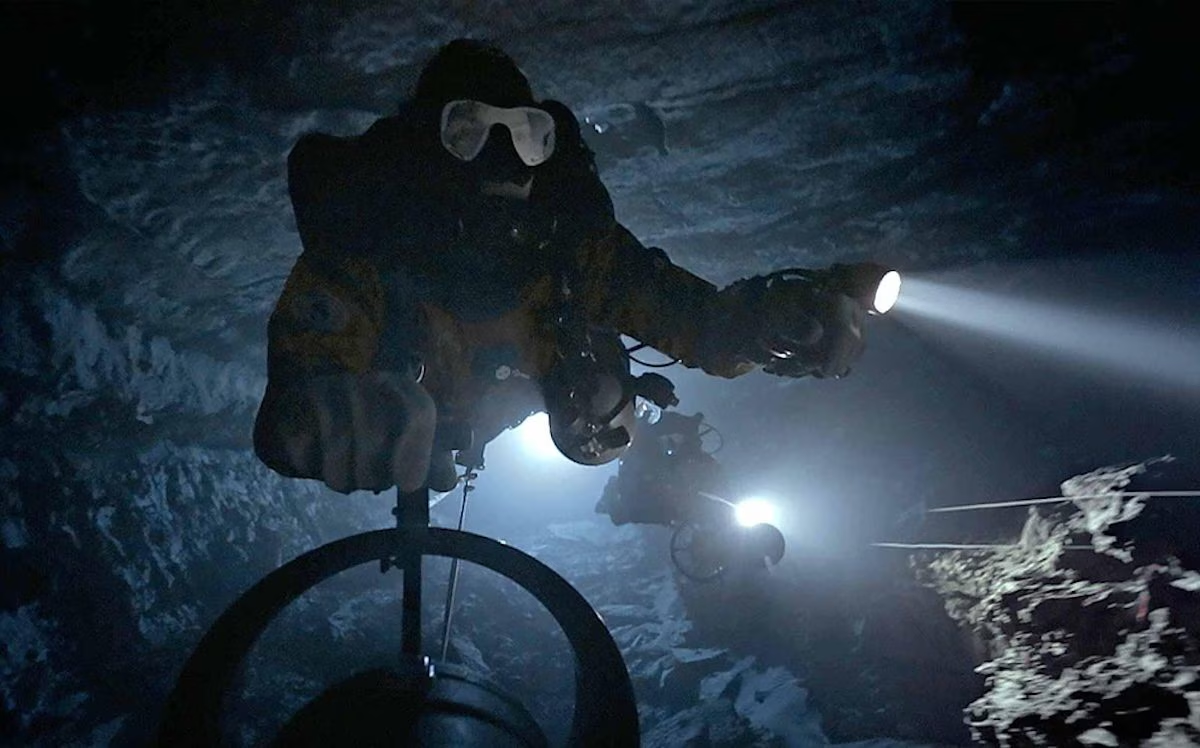
The equipment of Finnish divers to reach depths of 60m
As reported by DAN Europe, Finnish divers – who in 2018 had already participated in the rescue of Thai boys trapped in a cave – are using advanced technical systems supplied by the United Kingdom and Australia, including closed-circuit rebreathers and DPVs (Diver Propulsion Vehicles, a sort of underwater scooter), useful for overcoming any currents and saving effort and breathing space for the recovery team.
In this specific case, the rebreather is essential, a closed-circuit diving system that recycles the gas exhaled by the diver, removes carbon dioxide through an absorbent filter and automatically replenishes the metabolized oxygen. It is precisely this system that allows longer dives, but also reduced gas consumption and more precise control of the breathing mixture, also optimizing decompression times (i.e. the slow ascent during which the diver must make stops to be able to expel the gases, mainly nitrogen, which have accumulated in the tissues at high pressures).