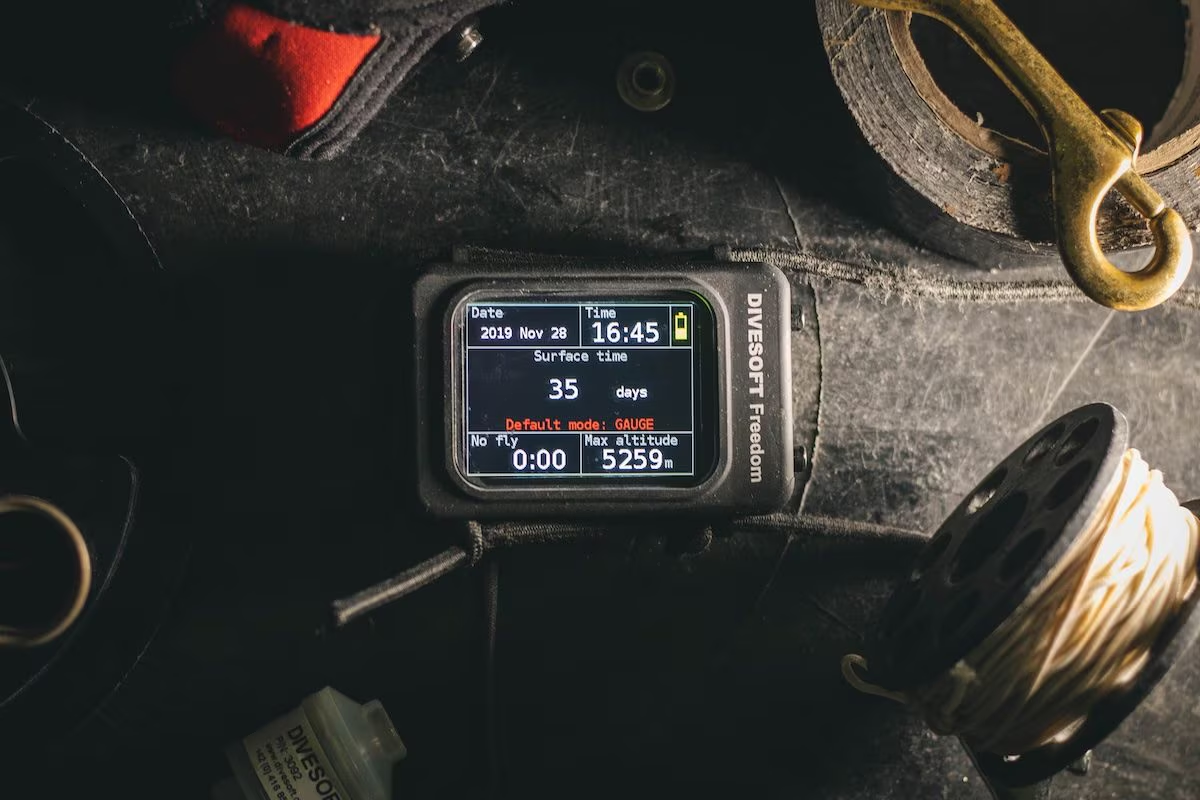
When investigating a serious diving accident – such as the one that occurred in the Maldives on May 14th, which involved five Italians – the search for the truth almost always involves reading the data recorded by the victims’ wrist computers. These devices, now indispensable for any diver, in similar cases act as real underwater “black boxes”: they continuously measure depth, bottom time, water temperature and ascent speed, and memorize every change in altitude by applying complex mathematical models. They are not simple pressure-resistant watches: they are real electronic computers capable of telling, minute by minute, what happened during a dive. Precisely for this reason they can provide valuable information on accidents that have occurred under the surface of the water. Let’s find out a little more closely how they work.
What are dive wrist computers and what are they for?
The main task of these instruments is to monitor the diver’s decompression status, which is the process through which the body eliminates gases dissolved in the tissues during exposure to pressure. If the ascent occurs too quickly, the nitrogen does not have time to be disposed of and can form bubbles in the blood and tissues, causing decompression sickness or DCS: a serious and potentially fatal pathology. Unlike older dive watches, which resisted pressure but only measured bottom time, modern wrist computers apply mathematical formulas in real time. The heart of these calculations is the decompression algorithm: the most widespread is based on the model developed by Albert Bühlmann, which simulates the absorption and elimination of inert gases in the various compartments of the human body. Modern manufacturers often use variations or derivative algorithms (such as Wienke’s RGBM or VPM) that further refine risk management. This approach allows you to update the ascent profile directly underwater, offering flexibility unthinkable with old paper tables, especially in multilevel dives, where the altitude varies continuously.
There are different types of devices on the market. Console models physically connect to the dispenser via a high-pressure hose and offer large, readable screens; the wrist models, similar to watches, combine everyday practicality and advanced functionality. Many recent instruments also integrate wireless technology, which communicates directly with the cylinder and displays the residual gas pressure in real time on the display. From this data (or, alternatively, from the pressures recorded manually at the beginning and end of the dive) the computer calculates the SAC (Surface Air Consumption), i.e. the air consumption normalized to the surface pressure, which allows us to estimate how much breathing autonomy remains. More experienced divers can also manage different mixtures, such as Nitrox – an air enriched with an oxygen percentage higher than 21% of normal atmospheric air – which reduces nitrogen absorption and allows longer bottom times; the computer also indicates the optimal time to change gases during the dive.
On the screen, during the descent, two fundamental values always stand out: the current depth and the no-decompression limit or NDL (No-Decompression Limit), or the maximum time you can spend at that altitude before it becomes mandatory to make decompression stops on ascent.
The investigative utility of dive computers: they function as underwater “black boxes”.
And this is precisely where the investigative utility of dive computers comes into play. Using special software, the data recorded by the computer are downloaded via Bluetooth onto a smartphone or PC, returning a detailed electronic log: the acoustic and visual alarms that have been activated, the ascent speed being exceeded, the possible omission of the safety stop – that recommended three-minute pause at five meters of depth at the end of each dive, not to be confused with the mandatory decompression stops that are triggered when the NDL is exceeded – and even the battery status during the course. of immersion.
This data is considered objective and difficult to intentionally alter, although not immune to possible corruption or physical damage to the device. Hyperbaric experts analyze these traces looking for anomalies: an irregular ascent profile, a sudden loss of gas, an unexpected depth peak. In the case of the accident in the Maldives, examining the memory of these devices could allow investigators to reconstruct the progress of the tragedy and try to establish its cause.









