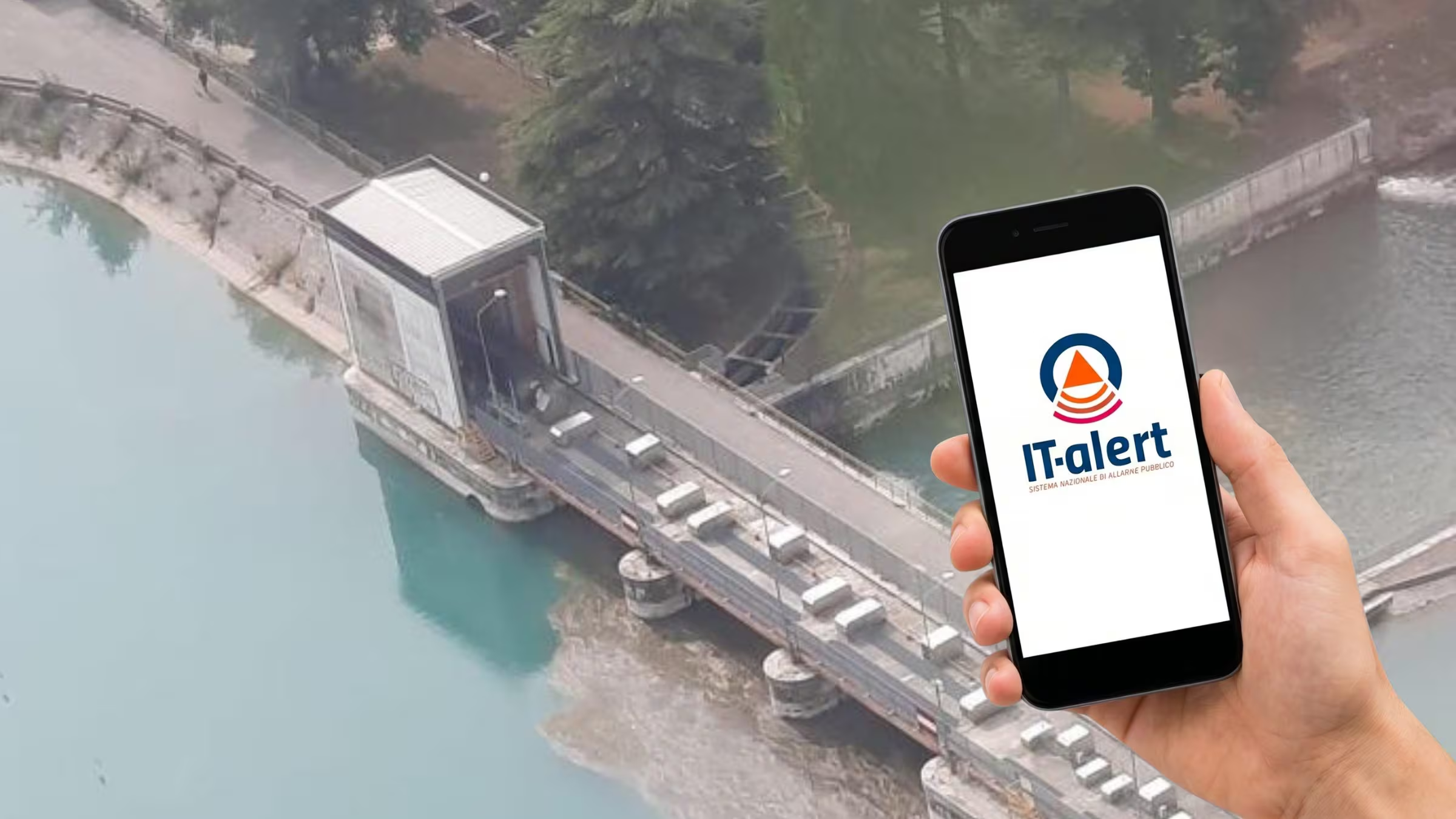
The trials of the IT-Alert system continue today, 26 June 2026. The national Civil Protection alert system will be tested in the Lombardy and Veneto regions, simulating the risk of “collapse of large dams” near the Salionze dam (Mantua). Yesterday, 25 June, the tests had instead affected the area surrounding the Porto della Torre dam, involving the provinces of Novara and Varese. The main purpose of these tests is to monitor the technological efficiency of the system, evaluating the correct coupling of the telephone cells and ensuring that the communication flows envisaged by the emergency plans are activated without problems.
The dynamics of IT-Alert remain unchanged: all devices connected to the cellular networks in the designated areas will receive a distinct sound and a text message, without needing an active internet connection. Currently, the platform (which became operational in 2024 for some scenarios) continues the testing phase to refine the response to specific dangers, including the failure of dams, tsunamis, volcanic activity, industrial accidents and extreme rainfall.
In conjunction with these tests, the vast Civil Protection exercise “EXE PO 2026” will continue until Saturday 27 June. This important maneuver involves Piedmont, Lombardy, Emilia-Romagna and Veneto, aiming to optimize the management of the complex hydraulic and hydrogeological scenarios linked to the Po river basin.
Times and municipalities involved: where the test message will sound
Today’s experiments, 26 June 2026, will focus on the areas adjacent to the Salionze Dam (MN). The messages will reach the inhabitants of six municipalities in Mantua (in Lombardy) and one location in the province of Verona (in Veneto). The envisaged scenario is the structural failure of a large dam, an eventuality defined as critical damage or collapse of the infrastructure capable of causing an uncontrolled and massive release of water, with the consequent and devastating flooding of the downstream territories.
According to the schedule, at 2.00 pm the simulation will start. The alert will affect the following territories:
- For the province of Mantua: Mantua, Volta Mantovana, Monzambano, Ponti sul Mincio, Goito, Marmirolo.
- For the province of Verona: Valeggio sul Mincio.
Anyone within the boundaries drawn by this exercise will receive the following text on their smartphone:
TEST TEST This is an IT-alert TEST MESSAGE. A SIMULATION of a dam collapse is underway in the area where you are located. To find out the message you will receive in case of real danger and to fill out the questionnaire go to www.it-alert.gov.it TEST TEST
Instructions: what to do when the notification arrives on your cell phone
The technical operation follows exactly that of previous events: the phones turned on and covered by the telephone signal in the exercise areas will emit a ringing sound and show a notification in the foreground.
When the alarm sounds, citizens will not have to take any emergency action or flee, as this is purely a test. Furthermore, the system does not provide direct interaction with notifications. However, it is highly recommended to fill out the short questionnaire accessible via the official IT-Alert website. Providing this feedback, reporting receipt or any anomalies, represents a valuable help for the authorities to calibrate the systems and maximize their effectiveness for future dangers.
What is meant by “dam risk” and when the alarm is triggered
“Large dam collapse” indicates a structural failure or severe damage that causes a catastrophic, uncontrolled release of water downstream. The management of this emergency is divided into four progressive levels, from pre-alert to actual collapse. By law, every large dam must be equipped with a Civil Protection Document to coordinate the rescue effort and an Emergency Plan which maps the floodable areas and defines the evacuation. In the event of an imminent or ongoing collapse, the IT-Alert system would intervene automatically to warn the population, but it is activated exclusively for infrastructures that exceed 15 meters in height or that retain a volume of over one million cubic meters of water.