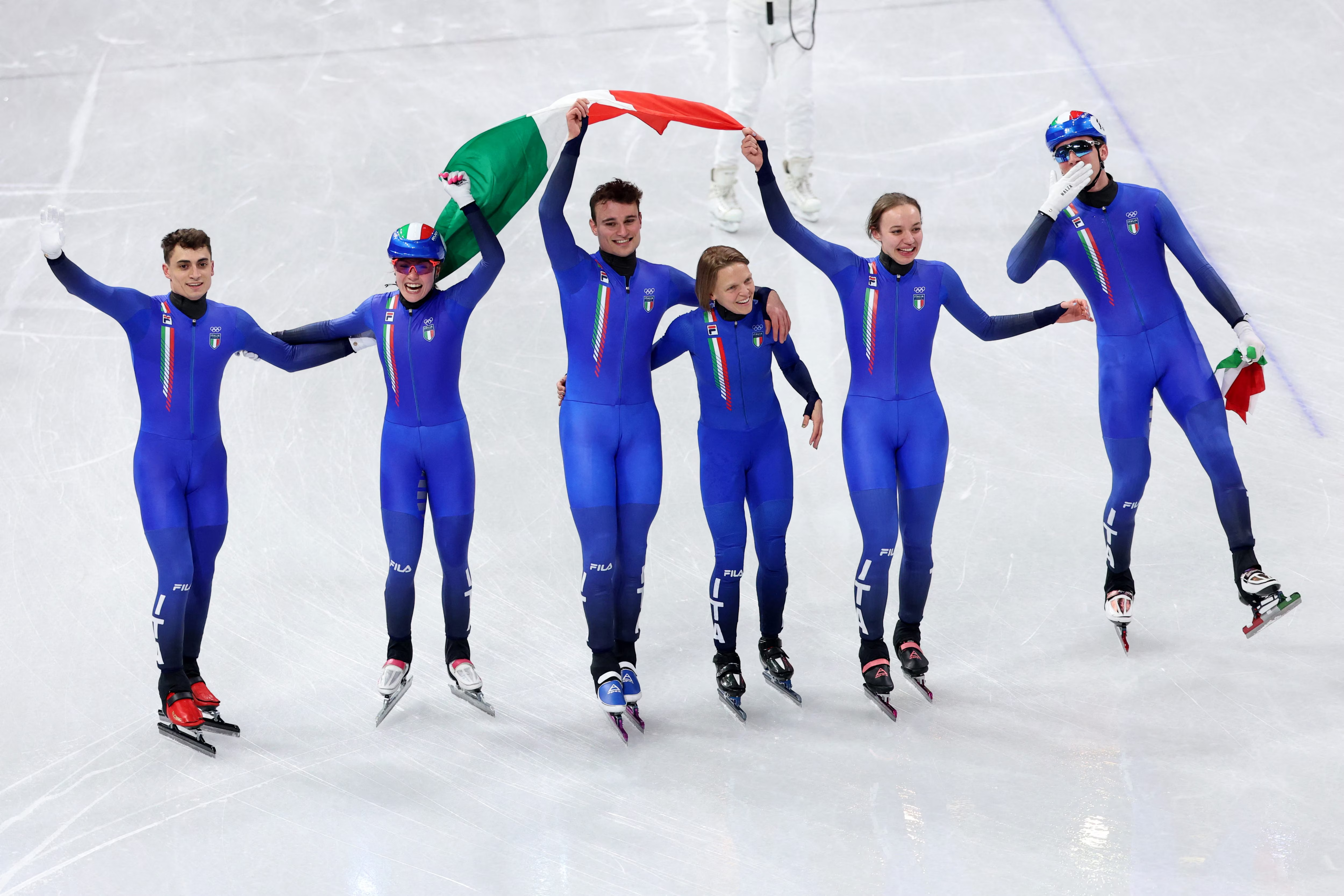
Gold medal for Italy in the mixed relay short tracks: Arianna Fontana, Pietro Sighel, Thomas Nadalini and Elisa Confortola took the top step of the podium with a time of 2’39″02. Arianna Fontana – the most medal-winning Italian athlete in history – thus added to her palmares – during her sixth Olympics – the 12th Olympic medal of her career.
An oval ice track on which overtaking, crashes, photo finishes and twists take place: it is a normal racing race. short tracksthe Olympic skating discipline. At the 2026 Milan-Cortina Olympics, nine events will be held at the Milan Ice Skating Arena. With speeds exceeding 40 km/h and impossible lean angles, these are direct elimination races where the athletes race simultaneously on a 111.12 meter track with equipment that guarantees their safety.
How the Short Track works: the rules
Short track debuted as an official Olympic sport Albertville 1992 (France). The number of events has grown from the initial 4 to the current 9, with the latest addition of the mixed relay at Beijing 2022. At the Winter Olympics, athletes compete in the 500 m, 1,000 m, 1,500 m, 5,000 m, men’s relay, women’s relay and 2,000 m mixed team relay.
In this fast-paced sport, athletes compete on an ice rink 111.12 meters in direct elimination rounds, with group starts. We start from the heats which are followed by the quarter-finals, semi-finals and the final where the medals are awarded. The number of participants per heat varies with distance: five in the 500 m and 1000 m, e seven in the 1500 m. In the mixed relay (two women and two men), the race sequence involves alternating woman-woman-man-man, repeated twice and the changes do not take place through a “baton” that is passed but with a light push.
The short track is not like the 100 meter race, where everyone runs on their own “track”. Here the lanes do not exist and overtaking is continuous. Precisely for this reason, however, lane changes are regulated and the rules on a straight line, for example, are different from those on curves. Being a contact and proximity sport, small contacts or pushes are tolerated, but actions that have a significant impact on the competition of other athletes can lead to sanctions by the referee who can assign penalties such as yellow and red cards.
The group starts, the high speed achieved and the sharp turns make this sport unpredictable and significantly increase the risk of falls and unexpected medals, such as that of the Australian Steven Bradbury in the 1000 meters in Salt Lake City 2002.
Short track speed and equipment
In short track races, skaters reach speeds of over 40 km/h and the difficulty lies in controlling and managing these rhythms in the curves of the ice oval. At that speed, the centrifugal force that pushes outwards is very high and, to counteract it, athletes bend until they touch the ice with their hand, a bit like motorcyclists when they touch the asphalt with their knee to manage balance and inclination with a third point of support. This feature allows male and female athletes with a low center of gravity to excel in this discipline and are able to maintain balance more easily when cornering. For example, the South Korean naturalized Russian Viktor Ahn, who won six gold medals in short track, is 1.72m tall, while our Arianna Fontana is 1.64m tall.
In short track, the equipment is specific to deal with sharp turns and close contact. Athletes have very stiff skates to ensure a better trajectory control with blades short, from 30 to 45 cm unlike the 40 – 55 cm for speed skating.

Due to the high risk of falls, a helmet is mandatory in this discipline. The safety equipment is completed by gloves to protect the hands from the blades and technical glasses to protect the eyes from the blades and any “splinters” of ice, in addition to the classic aerodynamic suits.
Italy in the Short Track at Milano-Cortina 2026
There mixed relay wrote history in Milan-Cortina. Italy triumphed on home ice with Arianna Fontanawhich conquers the twelfth Olympic medal of his legendary career. The first to cross the finish line in a thrilling final were Fontana, Pietro Sighel, Thomas Nadalini and Elisa Confortola. A success that belongs to the entire group: the top step of the podium is also Luca Spechenhauser And Chiara Bettifundamental for the team’s qualification in the previous rounds (quarter and semi-finals).
Italy boasts a solid tradition in short track, starting with Orazio Fagone (gold at Lillehammer ’94) and Roberto Sighel, but today the party is all for the team led by Arianna. The Italian athlete with the most medals ever at the Games (now at 12) honored the home edition in the best way, leading the group towards gold.