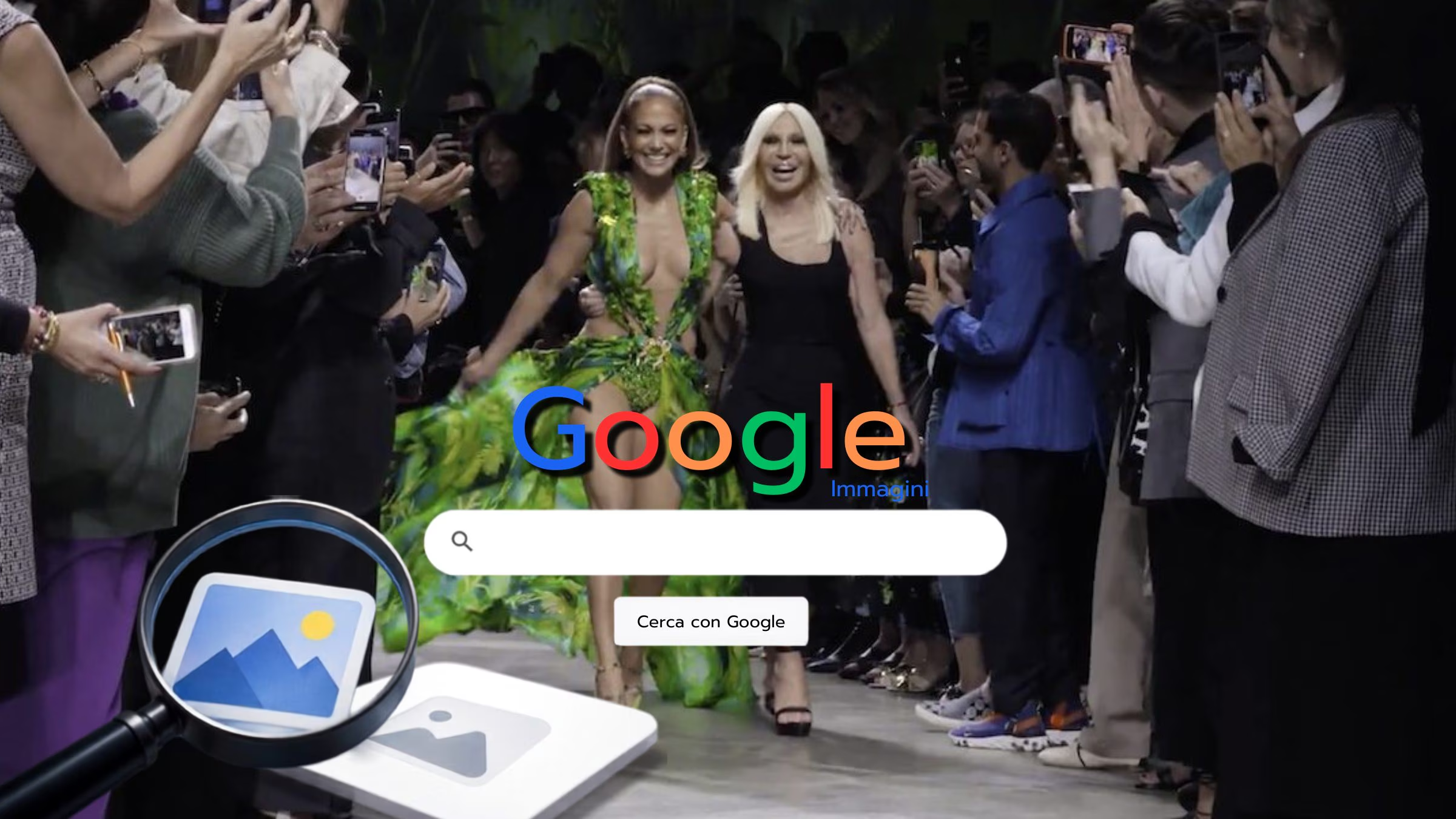
Today, you just need to type a few words into Google Images to immediately find photographs, illustrations and other visual content from all over the web. At the beginning of the new millennium, however, this tool did not yet exist and even the engine destined to become the most used in the world could find itself in difficulty when faced with an apparently simple request: to show a photograph of a dress.
The item in question was the famous Versace Jungle Dress, worn by Jennifer Lopez at the 2000 Grammy Awards. The interest aroused was such that it made it, according to the reconstruction of the Mountain View company itself, the object of the most popular query ever recorded on the platform up to that point. People weren’t looking for a description or an article about it, but above all they wanted to see how it was made.
Google search at the time, however, essentially returned a list of text links and didn’t allow you to immediately get to the reference image. That difficulty highlighted the need for a solution capable of directly organizing and displaying the graphic contents present on the Web.
Jennifer Lopez’s Jungle Dress that conquered the Internet
In February 2000, Jennifer Lopez showed up at the Grammy ceremony wearing a green dress with a tropical print, designed by Donatella Versace and characterized by a plunging neckline. The outfit immediately attracted the attention of the media and the public, quickly becoming one of the most recognizable looks in contemporary pop culture.
Success was not confined to television or magazines. After the singer’s appearance, an exceptional number of users turned to Google to find a photo of her. The phenomenon spread through newspapers, television programs, sites and online conversations, in a period in which social networks, as they are understood today, did not yet exist.
Talking about “viral research” therefore means using a modern expression to describe an already recognizable phenomenon, fueled by the same media event in a short period of time. What made it special was not only the quantity of requests, but above all their objective. Identifying pages containing the words “Jennifer Lopez” and “Versace” was not enough, because the desired content was a photograph of the singer in the Jungle Dress. That wave of requests thus brought to the fore a limitation that until then had never emerged so clearly.
Because the engine couldn’t show the photograph right away
To understand the problem, you need to remember what a results page looked like back then. After entering a query, the user mainly saw the classic blue links accompanied by short text extracts. To find the desired shot it was necessary to open one or more links and manually check whether the site actually contained the Jungle Dress.
The system was able to direct you to relevant documents, but it did not yet have a section capable of collecting thumbnails and allowing you to compare them at a glance. The response was therefore not built around the user’s actual intent.
The difference is fundamental to the operation of modern engines. Recognizing the words typed is not always enough: it is also necessary to understand which format can best satisfy the question. In that circumstance the solution was not another textual page, but rather a graphic selection that could be consulted immediately.
The World Wide Web already contained numerous visual elements, but these remained distributed within individual sites. The furore surrounding Jennifer Lopez’s appearance made it clear that a more direct way to locate and consult them was needed.
How that research contributed to the birth of Google Images
According to what Eric Schmidt, Google’s executive president at the time, told in 2015, the inability to satisfy that request pushed the company to develop a dedicated solution. In July 2001, Google Image Search was launched, later known in Italy as Google Images.
The new service allowed you to insert some words and obtain a collection of photographs and illustrations from different sources. Thumbnails allowed you to browse numerous results without opening each site separately, while each item linked back to the original content. Consultation thus became much quicker when the user was primarily looking for a visual answer.
At its debut the index included approximately 250 million images. The growth was then very fast, so much so that in 2005 the elements registered had exceeded one billion and in 2010 they had become more than 10 billion. These numbers show how widespread a need was that the Jungle Dress affair had helped bring to the fore.
However, attributing the entire invention to Jennifer Lopez would be an oversimplification. The Web was home to an increasing amount of graphic material, and the engine was already constantly evolving. The resonance of the Jungle Dress, however, made that limit impossible to ignore and clearly showed the need to fill it.
The company continued to point to the episode as the inspiration for the service. In 2019, during Milan Fashion Week, Jennifer Lopez paraded with a new version of the tropical model created by Donatella Versace. Google celebrated the return by recalling the role of the original in the evolution of its search engine.
Twenty-five years after its introduction, the service has gone far beyond simple thumbnail galleries. Today it is possible to use a photograph as a search key, recognize what is framed by the camera and combine text and graphic elements in the same request. Its symbolic origin, however, remains linked to a very concrete need: people wanted to see a dress and a list of links was not enough. The episode thus demonstrates how images can also mark the history of the Internet and how a phenomenon born from pop culture can guide the development of a technology used every day.