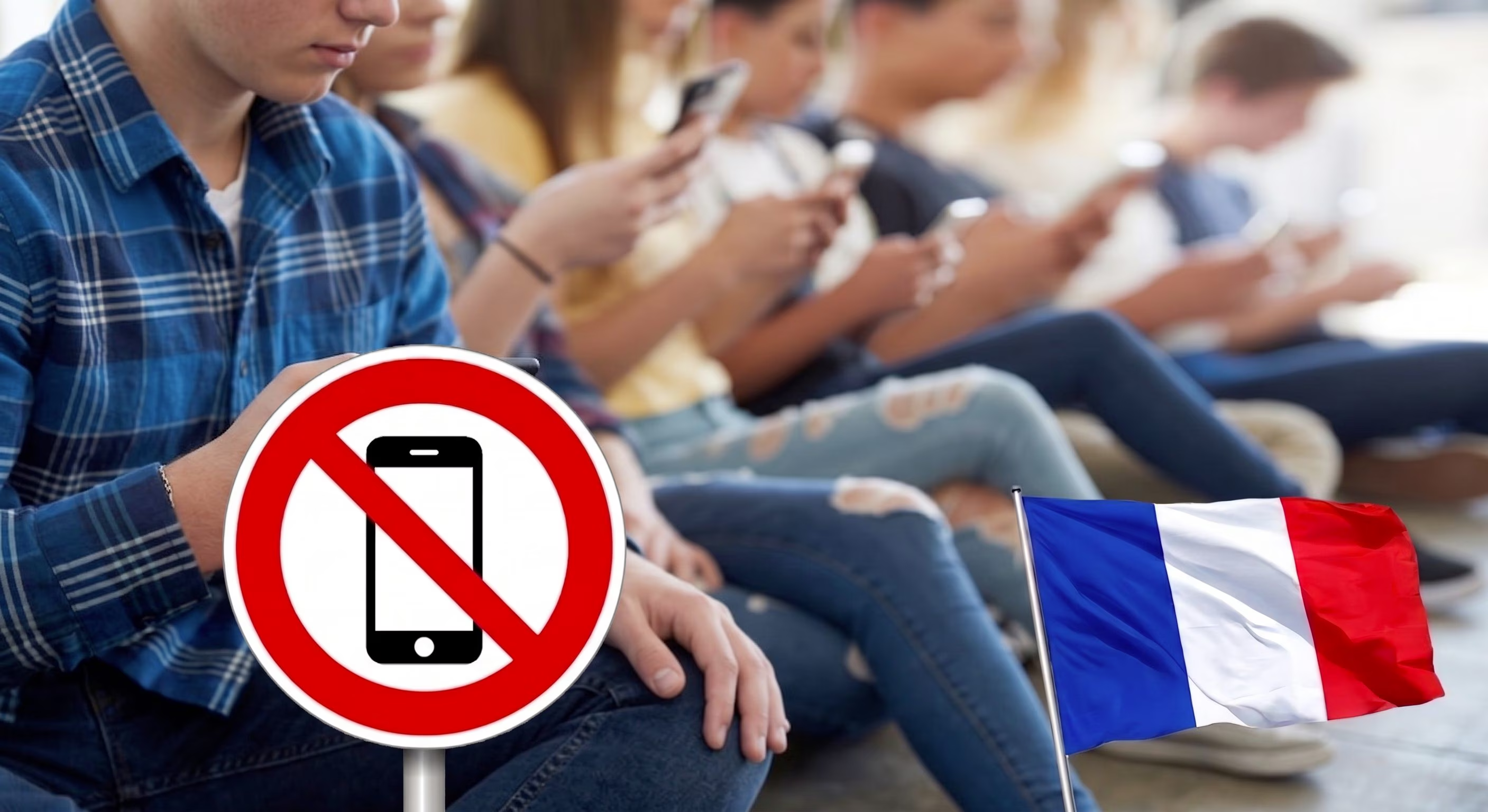
France has passed a law banning the use of social media by children under 15, becoming the first country in Europe to introduce such a measure. The global trailblazer was Australia, which in December 2025 officially banned under-16s from all platforms. Now the French legislation, promoted by MP Laure Miller, could be subjected to a final scrutiny Conseil constitutionnel for a constitutional review.
France, however, is not the only European country to move in this direction: the United Kingdom, Spain, Denmark and Italy are also discussing it. In our country, however, the bills are still at the discussion stage in Parliament, with the legislative process still requiring months (if not years) to reach definitive approval.
The European Parliament, however, approved a (non-binding) resolution on November 26, 2025, in which it asks to set the minimum age for signing up to social media, video sharing platforms and “virtual companions” based on artificial intelligence at 16, leaving children between 13 and 16 years of age the possibility of accessing them only with the authorization of their parents. The text also calls for banning practices that risk creating addiction, from infinite scrolling to automatic playback, deactivating them by default when the user is a minor.
What French law provides from 1 September 2026
The official approval of the French Parliament arrived on 21 July, but the entry into force of the provision was planned in two stages. From 1 September 2026, children under 15 will no longer be able to open new accounts. Existing accounts, however, must be verified by January 1, 2027: after that date, profiles registered to those under 15 will be closed. The text does not specify, however, to which platforms the ban will apply: the complete list should be drawn up by the Ministry of Artificial Intelligence and Digital, in collaboration with the Audiovisual and Digital Communication Regulatory Authority (the equivalent of our AGCOM).
The platforms themselves will have to enforce the ban, and will have to equip themselves with systems to ascertain the age of those who register. The law establishes that each platform makes available at least two different age verification solutions, without however directly receiving the user’s complete identity: a way to try to protect personal data by preventing the check from turning into a filing system.
Furthermore, the French text is not limited to social media: it also provides for a ban on mobile phones in high schools, thus extending a rule already in force in elementary and middle schools.
In Italy it has been discussed for some time, but the proposals have stalled
Other European countries are also considering banning social media for minors aged 15/16, with the aim of limiting young people’s exposure to content potentially harmful to their mental health. These include states such as the United Kingdom, Spain and Italy itself: in our country, however, the proposals have been stalled in Parliament for some time.
Today the legislation allows children to register on their own on social media starting from the age of 14, while below that threshold parental consent is required. In practice, however, many platforms set the limit at 13 years and verification almost always takes place through a simple self-certification by the user: an easily circumventable mechanism, which makes checks on the real age of members ineffective and fuels the request for more stringent rules.
The Minister of Education and Merit Giuseppe Valditara has returned several times to ask for a law, defining the issue as too urgent to be postponed. The problem is that, in the last two years, all the proposals presented have stalled along the parliamentary process, without managing to complete even the first passage in one of the two Chambers.
The most advanced text is the Mennuni-Madia bill (DDL 1136), which prohibits access to social media for minors under 15 years of age, forces platforms to adopt effective age verification systems and introduces specific protections for baby influencers: after coming close to approval in 2025, its path has stopped.
On the table, however, there is also the Carfagna bill (DDL n.2861), which proposes the introduction of an absolute ban on enrollment under 13 years of age and a protected regime between 13 and 16 years of age, up to the even more restrictive law proposal of the deputy Giorgia Latini (DDL 2777), which in addition to the ban for under 15s requires parental consent for the 15-18 age group.
Just like in France, the most delicate issue remains age verification. To prevent this process from turning into a form of mass surveillance, systems will need to comply with the EU’s strict GDPR rules on data handling. One of the hypotheses being studied would be to integrate the verification into the IT Wallet via SPID or electronic identity card: this, however, would make the user easily traceable.
It must be said, however, that Italy has already moved on another front, banning the use of smartphones even in high schools. With circular no. 3392 of 16 June 2025, the Ministry of Education and Merit has in fact also extended the ban on the use of mobile phones during teaching activities and, more generally, during school hours to students of high schools and technical institutes.
The measure, in force from 1 September 2025, extended to high schools what was already foreseen from July 2024 for elementary and middle schools, thus standardizing the rules in all cycles. Some exceptions remain permitted, for example when the use of the device is foreseen by the Individualized Educational Plan or by the Personalized Educational Plan to support students with disabilities or specific learning disorders.