An important agreement between the government parties closes one of the most delicate matches of the Budget Law: the contribution of the banking and insurance system to the financing of the new economic measures.
After weeks of confrontation and internal tensions, Prime Minister Giorgia Meloni found a synthesis between the positions of the League and Forza Italia, defining a framework that guarantees the necessary coverage and preserves the unity of the majority.
The compromise provides for a modulated levy and the introduction of a new IRAP surtax for healthcare, alongside the strengthening of the measures already envisaged in the budget planning document.
A summit at Palazzo Chigi to overcome tensions
After weeks of back and forth on how much and how the banks should contribute to the Maneuver, the political forces gathered at Palazzo Chigi for a tense three-hour summit between the League and Forza Italia.
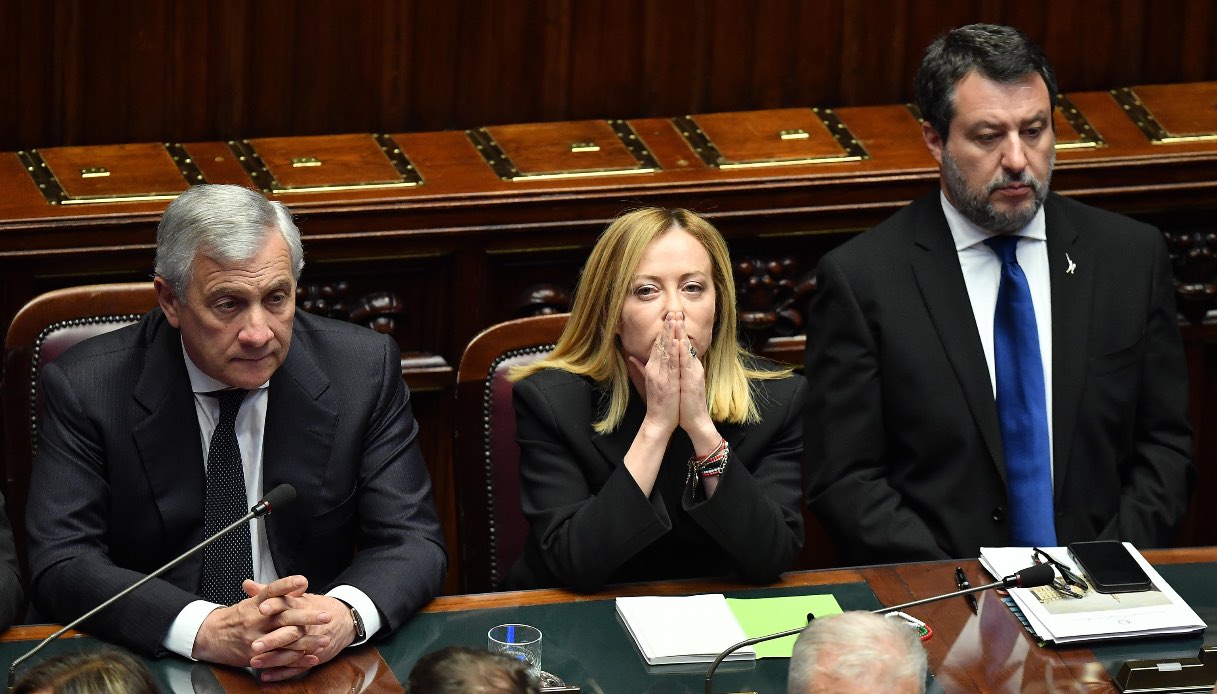
At the table, in addition to the Prime Minister Giorgia Meloni, there were the two deputy prime ministers Antonio Tajani and Matteo Salvini, the leader of Noi Moderati Maurizio Lupi, and the deputy minister of Economy Maurizio Leo.
From Washington, connected by video, the Minister of Economy Giancarlo Giorgetti, involved in meetings of the International Monetary Fund. The same man, in a very poetic and evasive way, then reassured the reporters:
You don’t believe in miracles, but I believe in miracles.
Maneuver, balance found on the banks’ contribution
The agreement reached does not include a single measure but a set of interventions to guarantee the revenue of approximately 4.4 billion euros expected for 2026. Among the main hypotheses, the confirmation of a 27.5% levy charged to banks and insurance companies on time deposits, linked to the 2023 rule which taxed extra profits at 40%.
Majority sources underline that it would not be a new tax on extra profits in the strict sense, but a contribution agreed with the sector, which will be called to discuss the technical details in the next few hours. The main issue remains the payment method: it is evaluated whether to act through tax credits or through a reduced direct withdrawal on the set aside capital.
Where will the money for the budget law be taken
According to the updated estimates, contained in the Programmatic Document sent to Brussels, in 2026 the economic measures envisaged in the Budget will amount to 18.4 billion euros. All financed with a slight increase in the deficit and with 17.3 billion in lower expenses and new revenues.
Of these, 4.3 billion will come from banks and insurance companies, which in three years will rise to 11 billion. These famous 4.3 billion will be covered partly by the strengthening of the measures already planned for the two-year period 2026-2027, equal to 2 billion per year, and partly by the release, on a voluntary basis, of the reserves set aside in 2024 based on the previous legislation on extra profits.
Part of the revenue will be ensured by a new additional IRAP intended to support public healthcare, in addition to the 2.2 billion resulting from cuts to ministries and the 5 billion obtained from the remodulation of the Pnrr.
The mechanism for banks
The paradox of Italian banks continues: after having set aside 6.2 billion in profits in 2023, avoiding paying them to the State, they will now be able to unlock those resources by paying a reduced tax of 27.5%, instead of the 40% originally foreseen.
The Government specifies that it will be a voluntary option, but the financial sector does not hide its discontent over an intervention perceived as imposed rather than agreed upon. A paradoxical complaint from a sector that has benefited from public bailouts and systemic protections for decades.
Banks and insurance companies will also have to contribute with a new additional IRAP, which is added to the one already in force of 0.75 points, and with an IRES increased by 3.5 points compared to other companies.