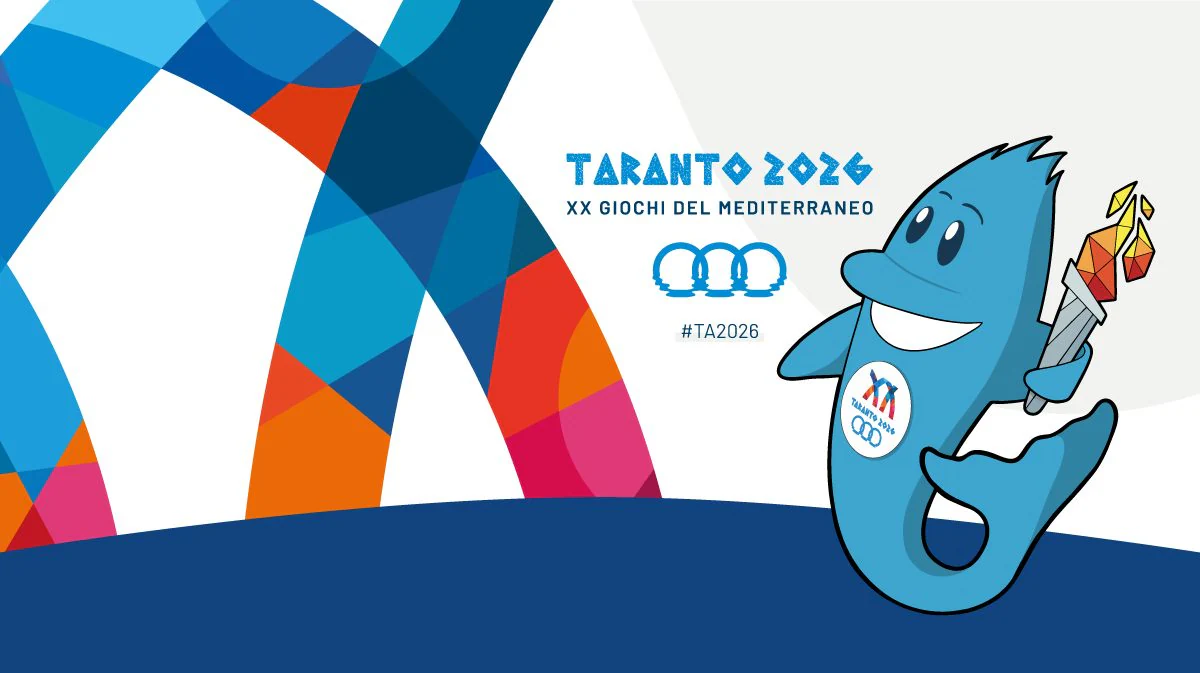
From 21 August to 3 September 2026 Taranto and 14 other cities in Puglia will host the XX Mediterranean Games, a multi-sport event that every four years brings together athletes from the countries overlooking the Mare Nostrum and which has existed since 1951. It is an event built on the model of the Olympic Games, with an opening ceremony, an athletes’ village, a medal table and a program which in Taranto includes 33 disciplines, of which 28 individual and 5 team, for a total of approximately 4,500 athletes representing 26 nations distributed across Europe, Africa and Asia.
The President of the Republic Sergio Mattarella will also participate in the opening ceremony, scheduled for August 21st. Italy arrives at this event in the condition of absolute favourite, because in 19 editions played it has finished in first place in the medal table on 14 occasions, a dominance for which there are very concrete reasons and which are worth examining further.
What are the Mediterranean Games and how they were born
The idea was born during the 1948 London Olympic Games, when the Egyptian director Muhammed Taher Pasha, then vice-president of the IOC and president of his country’s Olympic Committee, proposed a competition reserved for nations bordering the Mediterranean (and their neighbors, such as Portugal or San Marino), in an era in which traveling to major international events was expensive and complicated for many of the countries involved. The first edition was held in Alexandria, Egypt in 1951 with 734 athletes representing 10 nations in 14 sports, all men, while the first women debuted in the Tunisian edition of 1967, when there were just 38 out of almost 1,250 participants.
The symbol chosen for the Games is particularly eloquent, because it is composed of three rings representing the three continents bordered by the Mediterranean and which fray in the lower part into a wavy line, as if they were immersed in water.
When to compete in Taranto and where
The opening ceremony is set for Friday 21 August at the Iacovone stadium in Taranto, while the closing ceremony will be held on 3 September. The organizational model of this edition is widespread throughout the area: Taranto concentrates the leading disciplines, with athletics in the new Giuseppe Valente stadium, swimming and water polo in the Torre d’Ayala facility, and also tennis, volleyball, puglilato, canoeing, rowing, cycling and triathlon.
The rest of the program is distributed in the provinces of Brindisi, Lecce and Bari. The athletes’ village is the most original logistical choice of these Games, because the organizing committee gave up building a permanent structure and rented two cruise ships, which are moored at the Mar Grande Naval Station of the Navy to create the so-called floating Mediterranean Village symbolically entrusted to an exceptional “mayor” like Alessia Maurelli, former captain of the national rhythmic gymnastics team.
The competition program and tournaments reserved for young people
The calendar opens on August 21st, the swimming competitions begin on the 22nd, while athletics is concentrated in the second week, from August 30th to September 3rd, and effectively closes the event as typically happens at the Olympics. A detail that explains a lot about the nature of this competition concerns the age limits, because in the main team sports the Games do not field the major national teams but the youth selections, with the men’s football tournament reserved for the Under 21s and the women’s tournament for the Under 18s, handball and men’s volleyball for the Under 21s, women’s volleyball for the Under 18s and 3×3 basketball for the Under 23s. It is not a second-best choice, because historically the Mediterranean Games have functioned as a showcase where the federations “test” the young people destined to move up in category.
Because Italy almost always wins
The Italian record is clear: over the 19 editions played, first place in the medal table eluded Italy only 5 times, 4 to the advantage of France (in 1955, 1959, 1993 and 2001) and one to Yugoslavia (in 1979).
The main reason is the simplest, that is, that Italy has always fielded first-class athletes at the Mediterranean Games, while several countries have often used the event as a testing ground for second rows or young people. Names such as Pietro Mennea, Sara Simeoni, Jury Chechi, more recently Federica Pellegrini and Vanessa Ferrari appear in the blue roll of honor, and the 2026 team also brings a series of Olympic medalists to Taranto.
The second reason is the coverage of the program, because Italy presents itself punctually in all the disciplines on the calendar, while many delegations only cover a part of it. In a multi-sport medal table like this, it is more important to be everywhere than to excel in a few sports.
The Azzurri of Taranto 2026 and the names to follow
The Italian expedition is made up of 498 athletes, 259 men and 239 women, led by mission head Alessio Palombi, and is one of the largest in Italian history at the Games. The largest contingent is that of athletics with 82 players divided exactly in half between men and women, followed by swimming with 48. The standard-bearers at the opening ceremony will be the boxer Irma Testa, Olympic bronze in Tokyo in 2021, and the sprinter Filippo Tortu, gold in athletics in the 4×100 relay at the same edition and already champion of the Mediterranean Games with the relay in Tarragona 2018. There are 4 Olympic champions in the race, because in addition to Tortu, the list includes Gianmarco Tamberi in the high jump, Diana Bacosi and Gabriele Rossetti in clay shooting, to which are added seven other athletes who have already stood on a five-hoop podium. The Apulian component is strong with 26 called up, among which Benedetta Pilato from Taranto stands out, who will compete in her city’s swimming pool.
The value of the Games as a springboard for young people is demonstrated by an illustrious precedent that comes from Puglia itself because Pietro Mennea, born in Barletta, won his first major international title at the Mediterranean Games in Izmir in 1971, when he was 19 years old and won the 200 metres, a year before the Olympic bronze in Munich which would have made him known to the world.
Television coverage of the Games is entrusted to Rai, which has announced over one hundred hours of overall programming distributed between Rai 2, Rai Sport and the RaiPlay platform, with the opening ceremony live on Rai 2 on 21 August and a daily evening programme. CONI supports the public service with complementary streaming coverage on Italia Team TV channels, designed to also follow disciplines that do not find space on television.