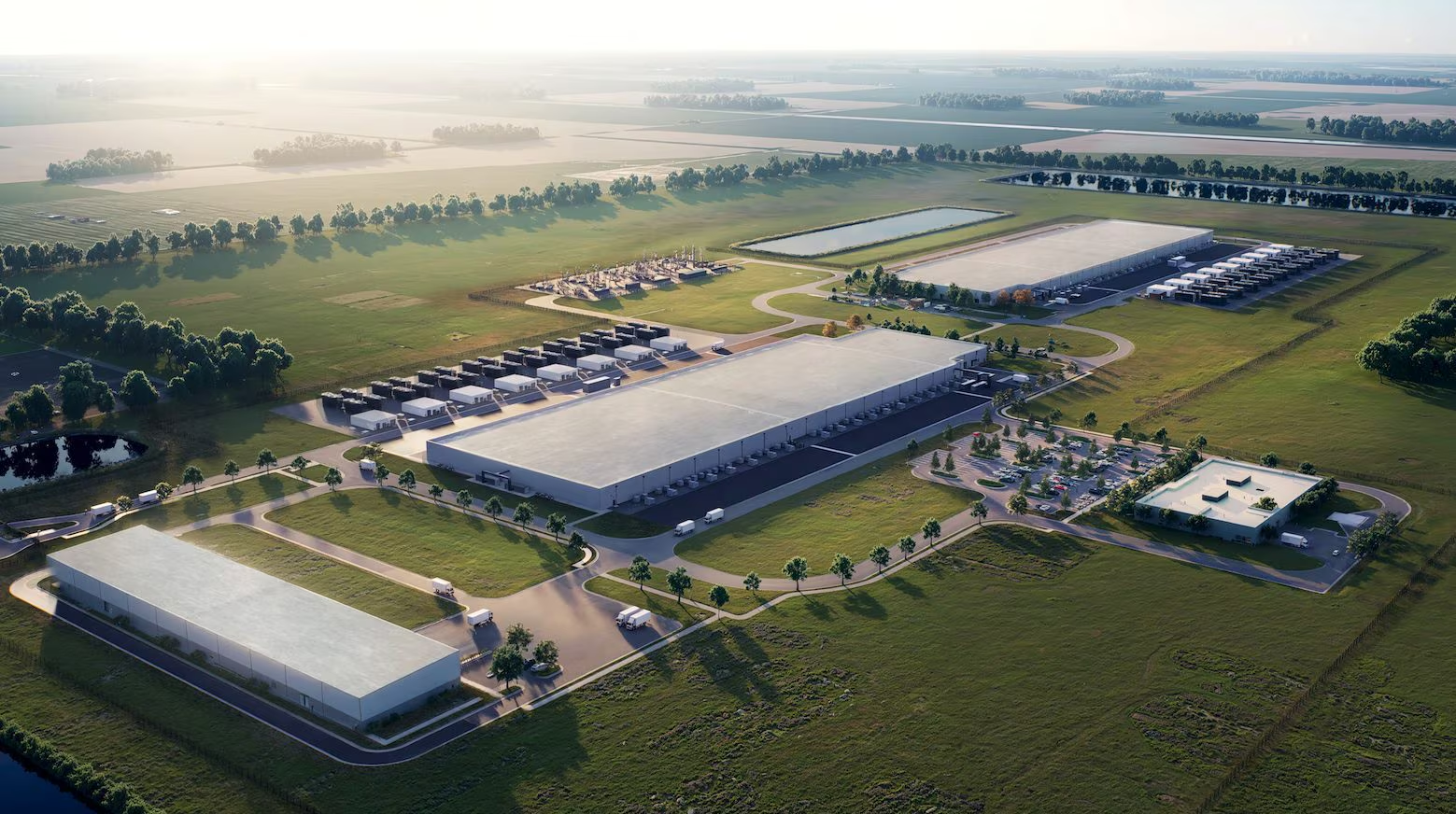
Recently, alarming news began to circulate on Facebook, Instagram, Reddit and various Substack authors: the data centers of Meta, Mark Zuckerberg’s technological giant, would have completely dried up the Rio Grande in New Mexico. The accusations pointed the finger at the Los Lunas complex, accused of consuming so much water that it emptied the entire waterway. Let us explain to you why these accusations actually have no solid basis.
Where does the water from Zuckerberg’s data centers come from and the hydrological crisis of the Rio Grande
The Los Lunas data center does not draw water from the Rio Grande. It is supplied by the municipal water network of the village of the same name, fed by four deep underground wells. An agreement signed in March 2025 between the municipality of Los Lunas and Greater Kudu LLC – the company affiliated with Meta for the project – certifies it in black and white. The permits authorize withdrawal exclusively from the underground aquifer, andNew Mexico State Engineer’s Office confirmed that Meta does not have any rights to draw on the river.
The data on consumption exists and is public: in 2023 the Los Lunas data center withdrew approximately 75 million gallons of water (approximately 284 million litres), which dropped to 67 million gallons in 2024. It is precisely the 2023 data that has been taken out of context and transformed into alarming news fed to social media.
So why is the Rio Grande drying up? The answer must be found in the ongoing climate crisis. The Federal Bureau of Reclamation el’New Mexico State Engineer’s Office are clear: the river is experiencing an unprecedented hydrological crisis, caused by climatic factors. 2026 brought record spring temperatures, the earliest snowmelt on record and some of the thinnest mountain snowpack in decades. New Mexico depends on snow at high altitude as a natural reserve for spring and summer: when it is missing, the rivers empty. Most reservoirs find themselves below 15% of capacity.
It should be noted, however, that this is partial drying and localized in specific sections of the river, not the entire watercourse, as the viral posts claimed. Tracts near Albuquerque and in the San Acacia area began to be discovered as early as late March, the earliest in thirty years. In official reports, the Meta data center is not mentioned even once among the causes.
The real problem: Meta’s data centers and water consumption
That said, the issue of data center water consumption deserves attention. These facilities house thousands of servers that continuously generate heat and require constant cooling to be fully operational. Many plants use evaporation towers, where heat is dissipated by turning water into steam. Added to this is an indirect water footprint: a 2021 study on npj Clean Water and a 2024 report from Lawrence Berkeley National Laboratory show that data centers consume water not only for cooling, but also indirectly in the processes of generating the electricity that powers them. On a national scale we are talking about approximately 66 billion liters of direct consumption and almost 800 billion of indirect impact and all this taking 2023 alone as a reference.
The Menlo Park company has declared its goal of achieving a positive water balance by 2030, thus committing to returning more water to the environment than it takes away. In the Rio Grande basin it has already financed seven environmental regeneration projects, which in 2024 have reintroduced 136 million gallons of water into the system, with the aim of exceeding 149 million per year when fully operational.
A question that remains open about the Los Lunas complex
However, there is one aspect that the checks conducted so far have not yet resolved: whether or not the intensive pumping of the underground aquifer by the Los Lunas water system – which also includes the consumption of the data center – could have indirect hydrological effects on the Rio Grande. This is a complex technical issue, on which local and federal authorities have not yet provided a definitive answer.
One thing is certain: the Rio Grande is suffering, and a lot, but the main cause, according to the authorities, is the drought and not Zuckerberg’s servers. However, the debate on the impact of large data centers on the world’s water-fragile regions remains open and absolutely necessary.