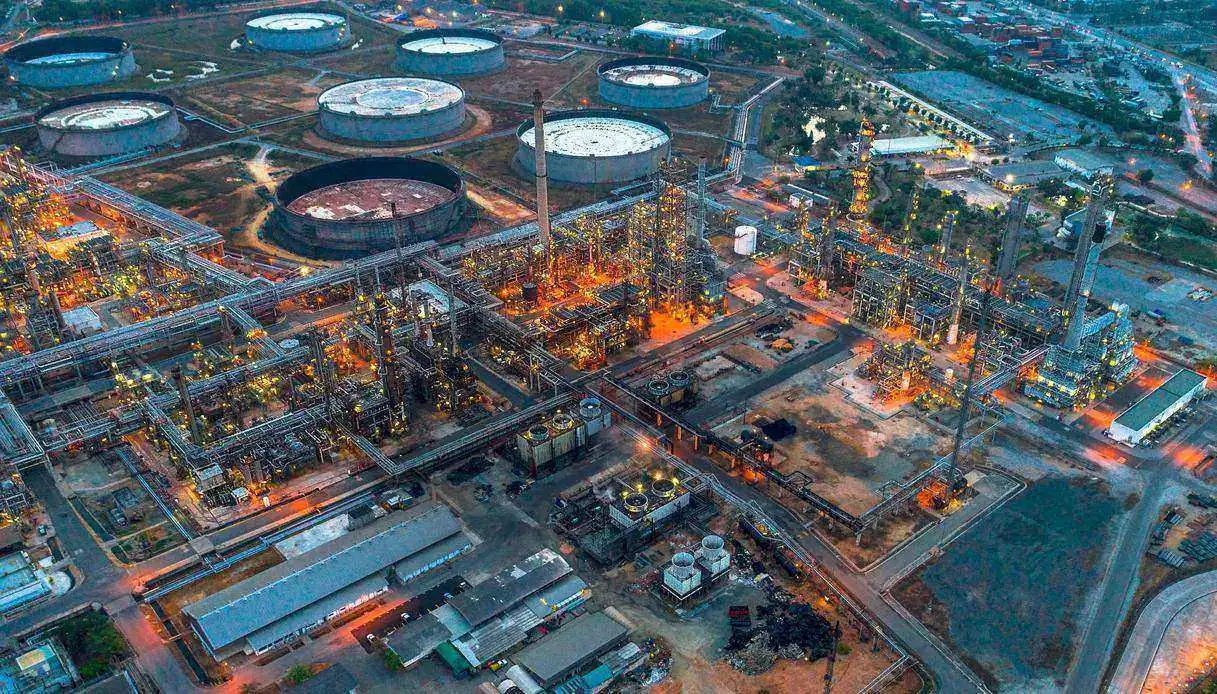
A diplomatic trip, an Indian refinery and some ships loaded with fuel headed for Europe. At first glance they seem like separate stories. In reality they meet in Jamnagar, Gujarat, where the large center of Reliance Industries, the company led by Mukesh Ambani, is located.
US Secretary of State Marco Rubio is traveling between Uzbekistan and India from October 17 to 22. According to the State Department, he will also talk about energy cooperation in Mumbai and Jamnagar and meet with business leaders, including Ambani. The stage takes on particular significance as the United States and Europe try to keep oil routes and the effects of sanctions on Russia under control.
An analysis by the Center for Research on Energy and Clean Air (CREA), published on 18 October, also brought attention to the refinery. The report follows shipments of petroleum products departing from refineries that also process Russian crude and arriving at European Union ports.
For Italy, the data deserves attention, but it must be read with precision: the loads arriving in an Italian port are not automatically fuel produced with Russian oil and do not equate to a violation of sanctions.
What does Italy have to do with the Jamnagar refinery?
According to CREA, in September seven cargoes of petroleum products from refineries processing Russian crude were unloaded in EU ports and classified by the organization as high risk based on European indications. Six had departed from Jamnagar and one from the Turkish refinery in Tüpraş Izmit. Italy received three of the seven shipments, making it the main destination country in the monitored group.
By cross-referencing these two data, it can be deduced that at least two of the three loads arriving in Italy came from Jamnagar: of the seven total, only one had left the Turkish refinery. The report, however, does not explicitly associate each individual ship with its port of arrival and, above all, the provenance from a refinery that also processes Russian crude oil does not demonstrate that a specific cargo was obtained from that crude oil.
| CREA data reported to September 2026 | What does it indicate |
|---|---|
| 7 loads | Petroleum products unloaded in EU ports from refineries considered high risk |
| 6 loads | Departed from Jamnagar refinery |
| 1 load | Departed from the Turkish refinery in Tüpraş Izmit |
| 3 loads | Unloaded in Italy, the first destination country in the group |
| At least 2 Italian loads | Inference from cross-referencing the data: Six of the seven were from Jamnagar |
CREA also notes that between July and September, 32% of the Jamnagar refinery’s crude purchases came from Russia. This data refers to the plant’s overall crude oil supplies, not to the composition of each individual exported product. It does not mean, therefore, that 32% of the fuel arriving in Europe or Italy was necessarily refined with Russian oil.
What European sanctions prohibit on Russian oil
Since 21 January 2026, the European Union has banned the import of certain refined petroleum products into third countries when they are obtained from Russian crude oil. The rule is not equivalent to a general ban on purchasing products from any refinery that has processed, or processes, including Russian oil: the decisive point is the raw material actually used for the imported product and the documentation certifying its origin.
The European Commission requires operators to adopt verification procedures and provide customs authorities with the information necessary to identify the origin of the crude oil used. The CREA report calls for checks on cargoes coming from refineries that process Russian oil precisely to verify that the rules are respected. His analysis therefore signals a need for traceability and supervision, not an automatic condemnation of individual imports.
Could Rubio’s visit change prices at the pump?
There is no automatic relationship between Rubio’s visit, Jamnagar’s loads and the price a family pays at the distributor. The presence of a ship in an Italian port is not enough to predict an increase or decrease in petrol and diesel prices: the international prices of refined products, the cost of crude oil, the euro-dollar exchange rate, taxes and margins along distribution also affect the price at the pump.
International routes can influence supply balances and market expectations, but do not in themselves allow us to attribute a price change to a single load. To understand how oil prices can be reflected in fuel prices, data on actual prices and tax components are also needed.
Italy received three of the seven European shipments monitored by CREA. Now the question concerns the ability to clearly reconstruct the supply chain, from the raw material to the ship, up to the port of destination. Not to fuel alarmism, but because effective sanctions and reliable supplies depend on understandable and verifiable controls.
Rubio’s stop in Jamnagar thus brings to the center an issue that affects diplomacy, energy and trade: in a global market, fuel can travel thousands of kilometers and cross multiple supply chains before arriving in Europe. To know what it really contains, the name of the refinery is only the beginning of the investigation.