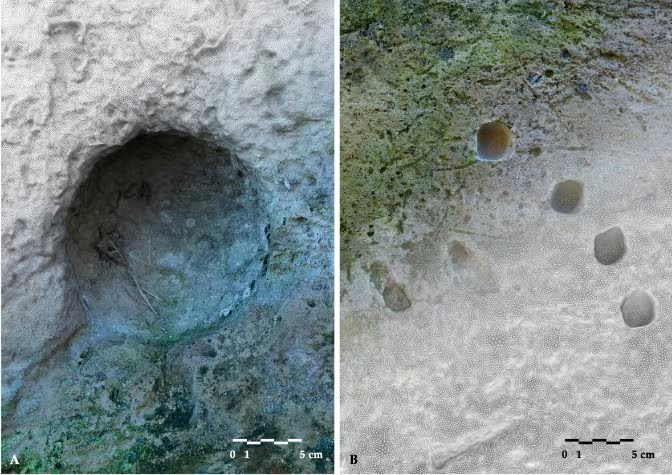
On the northern walls of Pompeii, between Porta Vesuvius and Porta Ercolano, ballistic impact footprints dating back to the siege conducted by Lucius Cornelius Sulla in 89 BC, during the Social War (a civil conflict between Rome and some rebel cities, including Pompeii) have been visible for decades. Alongside the classic circular cavities produced by spherical projectiles, a group of researchers from the University of Campania Luigi Vanvitelli and the University of Bologna have identified a different type of trace, described in a study published in the journal Heritage: small quadrangular cavities, about 25–30 mm in diameter, arranged in a fan along an arc of a circle, with short and regular spacing.
These groups of footprints were the subject of the study published in February 2026, as part of the SCORPiò-NIDI project, funded by the Italian Ministry of University and Research. The thesis put forward by the authors is that these traces were produced by polybolos: an automatic repeating crossbow, the invention of which is attributed to Dionysius of Alexandria, described in the 3rd century BC by Philo of Byzantium.
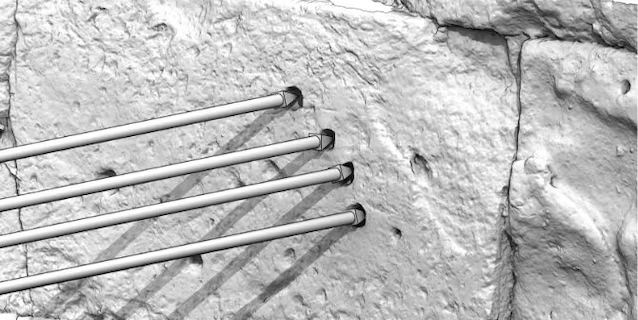
The survey was conducted with advanced digital instrumentation: terrestrial laser scanner for the general context, close-up photogrammetry and structured light scanner for the individual cavities. The morphology of the marks, i.e. quadrangular profile, the radial arrangement, the volumes of material removed by the impact of the projectile which are comparable between one mark and another, clearly distinguish the traces under study from those produced by spherical projectiles (such as those of catapults) or by single darts. The attribution is not based on shape alone, but on the combined analysis of geometry, spatial distribution and compatibility with documented shooting mechanisms.
The point of connection with the ancient sources is a passage from the Belopoeica (text describing the construction of siege engines) in which Philo describes the main limitation of the polybolos: the darts do not disperse, but follow a trajectory concentrated on a single point, tracing a narrow arc. This feature, presented by the ancient author as a tactical flaw, corresponds to the configuration observed by researchers on the walls of Pompeii. The German general Erwin Schramm (1856-1935), who at the beginning of the twentieth century built a working prototype of the machine by replacing the wooden chain described by Philo with a bicycle chain, had already noted this inability to disperse projectiles.
Three sets of footprints were analyzed as case studies. All three are interpreted as missed shots: the darts missed the target and left their mark on the tuff blocks. The use of a rapid-fire weapon is justified precisely by the mobility of the targets (probably the Pompeian archers on the walls): a single artilleryman with a traditional weapon would not have been able to realign the shot with that precision between one shot and another, nor would it have been tactically rational to employ multiple independent machines to hit a single target.
A historical-contextual element is added to support the hypothesis: in 96 BC, Sulla had held the role of governor of Cilicia, a province close to Rhodes, a center of excellence in military engineering and artillery construction. Philo probably had contact with the master craftsmen of the Rhodian arsenal. It is therefore conceivable that Sulla had access to Rhodian technological developments, including a polybolos enhanced compared to the original model described by Philo more than a century earlier.
The authors also calculated the dimensions of the machine starting from the damage detected, using Filone’s proportional formula, which links the diameter of the modiolusor the cylinder that contains the torsion beams of the weapon, at the length of the dart. The values obtained are compatible with the estimates published in the literature and with the results of the simulations conducted by the mechanical engineering team involved in the project. The study recognizes its limitations: no physical remains of the weapon were found, nor metal tips in the wall blocks, and the small cavities present measurement uncertainties, due to the wear and tear of time. It therefore remains a hypothesis, which will have to be verified through the physical reconstruction of the machine and other ballistic tests.