Slow drains, sewer odors rising, damp stains on the wall, manholes that overflow every time it rains: each of these signals has two possible prices. The first is that of a timely diagnosis and the second, much higher, concerns exploratory demolitions, building restorations and operational shutdowns.
It goes without saying that the objective is to remain on the former, but to do so you must undoubtedly opt for sewer video inspection: the smallest expense item of the entire intervention, as well as the only one capable of reducing all the others.
What is video inspection and when is it needed?
Whether for your home or for condominiums or offices, video inspection of pipes should be a necessary, almost fundamental, practice. This is a diagnostic investigation that takes a camera inside the pipes and reports in real time the state of what runs under floors, gardens and foundations.
It identifies breakages, obstructions, infiltrated roots, loose joints and counterslopes, and records their exact position without opening any traces. From an economic point of view, it is useful in two opposite moments: on the one hand it must be done when, unfortunately, the damage is already there (slowing runoff, bad smells, flooding, anomalous water consumption), because it transforms a blind intervention into a targeted intervention.
And then, without needing to have a problem going on, how due diligence technical (before purchasing a property, as a post-renovation check or as scheduled monitoring of condominium and industrial networks), because it allows us to understand today what will give way in two years and therefore consciously manage the interventions.
The principle is the same that governs any budget: every euro spent on a wrong hypothesis is a euro lost. Without diagnosis, you dig where the fault “probably” is, it breaks, it is checked and, if the hypothesis was wrong, you pay twice. Video inspection eliminates attempts, which is the least controllable cost component of all plumbing work.
How does it work?
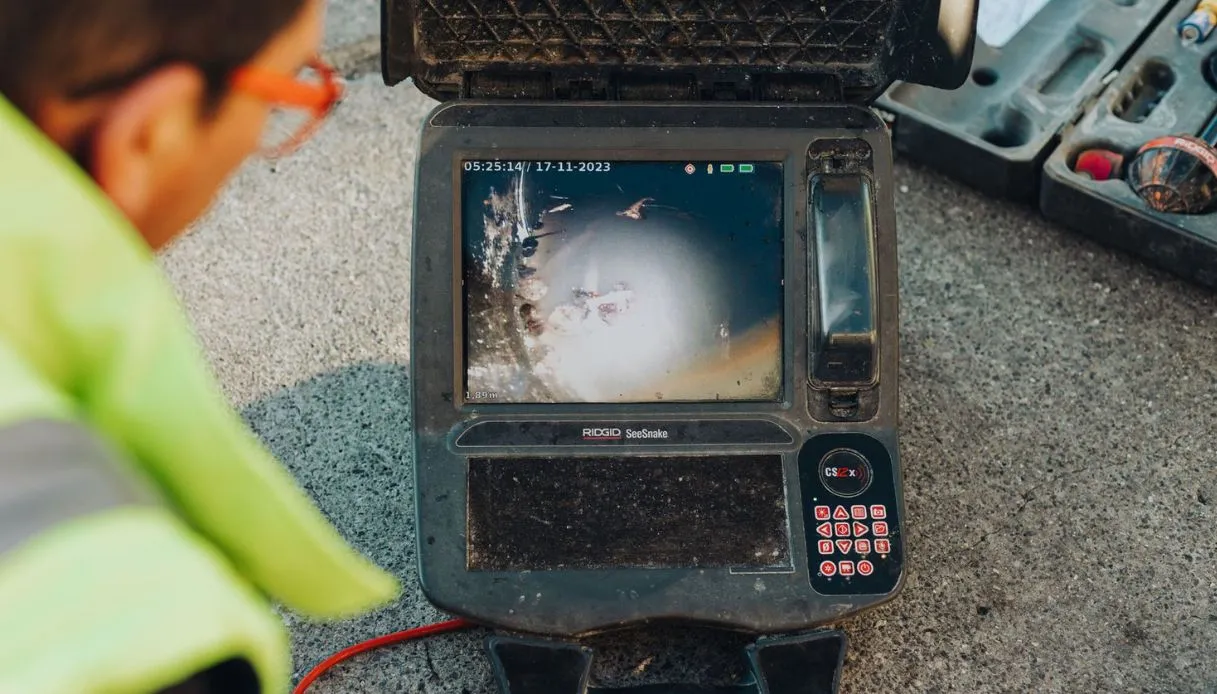
The inspection starts from an existing access point (a manhole, a manhole, a drain) from which a waterproof probe with a camera is introduced, which travels along the pipeline, filming it meter by meter.
Specialized operators such as Eco Spurghi Emilia, active in the provinces of Reggio Emilia and Modena, combine traditional probes with wire-guided trolleys, which keep the framing stable even on difficult sections, and robotic video inspections, designed for large pipelines and long routes, typical of industrial and consortium networks.
The interesting fact for those who think in terms of spending is the compression of time. The images flow into a self-sufficient mobile laboratory, equipped for immediate diagnosis and analysis: the fault is located, measured and reported on site, in a single inspection.
This means only one intervention to pay for, a repair estimate based on verified data and no costs for second visits. The availability 24 hours a day, 7 days a week completes the economic picture: in sewerage emergencies, every hour of waiting increases the damage from flooding, and with it the final invoice.
The advantages of a Zero Damage intervention
Eco Spurghi Emilia also counts on a targeted approach, the Zero Damage approach, which has an immediate accounting translation: it eliminates the expense items which in traditional jobs weigh more than the repair itself. No exploratory demolitions, no restoration of screeds, tiles and unnecessarily opened walls, no disposal of rubble produced just to look for the fault.
The diagnosis leaves walls, floors and gardens intact, and the construction site (when needed) opens up in just one point, the right one: smaller, shorter, more economical. Then there are the indirect costs, those that rarely appear in estimates and always in financial statements. For a private individual: unusable premises, dust, possible alternative accommodation.
For a condominium administrator: inconvenience to residents, extraordinary meetings, cost allocations contested due to lack of evidence. For a company: the heaviest item of all, the production stoppage. An inspection that works while the plant remains operational has a value that is measured by comparing it to the hourly cost of a stopped line.
The long-term benefits
In the long term, video inspection should be interpreted as any investment: low initial cost, return distributed over the years. A periodic check intercepts defects at the initial stage, when a root is cut and a joint is sealed with a few hundred euros, before they become structural failures worth thousands.
It is the difference between scheduled maintenance, which is planned on a budget, and emergency, which is incurred at the price that happens. Films and reports also build a documentary history with an independent economic value: it supports the multi-year planning of the works, gives objective bases to the condominium divisions, serves as proof with insurance companies and experts in the event of an accident and becomes a topic of negotiation in the sale, because a certified system is worth more than an unknown system.
For industrial companies, regular monitoring of sewer networks is an integral part of risk management: preventing a blockage costs a fraction of what it costs to stop production and suffer it.
The final bill is simple: a diagnosis costing a few hundred euros against renovations, shutdowns and restorations costing thousands. Few technical expenses offer a cost/savings ratio so unbalanced in favor of those who pay them.