In today’s production environments, efficiency is no longer linked exclusively to the speed of the machines or the organization of shifts, but also to the intelligent management of spaces.
Industrial warehouses and warehouses (and processing areas in general) are crossed by continuous flows of people, goods and vehicles, which require solutions capable of guaranteeing operational continuity without compromising safety and comfort.
Even apparently “service” elements take on a strategic role, and industrial closures in particular directly impact the fluidity of processes, access control and the ability to maintain stable environmental conditions inside buildings.
Why are high-speed doors strategic in industrial environments?
And it is in this scenario that industrial rapid doors fit in, designed to meet the needs of frequent passage and isolation between different areas.
Specialized companies such as ATI Dainese, active since 1985 in the production and installation of industrial doors, have contributed to spreading a design culture in which the door is no longer just a physical barrier, but a functional element of the production process.
High-speed doors find application in very different contexts, from logistics warehouses, where the gates are continuously crossed by forklifts, to production departments, where it is necessary to separate environments with different climatic or operating conditions. Their main function is to reduce opening and closing times, limiting dispersions and interference, without hindering daily work.
Impact on workflows, security and energy consumption
The adoption of high-speed doors has a concrete impact on the organization of internal flows. Fast and automated openings allow us to avoid slowdowns in the goods handling phases, helping to make loading, unloading and transfer operations between departments more linear.
This aspect is particularly relevant in areas such as logistics or manufacturing, where the continuity of steps directly affects productivity.
From a safety point of view, these solutions are designed to integrate with devices that protect operators and vehicles in transit, such as detection and stopping systems in the event of obstacles.
At the same time, the speed of closure helps to keep environments with specific requirements separate, improving management and control. The impact on energy consumption should not be overlooked, because limiting the time in which an opening remains open means reducing heat loss and air infiltration, factors which in the long term can affect the overall efficiency of the building and the comfort of workers.
Folding doors: when are they needed and how do they work?
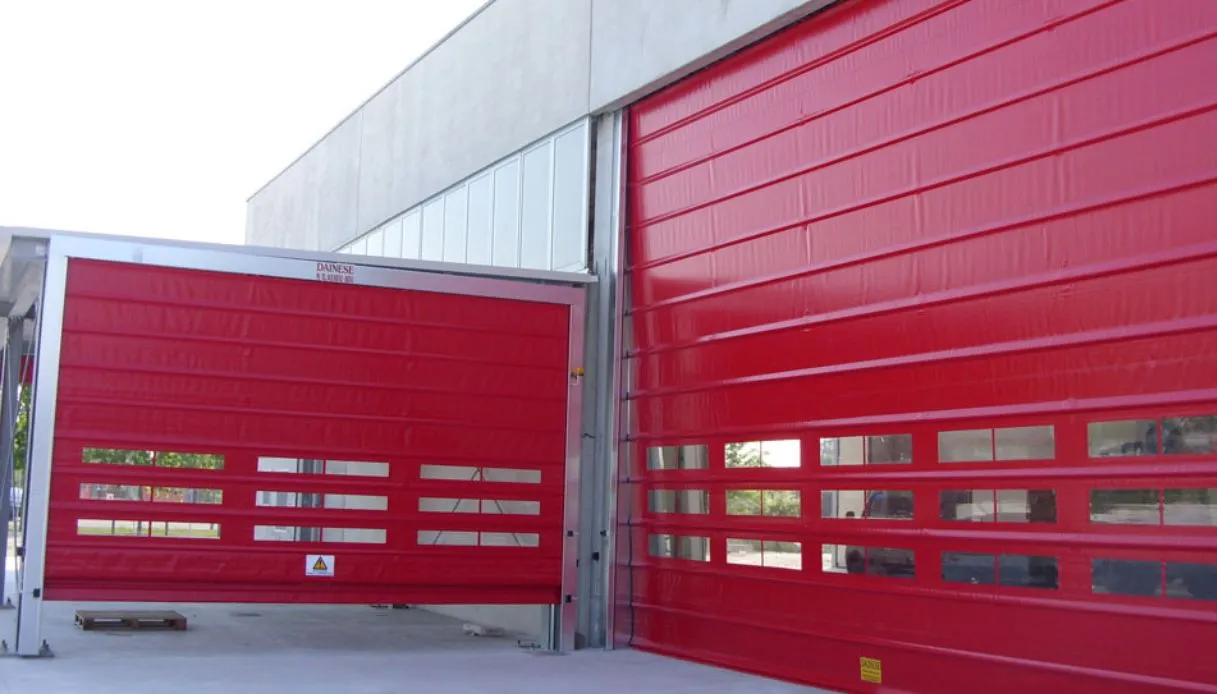
Rapid folding doors represent a solution particularly suitable for environments where the intensity of use is high. Their operation is based on a flexible curtain which, when opened, gathers vertically without creating lateral or upper encumbrances.
This feature allows installation even in complex spaces, such as corridors or side-by-side entrances, where other types of closure would be impractical.
From an operational point of view, these doors are indicated in environments where the passages are continuous and where there may be extraction systems or pressure differences between environments.
The possibility of opening even in the event of a power outage also represents an element of continuity and reliability, particularly appreciated in industrial environments that cannot afford unplanned downtime.
Rolling doors: characteristics and contexts of use
Rapid roll-up doors share many of the characteristics of folding solutions, but stand out for their smaller footprint and greater air tightness. In this case the covering wraps around itself inside special guides, making the system suitable for openings where available space is limited.
This type is generally suitable for moderate uses, such as passage areas between warehouses or departments with controlled opening frequency.
The choice between a rolling door and a folding door therefore depends not only on the size of the opening, but also on the intensity of use and the environmental conditions to be managed.
Operational, management, performance and reliability advantages over time
Beyond the construction differences, what industrial rapid doors have in common is the contribution they offer in terms of daily management of spaces. Solutions designed to measure and manufactured according to consolidated quality standards allow industrial high-speed doors to integrate immediately into the company’s operational flows, reducing the need for corrective interventions or unplanned downtime over time.
In this sense, companies such as ATI Dainese combine production with an approach oriented towards consultancy and assistance, accompanying companies in choosing the most suitable solution and guaranteeing support even in the post-installation phase.
Process optimization is fundamental today, and high-speed doors are confirmed as a functional investment, capable of improving space management and supporting productivity in the long term.









