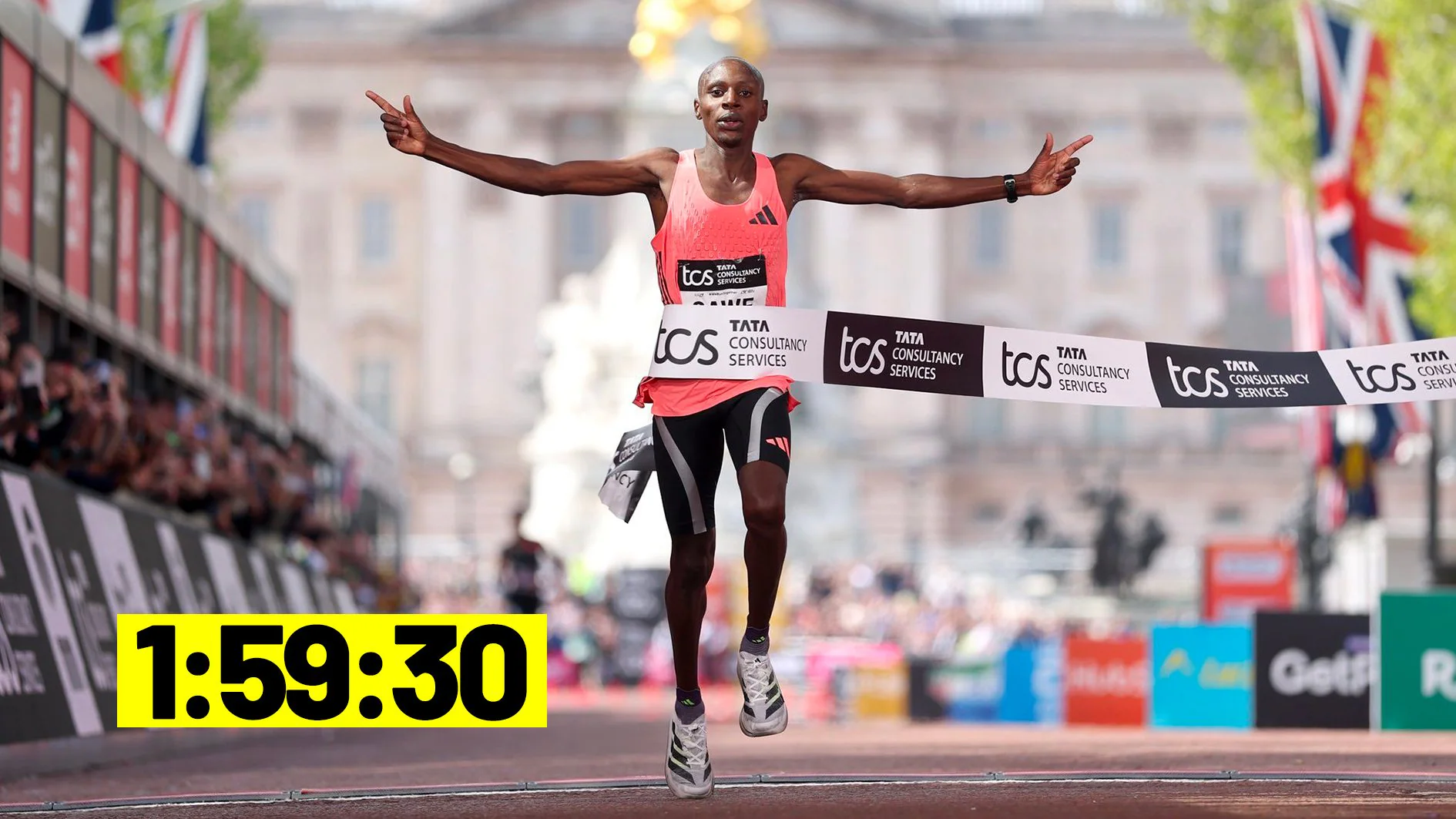
The streets of London were the stage for something many people thought they would never see: a human being running a marathon in under two hours in official conditions. And not just one: two in the same race on Sunday 26 April 2026, with 3 men under the previous world record and the new record also set for women. 31-year-old Sebastian Sawe crossed the finish line with a time of 1:59:30. The 2026 London Marathon was not only the fastest race ever, but also a day of sport that will go down in history.
Marathon under two hours in London: Sawe’s record rewrites history
Kenyan Sabastian Sawe won the 2026 London Marathon in 1 hour, 59 minutes and 30 seconds, becoming the first human to run an official marathon in under two hours. He bettered the previous world record by 65 seconds, a huge margin at these levels. Second place went to Ethiopian Yomif Kejelcha, who stopped the clock in 1:59:41 on his marathon debut. In third place was the most anticipated of the day, Ugandan Jacob Kiplimo with 2:00:28: a time which, in turn, would have established a new world record. In a single race, three athletes ran faster than anyone in history.
Among the women, Ethiopian Tigist Assefa defended the title she won last year by winning in 2:15:41, improving her own world record by 9 seconds. Behind her, Hellen Obiri finished second in 2:15:53 and Joyciline Jepkosgei third in 2:15:55, the first time in history that three women have finished a marathon under 2:16 in the same race.
An insurmountable limit and Kipchoge’s attempts
The marathon is 42.195 kilometers long and running it in less than two hours means maintaining an average speed of just over 21 km/h for the entire distance, covering each kilometer in less than 2 minutes and 50 seconds. Since the beginning of the 21st century, great Kenyan and Ethiopian marathon runners have begun to progressively lower their records, going from around 2 hours and 6 minutes to the fateful threshold of two hours: Haile Gebrselassie, Wilson Kipsang, Eliud Kipchoge, Kelvin Kiptum. Progress was steady, but the two-hour barrier always seemed out of reach, physically unattainable in a regular race.
In 2017 and 2019, two specific (but non-regulatory) events were organized to overcome this barrier which saw the double Olympic champion Eliud Kipchoge as the protagonist. In designed situations ad hocwith many pacemaker (expert runners who guide athletes towards a pre-set final time, maintaining a constant pace) taking turns, innovative shoes and weather conditions studied to perfection, the Kenyan champion managed to run the marathon in 1:59:40 on 12 October 2019 in Vienna, demonstrating that breaking the two-hour limit was feasible, but probably not in classic racing conditions.
Why London specifically? Favorable shoes and weather conditions
The London Marathon in recent years has earned the reputation of being the fastest circuit among the World Marathon Majors (the six major world marathons: Tokyo, Boston, London, Berlin, Chicago, New York). The course is flat, from Blackheath to the finish line on the Mall, in front of Buckingham Palace. The weather conditions of this year’s edition were practically perfect for the athletes: temperature at the start around 10°C, with a maximum of 17°C during the morning, light and favorable wind in the last part of the race, no rain.
Then there is the shoe factor: the two men who ran under two hours, as well as the winner among the women, wore the brand new Adidas Adizero Adios Pro Evo 3, publicly presented a few days ago and announced as a small revolution for high-level athletes, with just 97 grams of weight and a new design capable of improving running economy by 1.6% compared to the previous model. Translated into a high-level marathon, making 1.6% less effort than your opponents means actually having the possibility of arriving where no one has arrived before. This is a new step forward in the world of the so-called “super shoes” with carbon plate which have revolutionized the world of running over the last 10 years, significantly improving athletes’ performance.
The enormous potential of the competing athletes also had an influence, especially on the men’s side. If in the first part the “hares” did an exemplary job in leading the group, in the second half of the race the level of the first three classified led them to push themselves beyond that limit that seemed insurmountable, running the last 21 km in just 59:01.
The debut and record of runner-up Yomif Kejelcha
The winner Sabastian Kimaru Sawe, Kenyan born in 1996, made his marathon debut only in December 2024, in Valencia, winning in 2:02:05, one of the fastest debutants in history. The London marathon was only his fourth career marathon, but he had always finished under 2:03 in the previous three. But if Sawe’s story is extraordinary, that of runner-up Yomif Kejelcha is almost implausible. Among the best in the world in shorter distances, former record holder of the half marathon and indoor mile, in London he was competing in the first marathon of his career, finishing in 1:59:41: the best debut in history, an extraordinary time which however did not guarantee him either victory or the joy of the world record.