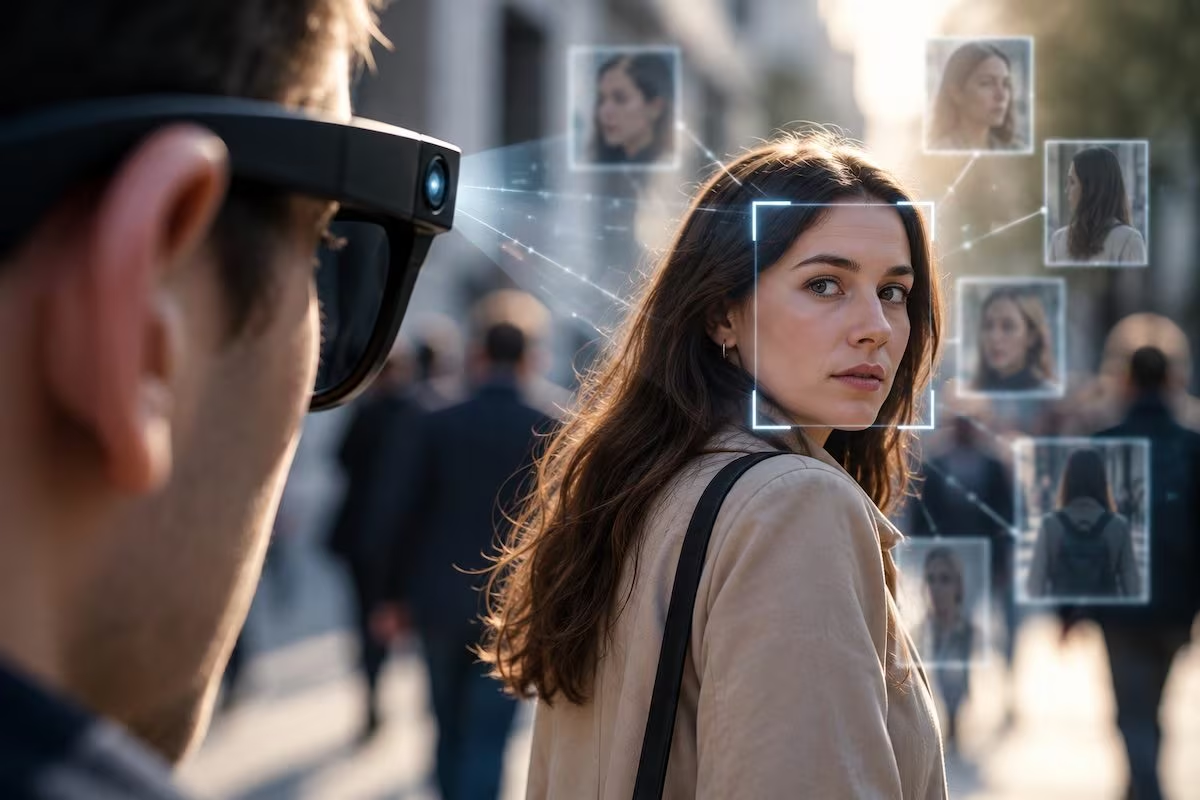
Smart glasses may look like normal eyeglasses or sunglasses, but some models integrate cameras, microphones and artificial intelligence functions. The wearer can then take a photo or record what is in front of them without taking out a smartphone. A person can thus end up in an image without realizing it. That footage, if analyzed with tools available online, could become the starting point for tracing his identity and other personal data.
This doesn’t mean that smart glasses automatically recognize people in front of them. The Ray-Ban Meta, for example, does not use facial recognition to identify strangers. The risk emerges when the collected image is processed with external services capable of comparing a face with photographs on the Web.
The I-XRAY Case: How a Footage Can Lead to Name, Address and Phone
I-XRAY, an experiment carried out in 2024 by two Harvard students, concretely showed how far a system of this type can go. The project was developed by AnhPhu Nguyen and Caine Ardayfio as a proof of concept, i.e. a practical demonstration designed to show what was already possible by combining existing technologies. The two authors declared that they did not want to make the code public or monetize the initiative and explained that they created it to draw attention to privacy risks.
The system used the Ray-Ban Meta primarily as a wearable camera. The images were analyzed by external tools: a facial search engine could search the Web for other photographs of the same face and attempt to associate it with a name. Once the latter was obtained, other publicly accessible information made it possible, in some cases, to trace the telephone number, home address and names of family members.
The focus is therefore not a hidden function in smart glasses. The system depended mostly on the external tools used to process the images. However, glasses make the acquisition more discreet, because looking at a person does not require holding a device in front of their face.
How to understand if smart glasses are recording
In the case of Meta devices there is an indicator designed to signal to those in front of the camera when an acquisition is in progress. When a photo or video is taken, an outward-facing capture LED automatically turns on.
This very system was strengthened in August 2026. It was in fact possible to start filming and cover the LED only at a later time, while still continuing to film. Meta then corrected this possibility with an update and now, if the light is covered during a recording, the camera stops working.
The LED is therefore the first element to observe, but it does not represent a universal rule. Other products may adopt different signaling systems. The use of the camera to take photos and record videos must also be distinguished from that required by some AI functions. On newer Meta models, according to Ray-Ban, some tools can operate without turning on the LED because they do not generate content intended for sharing. The company also specifies that facial recognition is not used in these cases.
If you realize that the glasses are recording, the first countermeasure is simple: point out that you do not want to be filmed and, if a photo or video has been taken, ask for it to be deleted. Meta, in its instructions for the responsible use of smart glasses, also invites those who wear them to respect the people around them and to obtain permission before taking photographs or recording videos.
How to protect yourself from facial recognition and limit the data available online
The I-XRAY case highlights a less intuitive aspect: the problem does not end when the camera is turned off. The risk increases when it is easy to associate a name with a photograph and, starting from this, recover other public data. For this reason, one of the most concrete defenses is to reduce the personal information that is easily available on the Web.
A first check consists of searching for name and surname on search engines and checking which data is visible. In this regard, Google provides a tool with which to identify results that show the home address, telephone number or e-mail and, when the conditions are met, request their removal.
It is also possible to intervene on facial search engines. PimEyes, one of the services used in the I-XRAY experiment, allows you to submit a free opt-out request to exclude your face from current and future results. The procedure requires a photograph and identity verification.
Finally, it is useful to check which information remains visible on social media. Headshots associated with your full name, location, place of work, and other details make it easier to link different sources. Making contents private that should not be accessible to anyone and removing those no longer necessary reduce the exposure surface, without guaranteeing absolute anonymity.
What to do if a photo or video ends up online
If an image or video of a person is published online, the priority is to understand where the content is located. You can ask the site to delete it or use the reporting tools made available by social networks and platforms.
An important distinction must be made here: removing a result does not mean deleting the content from the source. If Google accepts the request, the original page may in fact remain accessible. To intervene directly at the source, you must contact the manager of the site or service, when the conditions exist. In certain circumstances the right to cancellation may also be exercised. In this regard, the Guarantor for the protection of personal data reminds that the so-called right to be forgotten can also include de-indexing from search engines.
However, there is no accessory capable of making a person always “invisible” to facial recognition. Clothes and graphic patterns designed to confuse some algorithms have also been tested, as in the noRecognition project, but the effectiveness varies depending on the system used and such solutions do not constitute reliable protection in every situation.
The most realistic defense is therefore much less science fiction and involves paying attention to signals from glasses, intervening when a recording is evident and limiting the amount of personal data that can be linked to one’s face. I-XRAY showed this above all. The trickiest part is not just the camera in a pair of glasses, but everything the Internet may already know about the person that camera is looking at.