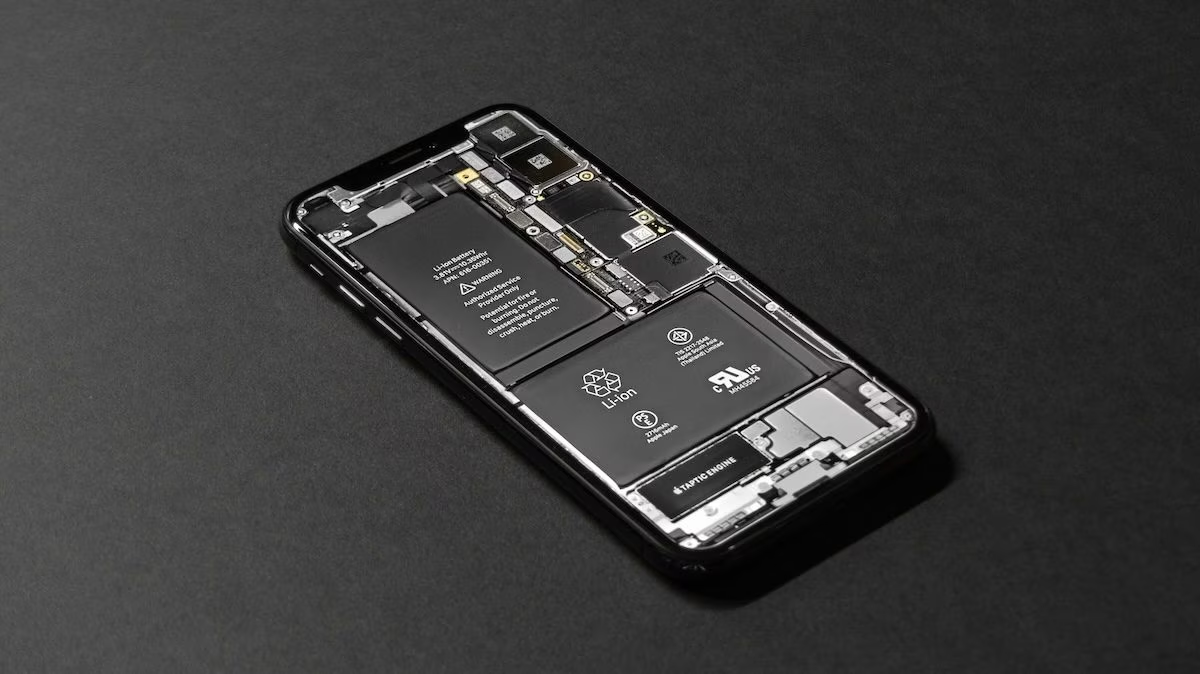
A smartphone can remain turned off for months, be used very little and still find itself with a battery that has lost some of its capacity compared to when it was new. It may seem counterintuitive: if it isn’t used, why should it deteriorate? The point is that a lithium ion battery is not a simple “tank” in which the energy remains immobile. Chemical reactions slowly continue inside it which, over time, modify the materials of the cell.
This phenomenon is called calendar aging, or calendar agingand also happens when the device is at rest. It is different from aging by cycles, or cycle aginglinked to repeated charging and discharging phases. Both contribute to the deterioration which, on the phone, manifests itself as a progressive reduction in the maximum battery capacity. In the first case, however, it is not so much the use of the smartphone that has an impact but the simple passage of time.
Why does the lithium ion battery age on its own?
During normal operation, lithium ions move between two electrodes, anode and cathode, through a material called an electrolyte. When the phone is turned off, the normal discharge due to use of the device is eliminated. Internal chemistry, however, does not “freeze”.
Electrodes and electrolyte remain in contact and parasitic reactions can continue to occur, i.e. transformations that do not produce useful energy but slowly modify the cell materials. They are much slower processes than those involved in normal charging and discharging, but they have months and years to accumulate their effects. Over time they can consume some of the available lithium and alter the surfaces of the electrodes.
This does not coincide with self-discharge, i.e. the spontaneous loss of part of the stored charge during disuse. In calendar aging, however, another effect takes on particular importance: the irreversible loss of capacity and the increase in internal resistance due to the transformations that occur in the cell.
What happens chemically inside the battery: the role of the SEI layer
One of the protagonists of this process has a not very intuitive name: SEI, acronym for Solid Electrolyte Interphase. It is a very thin layer that forms on the surface of the anode following the decomposition of some components of the electrolyte.
SEI is not a defect. On the contrary, its formation is fundamental because it creates a barrier between the anode and electrolyte, limits further reactions between the two and at the same time allows lithium ions to pass. The problem is that this protective film does not remain perfectly unchanged for the entire life of the cell.
In fact, even when the battery is stopped, the layer can continue to slowly grow. To form new material, molecules of the electrolyte are consumed and a part of the lithium ends up trapped in compounds that can no longer participate normally in subsequent charge and discharge cycles. In technical terms this is called lithium inventory loss, or Loss of Lithium Inventory.
“Cycling” lithium can be imagined as a collection of balls that must continue to move back and forth between the two electrodes. If some are progressively removed from the game and immobilized in secondary reactions, fewer remain available. The consequence is a battery that can store less energy than when it was new. Furthermore, the thickening of these surface layers can make it more difficult for ions to pass through and contribute to increased internal resistance.
SEI is not solely responsible for the degradation
The aging of a lithium ion battery actually arises from the combination of several phenomena. Even on the cathode, for example, the electrolyte can undergo oxidation reactions and, over time, changes can occur in the materials that make up the electrodes.
These changes can reduce the amount of material actually available to store and release lithium ions, contributing to capacity loss and, more generally, worsened cell performance.
Not all batteries age the same. The speed at which these processes occur and their importance depend on the composition of the electrodes, the electrolyte, the design of the cell and the conditions in which it has been stored. Two batteries of the same age, therefore, can find themselves in significantly different conditions after a few years.
What accelerates chemical reactions even when the battery is at rest
The fact that the calendar aging depends on time does not mean that it always proceeds at the same pace. Two particularly important factors are temperature and state of charge.
High temperatures accelerate many of the transformations that occur within the cell, including unwanted ones, and can promote SEI growth, electrolyte decomposition, and other degradation phenomena. The result is faster calendar aging.
The amount of energy stored also counts. At high charge levels the potentials of the two electrodes change and some secondary reactions can be favored: at the anode the growth of the SEI can continue more rapidly, while at the cathode the oxidation phenomena of the electrolyte can intensify. The precise effect depends on the cell chemistry and can become more pronounced when this condition is combined with heat.
A little used battery can therefore still be “old”
That’s why counting charging cycles alone doesn’t tell the whole story. You can consider, for example, two identical smartphones produced at the same time: one is used regularly, the other is turned on a few times and then forgotten for years in a drawer. The second will have been used much less, but its battery will not have remained chemically identical to the day it left the factory.
In the meantime, the scheduled degradation continued. How pronounced it is depends on the storage conditions and the specific composition of the cell, but the principle remains: not using a battery does not mean stopping its aging.
This is also why “new” and “never used” are not necessarily synonymous in the case of rechargeable batteries. The cycles tell of the wear and tear linked to use, while the simple passage of time contributes to another form of deterioration, more silent but inevitable. In short, even when the smartphone remains turned off, its battery continues to age.