A new phase of escalation opens for the war in the Middle East after Israel bombed South Pars, the Iranian portion of the largest natural gas field in the world, located in the Persian Gulf and shared by Tehran with Qatar. Iran responded to the attack by hitting the Ras Laffan industrial complex in Qatar, crucial for the processing and export of liquefied natural gas (LNG), while this morning a drone hit the Saudi Samref refinery, located on the Red Sea coast.
Meanwhile, US President Donald Trump wrote in Truth that he had not been informed before the Israeli attack, however threatening to completely destroy the field in the event of new offensives by Tehran against Qatar, a US ally.
But why was this natural gas field hit? South Pars is an essential basin for Iranian energy needs: 80% of Iranian electricity is generated by gas and, according to IEA estimates, most of this gas comes from the bombed field. Let’s look in more detail at its characteristics and the possible implications for other countries in the region.
The characteristics of South Pars, part of the largest gas field in the world
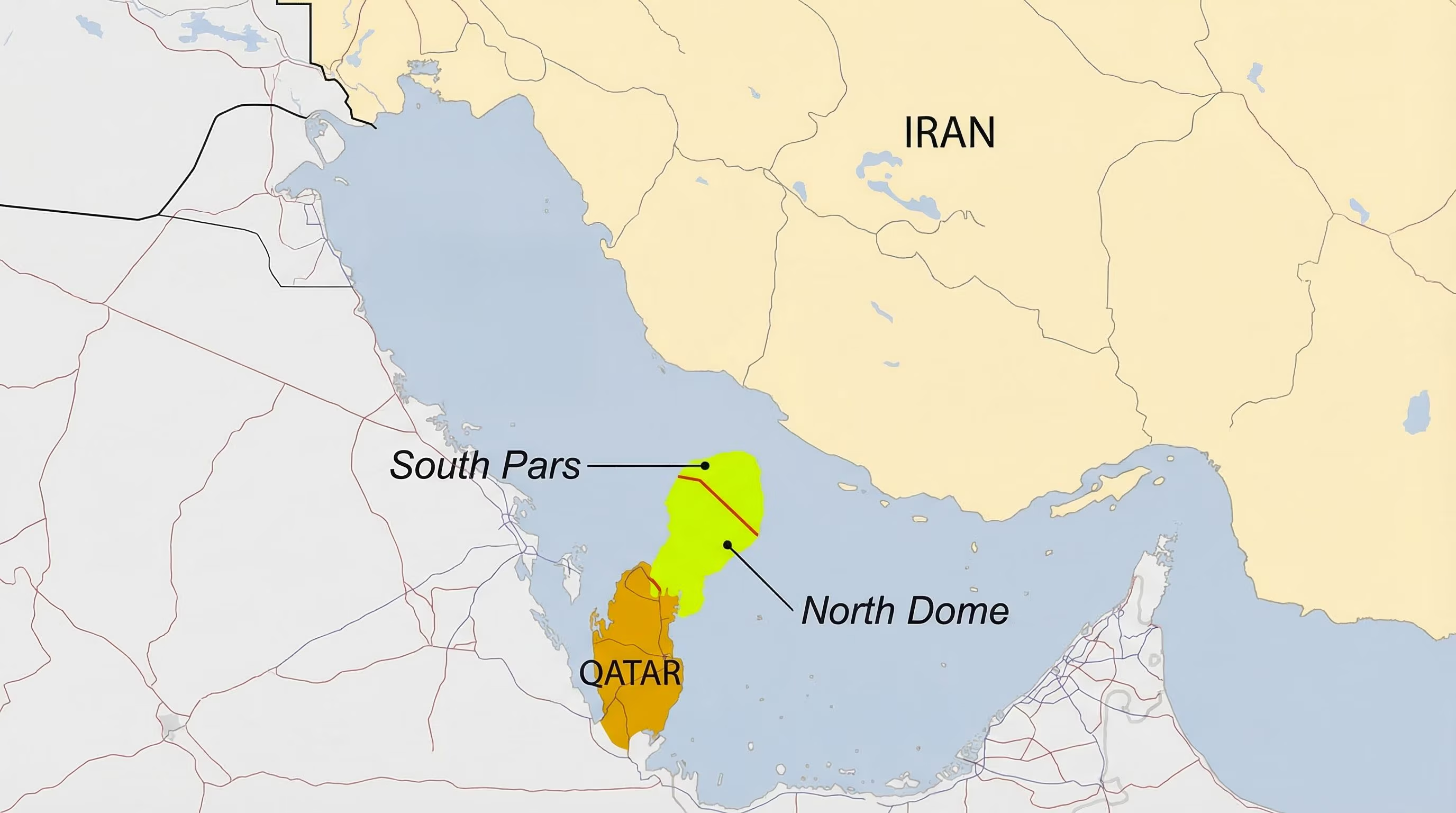
From a geological point of view, the largest natural gas field in the world constitutes a single structure, but from a political point of view it is divided between two countries: the South Pars, in fact, is the Iranian portion (located to the north), while the North Field, located to the south and also known as North Dome, is located in the territorial waters of Qatar.
Overall, the offshore basin (i.e. in the sea) extends for approximately 9,700 km2: the Iranian part occupies about a third, equal to 3,700 km2and according to estimates by the International Energy Agency (IEA), it would contain reserves of around 50 thousand billion cubic meters of gas.
The site, which is located under the Persian Gulf, is organized into 24 development phases (not yet all completed), each of which involves the construction and activation of offshore platforms, as well as subsea wells and treatment plants. These different phases are then connected via underwater gas pipelines to the Iranian port of Assaluyeh, where the gas is treated and then injected into the national network.
Furthermore, while Doha started production in the North Field in 1989, on the Iranian side the exploitation of this field only formally began in 2002.
Because this field in the Persian Gulf is strategic for Iran
Even just by looking at its characteristics, it is easy to understand why the South Pars field is so strategic for Iran. As also reported in one of the latest IEA reports, between 2018 and 2024, Iran’s natural gas production grew by as much as 30%, effectively consolidating the country among the largest gas producers in the Middle East. This strong growth, however, has been driven primarily by the continued development of the South Pars field: more specifically, growth is primarily supported by phase 11 of this field, which opened in 2023.
In short, South Pars is essential for Iran’s energy supply: also due to international sanctions on its exports, Tehran allocates most of the gas extracted from this field for internal consumption. Again according to the IEA, 80% of Iranian electricity is generated by gas, most of which comes from South Pars.
There is a big difference, therefore, between the ways in which Qatar and Iran exploit this field: while on the one hand Qatar exploits the gas extracted from the North Field for exports, Iran uses it above all to support its internal energy needs.
In any case, the repercussions of this attack will inevitably also fall on other countries in the Middle East, primarily Iraq, which depends on Iranian gas to satisfy 40% of its gas and electricity needs. At the same time, this new escalation risks also damaging states close to Iran such as Qatar, the United Arab Emirates or Saudi Arabia – whose energy infrastructures are, now more than ever, sensitive targets – with serious consequences for the global energy market, already in crisis due to the blockade of the Strait of Hormuz.