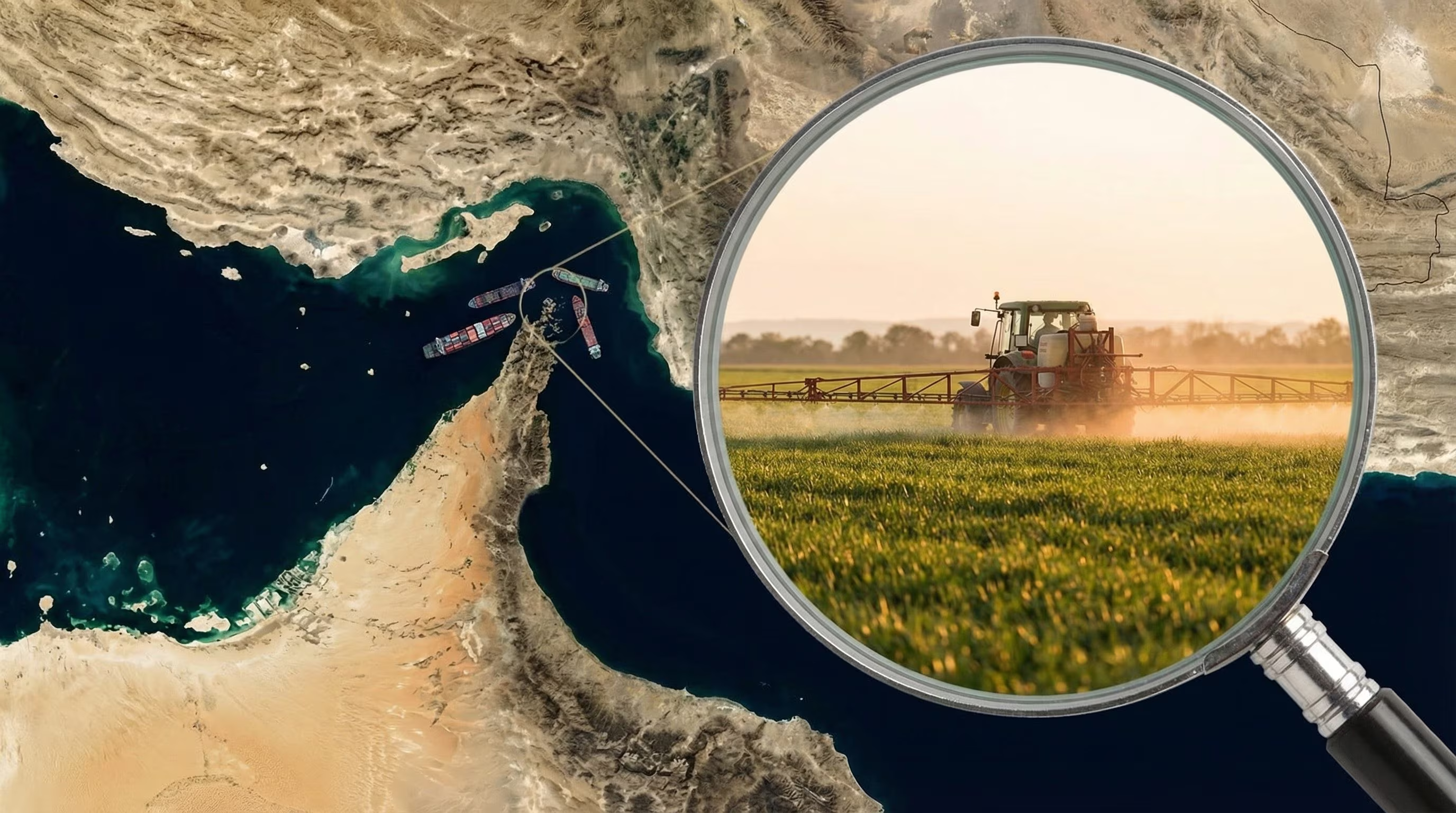
The Strait of Hormuz is not only crucial for the trade of fossil fuels: around a third of the world’s seaborne fertilizer trade passes through this route: we are talking about around a million tonnes per month of raw materials essential for modern agriculture: ammonia, urea, phosphates and sulphur. These products are transported almost exclusively by sea: in fact, there are no large-scale alternative land infrastructures that can quickly replace the passage through the Strait. A prolonged reduction in the raw materials needed to produce fertilizers – and in the natural gas needed for their production – can lead to food risks for several world economies already fragile from this point of view, such as Brazil, India and some African countries.
The problem does not only concern raw materials, but also production
Fertilizers are fundamental products for food production: nitrogenous ones, for example, are essential for crops such as wheat, corn and rice, because they provide nitrogen, one of the essential nutrients for plant growth. Without an adequate supply, yields can decrease by up to 30-50% depending on the crops. It is no coincidence that around a third of agricultural production costs are linked to fertilisers. Without the latter, yields drop, generating direct effects on food availability. The link between Hormuz and fertilizers is even closer when considering the origin of these products. In fact, approximately 45% of the world production of urea, one of the most used fertilizers in the agricultural sector, comes from the Persian Gulf area.
A key element to clarify is that many fertilizers, particularly nitrogenous ones, derive from natural gas: the gas therefore serves both as a raw material and as an energy source to produce ammonia. This means that any energy tensions are automatically reflected in the availability of fertilizers. The Persian Gulf is one of the main production centers of raw materials essential for modern agriculture: ammonia, urea, phosphates and sulphur.
But the problem isn’t just about transportation: it’s also about production. The blockade of the Strait prevents not only exports, but also access to the raw materials needed to produce fertilizers. In some countries, such as Egypt, the reduction in gas supplies has already affected urea plants, while in South Asia – India, Bangladesh and Pakistan – several companies have had to slow down or stop production due to the lack of energy assets.
The consequences of the blockade: rising prices and markets under pressure
The first consequences of a closure or severe limitations on maritime traffic are already evident in prices. The price of urea increased by around 30%, reaching peaks above $600 per ton. In some markets, increases have exceeded 40%.
These increases are not just a market issue, but generate a domino effect along the entire agri-food chain: when fertilizers become more expensive or scarce, farmers tend to reduce their use. In the medium term, this can translate into lower yields and higher food prices. According to the Carnegie Endowment for International Peace, reducing the supply of fertilizers can directly impact agricultural production and therefore food inflation. A key point that makes this crisis particularly critical is the time element. Fertilizers cannot be used at any time of the year, but must be applied in a specific period, that of sowing. In Europe and many other agricultural areas, farmers purchase these products between March and April to use them in the months immediately following.
If at this stage the fertilizers do not arrive, or become too expensive, the damage is not recoverable. Farmers are forced to reduce cultivated areas or give up certain crops. The consequences begin to emerge in the medium to long term, in the following months, when harvests are poorer. Even if a rapid reopening of the Strait of Hormuz occurred, returning to normality would take time. The production, transportation and distribution of fertilizers do not restart immediately and this delay would be enough to compromise an entire agricultural season.
Global dependencies and food security risks
A further critical element concerns the geographical dependence of some countries, such as India and Brazil, which import a significant share of fertilizers from the Middle East and are therefore particularly exposed to the consequences of a total or partial blockage of supplies. Even many African economies, already fragile from a food point of view, risk suffering serious repercussions. In some cases, the crisis is not just about transportation: the lack of natural gas is forcing the closure of local fertilizer production plants.
Following this news and price increases, some governments are starting to take measures to protect their economies from this crisis. China, for example, has decided to tap into its strategic fertilizer reserves to avoid shortages during the planting season. This is an extraordinary measure that highlights how the crisis is not limited to the markets, but is already influencing national agricultural policies. Urgent interventions are also being evaluated in Europe: the European Commission has opened up the possibility of temporarily suspending duties on the import of ammonia and urea, with the aim of reducing costs for farmers by around 60 million euros. However, this is a stopgap measure, designed to mitigate the immediate effects, while awaiting structural solutions which are currently still being defined.