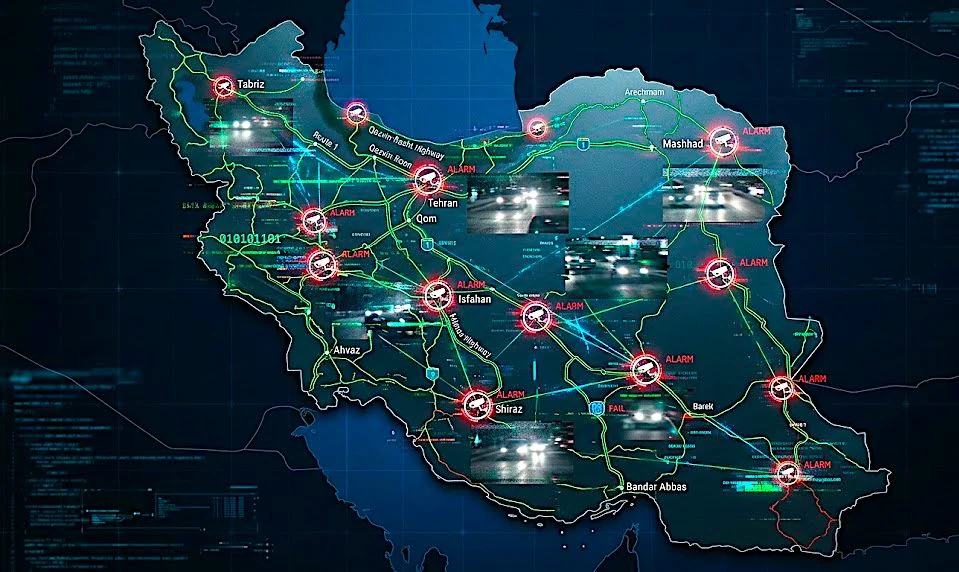
The killing of Ayatollah Ali Khamenei and top Iranian military leaders, which occurred last Saturday in Tehran, may have been the result of a cyber infiltration that lasted over a decade. Israeli intelligence is said to have monitored traffic cameras in the Iranian capital, constantly mapping the habits of the regime’s leadership. This visual surveillance has been the centerpiece of an AI-driven infrastructure designed to analyze massive amounts of data from cross-sources: field intelligence, satellite imagery, and wiretaps. The algorithm continuously processed these inputs to generate geographical coordinates of very high precision.
It is not the first time that the Israeli secret services have carried out technological attacks: in 2024 they exploded thousands of hacked pagers supplied to Hezbollah militiamen in Lebanon. But let’s go back to the tracking system used in Tehran: already used successfully in the “12-day war” of last June, it was reactivated at full capacity following the partial failure of diplomatic negotiations on the nuclear program. On Friday, the direct order triggered the operation codenamed “Epic Fury” by the US. Thanks to the precise geolocation data provided by the CIA on ongoing meetings, the Israeli fighters hit the targets with a margin of error close to zero. At the same time, American cyber divisions blacked out Iranian networks, preventively eliminating Tehran’s defenses. The attack decapitated the command structure, causing hundreds of victims in the country and requiring the rapid appointment of an emergency governing council, effectively reshaping the regional geopolitical balance through an unprecedented use of cyber warfare.
Attention: The reconstruction made in this article is the result of statements collected by reliable international media, such as Financial Times and the New York Times. At the moment, however, the American and Israeli governments and intelligence services have not released all the details of the operations in question.
Traffic cameras hacked in Iran: the technological architecture of the operation
Let’s analyze the technological architecture underlying the operation in a little more detail. The Israeli forces have created a real validation chain for the production of targets. The IT systems have been trained to assimilate Signal Intelligence – a technical term by which we refer to the active interception of electronic, radio and telecommunications signals – integrating it with hacked urban footage in real time. The final result of this algorithmic analysis resulted in millimetric coordinates consisting of 14 digits.
According to what an Israeli official said at Financial Timesthe cameras, hacked years ago, allowed Israel to map Tehran in detail and establish precise movement patterns. But the hacked cameras were only part of a highly complex spy system, which also included visual intelligence data, human intelligence information, as well as intercepted communications and satellite imagery. All of this is then processed with artificial intelligence to reconstruct recurring patterns and habits.
An Israeli intelligence official, speaking about how effective the years-long espionage work has been, told the Financial Times:
We knew Tehran as we know Jerusalem. And when you know a place as well as you know the street you grew up on, you notice only one thing out of place.
In the attack which occurred on Saturday morning at 09:40 (local time in Tehran), the leaders were gathered in a civilian building in the center of the city, giving up the safety of the underground bunkers. US intelligence had identified this fatal behavioral pattern by intensifying electronic surveillance in the previous months on the IRGC, or the Islamic Revolutionary Guard Corps, also known as Pasdaran, the elite unit of the country’s armed forces.
The material air incursion was anticipated by the use of so-called “non-kinetic effects” by US cyber commands. With this expression we refer to all those military actions that do not use explosives or physical force, but which aim to sabotage the adversaries’ digital infrastructures: in this scenario, it involved blinding the radars and degrading the signals to prevent any reaction from the Iranian forces before the arrival of the Israeli jets.
The consequences of the attack on the Ayatollah
In addition to the death of the Supreme Leader, who has been in power without interruption since 1989, the daytime bombing eliminated in one fell swoop his entourage and over forty top leaders, including Defense Minister Azis Nasirzadeh and Chief of Staff Abdolrahim Mousavi. The offensive would have caused a total of 787 victims nationwide in different waves, confirming on the field a lethal and irreversible integration between predictive data analysis, urban hacking and air supremacy by the Israeli-US forces.