On 8 and 9 November 1987, Italian citizens were called to the polls to express their opinion on five repeal referendum questions, three of which concerned specific legislative decrees regulating the nuclear sector in Italy. The electoral turnout was high, also due to the recent Chernobyl disaster, with a quorum being reached for all questions, despite a significant incidence of blank or null ballots, equal to approximately 13%. Italy held another referendum on nuclear power in 2011, a few months after the Fukushina accident.
The 3 nuclear referendum questions of 1987
The referendum did not directly concern the abolition of nuclear power in Italy, but proposed three repeal questions having as their object the legislative decrees of 18 December 1973 n.856 and 10 January 1983 n.8.
- Question 3: repeal of the powers of the CIPE (Interministerial Committee for Economic Planning) to decide unilaterally on the location of nuclear power plants in the absence of an agreement between the local authorities involved.
- Question 4: elimination of compensatory contributions to local authorities hosting nuclear or coal power plants.
- Question 5: exclusion of the possibility of ENEL (National Electricity Agency) promoting the construction of nuclear plants through foreign companies/bodies or taking on shareholdings aimed at their construction/management abroad.
Nuclear power in Italy in the 1980s
At the time of the referendum, four nuclear power plants were present on Italian territory:
- Borgo Sabotino power plant, Latina: 210 MWe Magnox reactor, commercially active since 1964
- Garigliano power plant, Sessa Aurunca: 160 MWe boiling water reactor (BWR), shut down since 1982
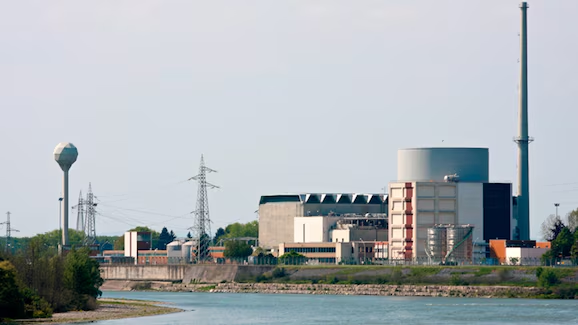
- Enrico Fermi power plant, Trino Vercellese: 270 MWe pressurized water reactor (PWR), operational since 1965
- Caorso power plant, Piacenza: 860 MWe second generation BWR reactor, in commercial operation since 1981
In the 1970s, the energy crisis resulting from the Arab-Israeli conflict caused a surge in import prices for petroleum products, leading the Italian government to issue the first National Energy Plan (PEN) in 1975. This program aimed to strengthen the electronuclear component in the energy mix, providing for the installation of eight new nuclear units on four dedicated sites, as well as the creation of prototypes for innovative reactor chains.
The Three Mile Island and Chernobyl accidents
Two critical events accelerated the decline of Italian nuclear power. On March 28, 1979, the partial meltdown of the reactor core occurred at the Three Mile Island power plant in Pennsylvania (USA): although there were no victims or injuries, there was a limited dispersion of radioactive material into the environment. Two months later, a demonstration in Rome gathered around 20 thousand people, alarmed about the safety of nuclear plants. Furthermore, the US accident indirectly influenced the decision not to restart the Garigliano plant and postponed the start of commercial operations for the Caorso plant.
Despite this, the atomic component also remained a key element of the 1985 PEN, which established the construction of further new nuclear units for an installed capacity of 12 GW by 2000. On 26 April 1986, the Chernobyl disaster, with the explosion of the reactor core and the significant dispersion of highly radioactive material into the atmosphere, profoundly affected Italian public opinion, reviving the debate on plant safety. The subsequent protests accelerated the turnaround in national energy policies and the expansion of the anti-nuclear front.
The referendum campaign was marked by bitter public confrontation. Environmentalist movements and left-wing parties promoted the repeal “YES”, qualifying the referendum as a tool to stop the development of nuclear power in Italy, in order to promote alternative energy sources. Conversely, political and industrial sectors continued to highlight the relevant role of the atomic component for electricity generation.
Results and subsequent implications
Approximately 29.9 million Italian citizens showed up to vote, equal to 65.1% of those entitled to vote. All three questions on nuclear energy exceeded the quorum with the clear prevalence of the abrogating “YES”: 80.57% (question 3), 79.71% (question 4) and 71.86% (question 5). The results were a clear expression of the popular will to stop any development of the national nuclear program. Therefore, as a natural consequence, the definitive stop to the commercial operations of all nuclear power plants present on Italian territory was ordered and the works initially planned for the Montalto di Castro plant were reoriented for the construction of the Alessandro Volta multi-fuel unit. In 1999, SOGIN (Nuclear Plant Management Company) acquired the four former power plants to manage their dismantling, marking the irreversible end of electronuclear production in Italy.