The Hyatt Regency Hotel in Kansas City (the tallest building in Missouri from 1980 to 1986 at 500 feet and over 40 floors) was the scene of one of the most emblematic tragedies in the history of civil engineering. In a matter of moments, a tea party turned into a disaster that left 114 people dead and 216 injured: the deadliest accidental collapse in the United States and – excluding the attack on the Twin Towers on 9/11 – the deadliest disaster in the country’s history. The cause of the accident, which occurred on 17 July 1981, was the collapse of two walkways above the tea party guests: not a macroscopic calculation or design error, but rather an apparently marginal modification during the construction site, carried out on some construction details. It is precisely this aspect that makes the event both unique and worthy of technical study: the modification carried out, which proved fatal, transformed the Hyatt Regency case into a still relevant warning for designers, companies and inspectors. In this article, we trace the history of this hotel, the dynamics of the collapse and the lessons that guide the modern design of engineers and business technicians.
The Story of the Hyatt Regency Hotel: What Happened on July 17, 1981
The Hyatt Regency Hotel opened in July 1980 near Downtown Kansas City, presenting itself as a work of luxury and innovation. The building, with over 40 floors and equipped with a spectacular atrium more than 15 meters high, in fact exhibited a system of open and bright spaces, an architectural paradigm of the time. However, a distinctive element of the construction were some suspended walkways, which crossed the central atrium longitudinally, connecting the upper floors and offering a panoramic view of the area below, almost like small internal bridges.
These lightweight structures were designed exclusively for the transit of guests, but soon became the protagonists of the hotel’s social evenings: during events and parties, the walkways were transformed into entertainment areas, where various numbers of people danced and crowded together. A condition that already put their load-bearing capacity to the test, also aggravated by a hidden error in the construction details.
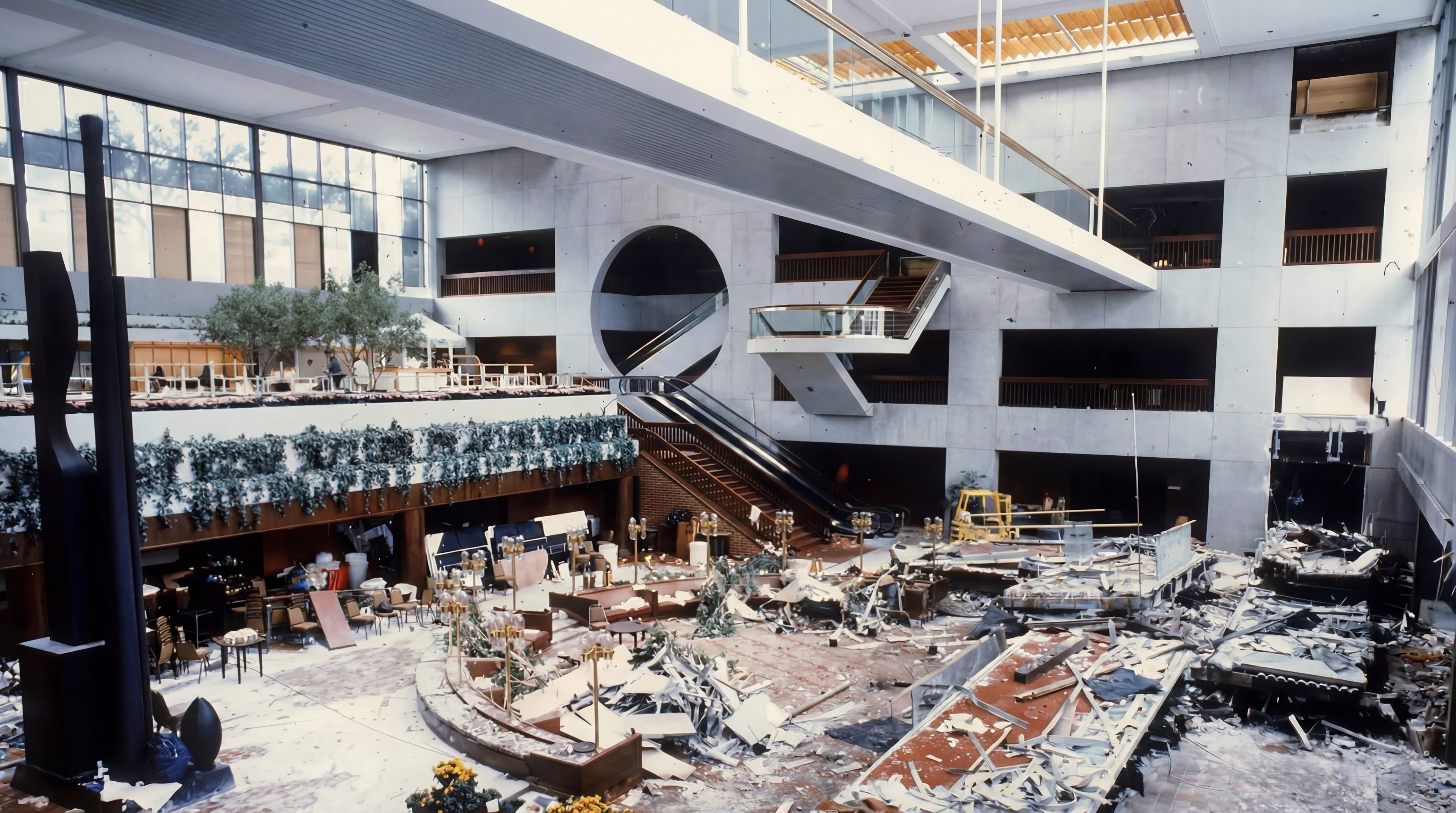
On July 17, 1981, during a dance party, two suspended walkways – occupied by dozens of people intent on enjoying the evening – suddenly gave way, falling onto the crowd below. The toll was dramatic: 114 dead and more than 200 injured. In a few moments, the walkway support system completely lost its load-bearing capacity, triggering a tragic chain reaction: the upper walkway collapsed onto the lower one, which in turn gave way and fell to the ground.
The forensic investigations, conducted in the following months, clarified the cause of the structural collapse: it was not a calculation error, but rather an apparently irrelevant modification made to the construction details of the connections between the beams and the support rods of the walkway. The original project envisaged that the walkways were suspended by a single continuous metal tie rod, which crossed the various levels, allowing the connection of the generic floor beams via bolted joints. According to this scheme, the beams were anchored directly to the vertical tie rods, ensuring structural resistance through appropriately sized bolted connections.
During the construction phase, however, to simplify assembly operations and reduce costs, the company decided to divide the continuous tie rod into two distinct elements, each connected to the walkway beams. This apparently harmless variation had devastating consequences: the load that originally should have been distributed along a single structural element, and then transferred to the tie rod, was now concentrated on the beam of the upper walkway, forced to bear not only its own weight, but also that of the lower walkway. In practice, the connection point underwent a doubling of the stresses, generating an area with a very high concentration of stress in an extremely small space. The connection, designed and sized to support the load of a single walkway, therefore had to guarantee resistance for double the design strength.
Because the collapse happened that very evening
Despite the structural flaw, the system was able to support the permanent loads, i.e. its own weight and that of the finishing touches, for months. The problem manifested itself when the walkways were subjected to overloads: dozens of people, in addition to unloading their weight on the walkway, involuntarily amplified the vibrations by dancing, increasing the dynamic component of the load. In these conditions, the internal stresses increased so much as to lead to the sudden failure of the joints and total collapse, as evidenced by the historic images showing the deformation zone of the beam connected to the tie rod, literally torn due to too much effort.
The collapse of the Hyatt Regency walkways is one of the most cited case studies in structural engineering today, because it demonstrates how a seemingly minor error can have catastrophic consequences. Often, in fact, it is precisely the lack of attention to construction details that generates hidden vulnerabilities. This tragedy also highlights the importance of collaboration between designers, companies and inspectors/testers, especially in the management of variations during construction. Every change, even minimal, must be evaluated with the same care reserved for more significant changes. After the disaster, US regulations were profoundly revised: more rigorous controls on design changes and independent review procedures were introduced, as well as greater professional responsibility required of the actors involved.