Circular (or cyclical) time is a view that events proceed according to eternal and infinite cycles. A mechanism different from the linear one. We are used to thinking of time as a line. Behind us is the past, in front of us the future: the years advance, people “move forward”, societies progress and what has happened cannot come back. Even language betrays this geometry: we waste time, we gain time, we are late or early. Yet, from a sociological point of view, this representation is neither natural nor universal.
Time is not only a physical quantity measured by clocks, but also a social and cultural construction through which human beings organize activities, memory, relationships and expectations. In his “The Anthropology of Time” (1992), the anthropologist Alfred Gell questions precisely the easy opposition between a West dominated by linear time and traditional societies immersed in an eternal cyclical present, in which events repeat themselves as the seasons repeat themselves.
The two forms can in fact coexist: a society can record historical successions and, at the same time, organize fundamental parts of its experience through seasons, genealogies, harvests or recurring rituals. What changes, therefore, is not necessarily the passage of time, but the way in which human beings attribute meaning to it. The question then becomes more interesting: what happens when the past is not thought of simply as something we leave behind, but as something that can return?
When time is cyclical and non-linear: myth, ritual and regeneration
One of the most influential interpretations of cyclical temporality is that proposed by the historian of religions Mircea Eliade in “The Myth of the Eternal Return” (1949). Studying different religious traditions, Eliade observed how certain rituals did not simply serve to remember a past event: through their repetition, they could symbolically reactualize the time of the origins. A celebration of renewal, a seasonal rite or the repetition of a gesture attributed to the gods allowed the community to lead the present back to a founding moment.
The new year, in this perspective, does not represent just another point further along the chronological line: it can become a regeneration, the symbolic possibility of starting over. This is what Eliade describes through the idea of ”eternal return”. His theory was subsequently criticized for its tendency to lump together very different historical and cultural realities under overly broad categories such as that of “archaic” societies.
However, one of his intuitions remains central: repetition does not necessarily mean immobility. A rite can be repeated every year and acquire a different meaning each time, because the people and circumstances in which it is celebrated have changed.
Circular time, therefore, is not necessarily a perfect circle that always returns to the same point: it can rather be imagined as a spiral, in which something returns without ever being completely identical to what it was before.
From hands to human activities: the Neur
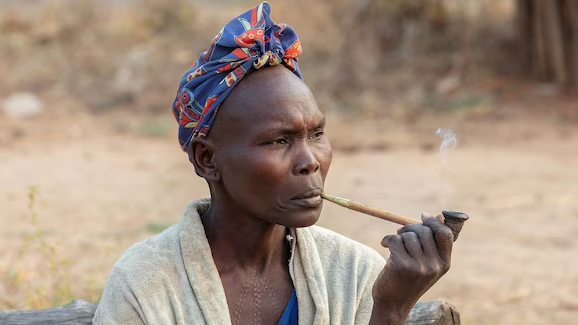
An example that has become classic in the anthropology of the time comes from the work of Edward Evan Evans-Pritchard among the Nuer of present-day South Sudan. In “The Nuer” (1940), the anthropologist distinguishes between ecological time and ecological time and structural time. The first arises from the relationship between community and environment: the alternation of the seasons, the rains, the movement of livestock and the activities necessary for subsistence mark the year.
The second concerns social relations, generations and the organization of groups. What makes this ethnography particularly interesting is that ecological time is not simply described as an abstract, homogeneous quantity that proceeds independently of people: it acquires meaning through what people do. Seasonal variations return and with them certain activities return; the future is therefore partly recognizable because it incorporates already experienced sequences.
Evans-Pritchard explicitly calls this ecological movement cyclical. However, it would be wrong to deduce that the Nuer do not conceive of succession or change: people are born, grow old and change their position in the social structure. Line and cycle can therefore overlap. Above all, the Nuer case shows that the clock is not the only tool through which human beings can organize duration.
A seemingly universal question like “what time is it?” may be less significant than another: what is happening, and what activity is it time to do?
The Maya: cycles within other cycles
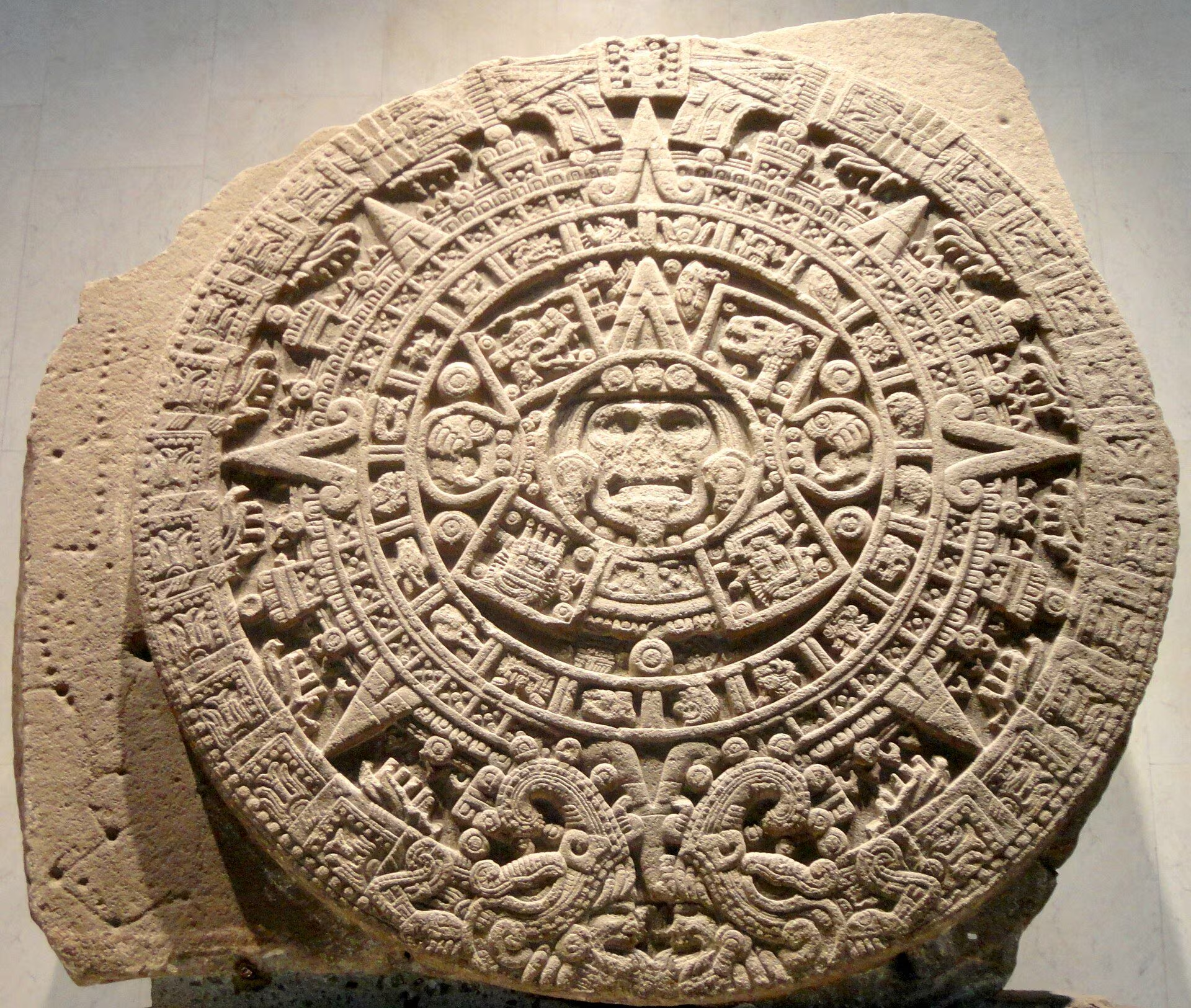
Few civilizations demonstrate the complexity of this relationship better than the Mayan societies. Their time was not simply a circle that began again every year, but a sophisticated system of overlapping calendric cycles, connected to astronomical observation, leisure life, political power and the ritual dimension.
The studies of the archaeo-astronomer Anthony Aveni have shown the complexity of these systems: alongside the 365-day solar calendar there was a ritual cycle of 260 days, while other systems allowed much longer periods to be recorded.
The so-called Long Count, explained in “Aveni, Mesoamerican Calendars and Archaeoastronomy” (2012), demonstrates in fact why it is reductive to simply state that “the Maya conceived time as circular”: events could be placed within extremely extended chronological successions.
Time thus emerges not as a single line or a single circle, but as a plurality of intersecting rhythms. And this is perhaps the most useful image for understanding our relationship with time. Our biography proceeds without being able to go back, but at the same time we live through weeks, seasons, birthdays, anniversaries and anniversaries. Anthropology therefore suggests something more complex than the opposition between “linear” and “circular” societies: human beings build different temporal architectures to make change intelligible. And sometimes, to understand where we are going, we need to return.