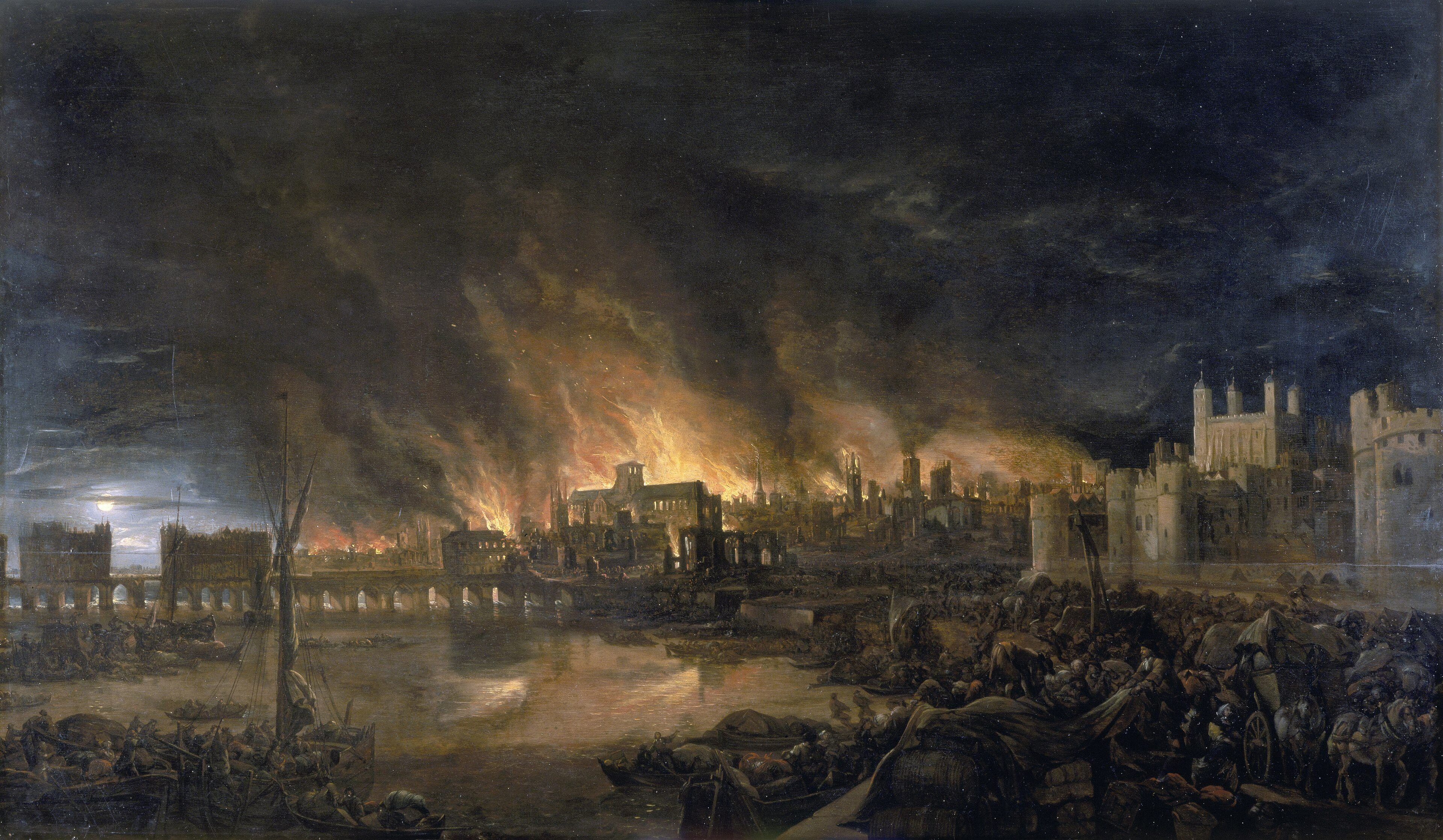
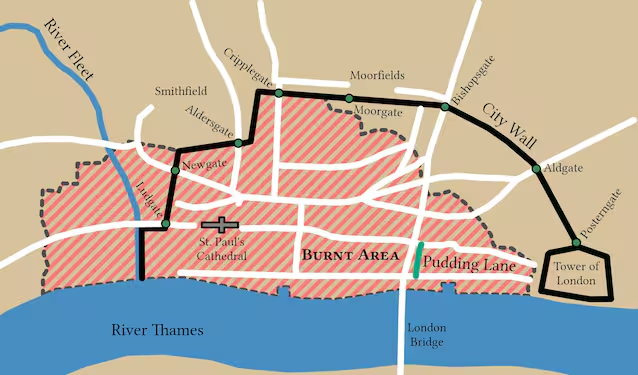
The Great Fire of London 360 years ago was a disastrous fire that occurred between 2 and 6 September 1666 which destroyed part of the capital: it started in the heart of the city, in Pudding Lane, in the house of a baker who had left the fireplace lit, and spread rapidly because many buildings were built with flammable materials, such as wood and straw.
Authorities were unable to act quickly to contain the flames. The fire razed much of the City and a sector of the surrounding area, destroying approximately 13,200 homes, 87 parish churches and 6 chapels.
The number of victims is not known, but is probably between a few hundred and a few thousand. After the fire, London was rebuilt with the same previous urban layout, which still characterizes the city center today.
Why the Great Fire of London broke out: dynamics and causes
In the seventeenth century, at the time of the great fire, the city of London was much smaller than it is today. The oldest and most central part, the City, was included in the walls of Roman origin, next to which stood some other built-up areas, known as the Liberties. Westminster (where today the Parliament and the famous Big Ben are located), was still a municipality in its own right and administratively was not part of London. Even Southwark, the part of the city on the south bank of the Thames was not part of the City.
The number of inhabitants is not known exactly: estimates indicate around 400-500,000 residents, of which around 80,000 in the City. However, in 1665 the city was hit by a very serious plague epidemic, which killed around 100,000 people.
The fire broke out on the night between 2 and 3 September 1666 in the house of a baker, a certain Farrinor (also written Fraynor and with other spellings), in Pudding Lane, in the heart of the City. Farrinor had gone to sleep without putting out the fire and some brands set fire to the wood stacked near the fireplace. The house quickly caught fire. The baker and his family managed to save themselves by climbing out of a window, but one of their servants was trapped: she was the first victim of the great fire.
The flames spread rapidly in the surrounding area, favored by the fact that the buildings were built close to each other and many homes were made of easily flammable materials, such as wood, and had thatched roofs. The climatic conditions also facilitated the flames: the dry summer had made the wood drier and the wind favored the circulation of the fire. The City was thus engulfed in flames.
One of the most vivid descriptions of what happened was written by Samuel Pepys, a civil servant and author of a famous diary, who described the scene on the first day thus:
So I went down to the river bank, and there I took a boat and went under the bridge, and there I saw a fearful fire. Poor Michell’s house, as far as the Old Swan, had already burned in that direction, and the fire advanced further, so that in a very short time it reached as far as the Steeleyard, while I was there. Everyone was trying to move their possessions, throwing them into the river or loading them onto barges moored offshore; the poor people remained in their homes until the fire actually touched them, and then they ran into boats or climbed from one flight of stairs to another along the river bank. And among other things, I noticed that the poor pigeons were reluctant to leave their homes, but hovered around the windows and balconies until some of them burned their wings and fell off.
The response of the authorities and the spread of the flames
The fire spread rapidly, reaching the Tower of London and its surroundings. However, the authorities were unable to act quickly. At the time, the strategy to contain the fires included, in addition to extinguishing them with water, demolishing the buildings around the burning area to create a fire line: this removed the fuel from the fire, preventing it from spreading. However, the Lord Mayor of the City did not immediately order the demolition of the buildings, for fear that the costs of rebuilding would be too huge. The response of other institutions, including the king, Charles II, was also slow. The demolition of the buildings was late and meant that the flames spread for four days, reaching the edges of Whitehall, where the royal palace (which was not burned) was located. The fire only went out on September 6, after having devastated the city for four days.
Casualties and damage
The number of victims of the Great Fire of London is not known with certainty. The official statistics recorded only six deaths, but it is probable that the real figure was much higher: numerous citizens were killed and their bodies were cremated in a “natural” way by the fire. Estimates of victims range from a few hundred to several thousand.
The material damage was enormous. Around 13,200 buildings were destroyed, including numerous churches and Saint Paul’s Cathedral. Overall, 80% of the city was razed.
The reconstruction of the fire of 1666
After the fire, two reconstruction commissions were appointed, one chosen by the king and one by the city authorities. The commissions included famous architects such as Christopher Wren and Robert Hooke. The city was rebuilt on the foundations of the destroyed buildings and therefore the urban plan did not change significantly (despite the fact that it had originally been proposed to re-found it with a new grid system). For this reason, even today the City of London has a “medieval” urban structure. However, the construction material was changed: the city was rebuilt in bricks and stones, less flammable than wood.
Wren also designed a monument in memory of the victims, a tall column, known to Londoners simply as “The monument”, near the place where the fire began: even today, the column reminds Londoners and visitors of the tragic event of 1666.