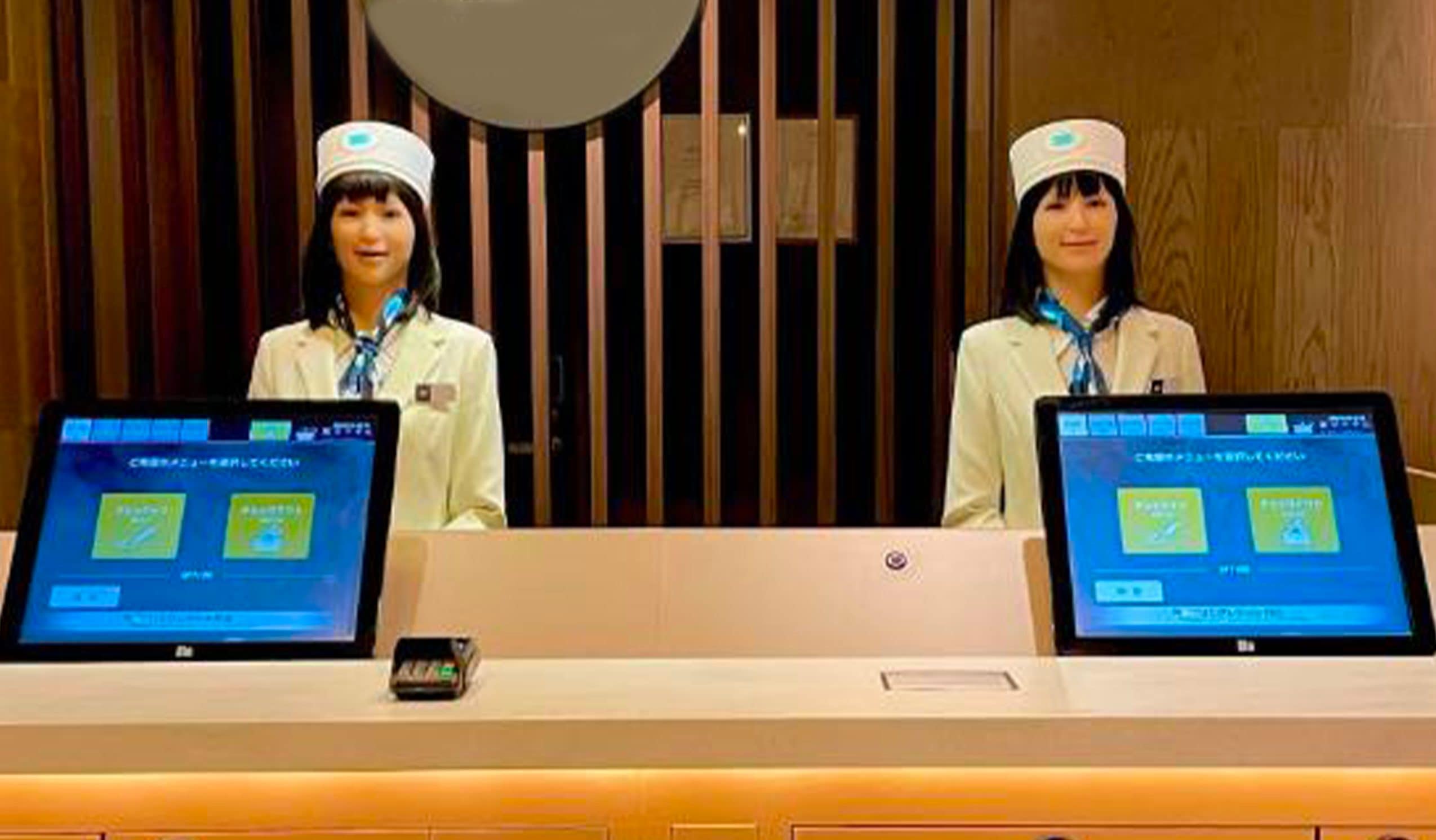
When its opening to the general public was announced, the Henn-na hotel in Tokyo ended up on the front pages of all the sector newspapers. It was in fact the first hotel in the world managed by robots! A revolution in the field ofhospitality which, however, did not give the expected results: soon the tourists began to feel disturbed by these semi-human presences, experiencing first-hand the so-called phenomenon of uncanny valley and forcing managers to partially decommission these androids.
But let’s proceed in order, first looking at when the hotel was built and how it was made.
The birth of the first robot-run hotel: Henn-na in Japan
Henn-na can be translated as “strange” and this fully encapsulates the soul with which this structure was opened. The first branch of this robotic hotel was born in 2015 as part of the Huis Ten Bosch theme park in Nagasaki. Inside, as also reported by the Guinness World Record, there were three robots behind the reception counter.
Consider that the success was such that it pushed the managers to inaugurate other locations, the largest of which opened its doors in Tokyo in 2017, the Henn-na Hotel Maihama Tokyo Bay. And that’s not all: by visiting the various hotels it was also possible to find other types of robots, such as robo-velociraptors, also capable of speaking and interacting with the public, robo-ninjas or even holograms!
However, soon, something broke.
Because the hotel fired many humanoids
Although at first it seemed like a fun and curious commercial gimmick, many of the tourists began to experience a phenomenon called “uncanny valley”. This term refers to everything that has an appearance rather similar to ours, to that of the human being, but which at the same time has something slightly different. Well, that small difference is often perceived as disturbing, creating discomfort and repulsion in the viewer.
We can compare it to that subtle anxiety that pervades us when we look at a porcelain doll that is a little too realistic.
Precisely for this reason many tourists began to doubt the validity of this choice, criticizing the androids but – on the contrary – defending the velociraptors. In fact, these are not included in the uncanney valley they were perceived as nice and funny.
This, combined with constant maintenance and their inability to answer some customer questions, pushed the managers to adjust the aim, not completely removing the robots from service but reducing their number. Of the 243 androids in service, 123 were sent into “early retirement”. The shortcomings, of course, were replaced by human personnel.
What seemed like an idea doomed to failure, however, found new life the following year.
The trend reversal
In 2020, Covid-19 revolutionized the way we relate to others, leading billions of people around the world to avoid direct contact with others. From this perspective, you understand well how a structure operated (at least partially) by robots is able to guarantee high safety standards, while still managing to provide a high level of customer service. But not only that: the presence of androids allows the owners to have lower costs than a traditional structure, thus giving tourists the opportunity to stay in the city at rather competitive prices.
This mix of factors, especially during and after the pandemic, has allowed the chain to expand to open more than 20 locations around the world. Below is a short video showing the inside of one of these structures.
Little curiosity: in addition to having received the Guinness World Record for being the first hotel managed by robots, the Henn-na chain was also awarded for the highest number of themed rooms in collaboration with brands: there are 44 of them!