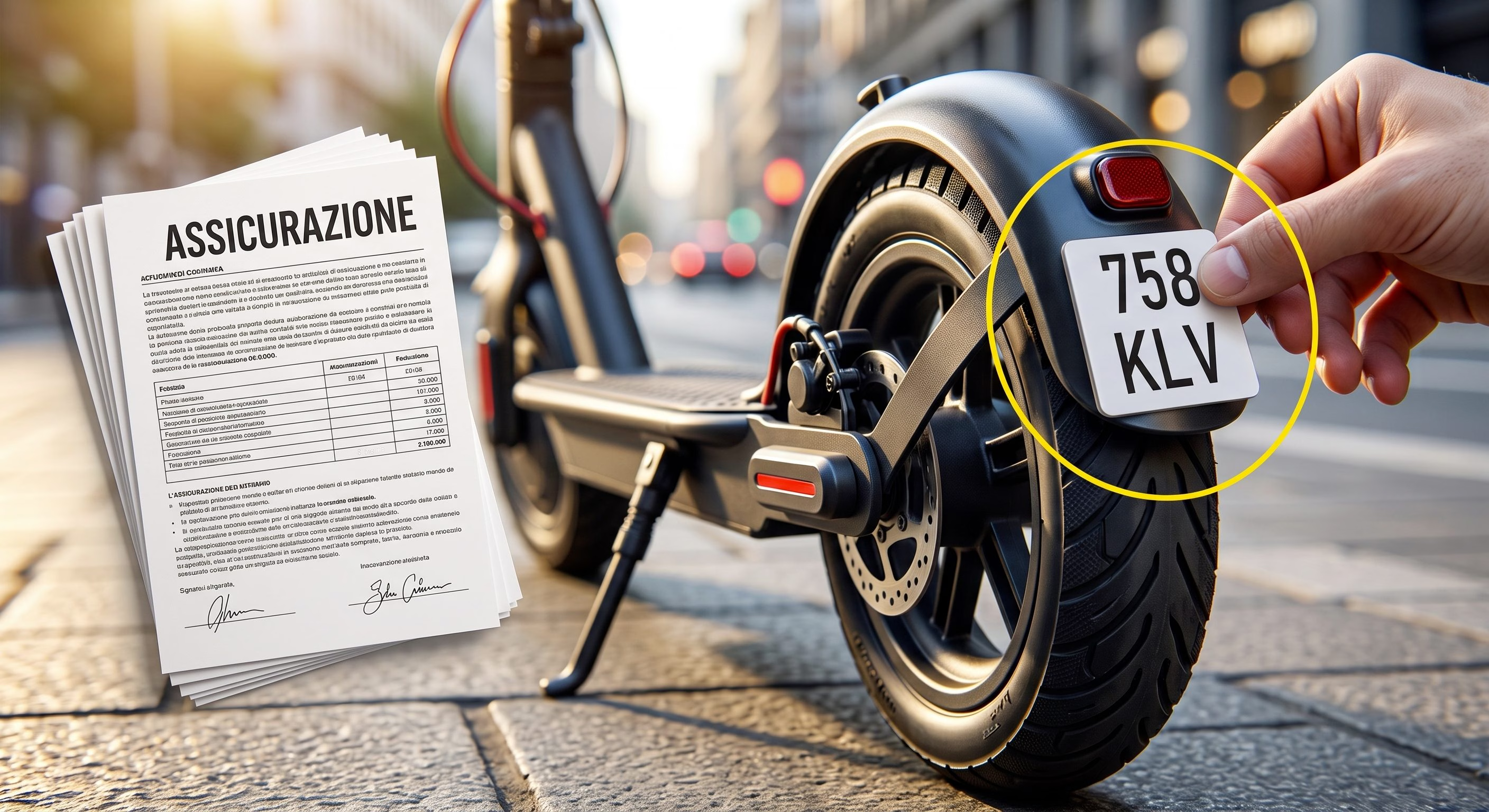
From today, Thursday 16 July 2026, the obligation to have insurance coverage for electric scooters comes into force, according to the latest compliance with the new Highway Code. These vehicles, after the two-month extension defined by the government, will no longer be able to circulate unless covered by civil liability insurance provided by law for damage caused to third parties, the same as provided for by article 2054 of the Civil Code for other vehicles.
The obligation, introduced by law no. 177 of 25 November 2024, will affect approximately one million private scooters, to which will be added those available for rent in the larger cities. To be valid, the vehicle must also have displayed the code of the identification mark mandatory from 16 May 2026, i.e. the mini-plate, the only element that allows the vehicle to be associated with its owner. The costs for owners will be between 35 and 55 euros, with fines of 100 to 400 euros for anyone caught without an insurance policy.
As underlined by Assoutenti, therefore, the so-called family policies will not be enough, but third party liability insurance is required, i.e. coverage for damage caused to other people or things while riding the scooter.
How compulsory insurance for electric scooters works
The insurance can be taken out by any adult, while for minors who are over 14 years old (which is the minimum age for the use of electric scooters), the application must be submitted by a parent. Subscription can be done online or in an agency, with numerous insurance companies having launched specific coverage for these vehicles. As we explained at the beginning, before signing the contract it is essential to have obtained the mark, i.e. the mini-identification plate: without that code reported in the policy, the coverage is not considered valid for the purposes of the new obligation. The code must be communicated to the chosen insurance company, which will use it to issue the policy.
The legislation also provides that “there will not be, at least for the first two years, the direct compensation system”. In other words, insurance protection will be there from day one, while the fast track to compensation will arrive only after a period of observation in which real data will be collected on accidents caused by scooters, and on the related compensation costs, and consequently a “flat rate on a national basis” will be built.
In the meantime, “for road accidents caused by scooters, the ordinary compensation procedure provided for by article 148 of the insurance code will be applied and the injured party will have to request compensation from the insurance company of the civilly liable party and not from his own company”.
How much does the policy cost and what those who don’t comply risk: fines
An insurance policy for an electric scooter can have an average cost of between 35 and 55 euros: only if you add accessory elements, guarantees or other coverages can the cost rise to around 150 euros per year. What is certain is that for those who do not pay and do not comply with the new rules, the consequences are much more costly, since from 16 July anyone caught driving an electric scooter without insurance coverage risks an administrative fine of 100 to 400 euros.
A different matter applies to scooters sharingfor which coverage must be guaranteed by the relevant rental company.
All the other innovations of the Highway Code: helmet, license plates and speed
The growing diffusion of these means of transport has made a whole series of regulations relating to traffic necessary, above all for a question of safety for drivers, pedestrians and motorists. A path started by the new Highway Code which has redesigned the rules for electric micromobility and which, as of today, provide for the obligation to wear helmets for all drivers, as well as the identification mark (the mini-plate mandatory as early as 16 May).
Added to this are circulation, which is restricted to urban streets with a limit of up to 50 km/h, with a maximum speed of 20 km/h which drops to 6 km/h in pedestrian areas, and the ban on parking and circulation on pavements, extra-urban roads or against traffic. Furthermore, the vehicles must be equipped with indicators and brakes on both wheels, while it is forbidden to transport passengers, animals or objects, or modify the vehicle to increase performance.
Finally, to travel on the road, scooters must have a maximum power of 500 Watts (0.5 kW).