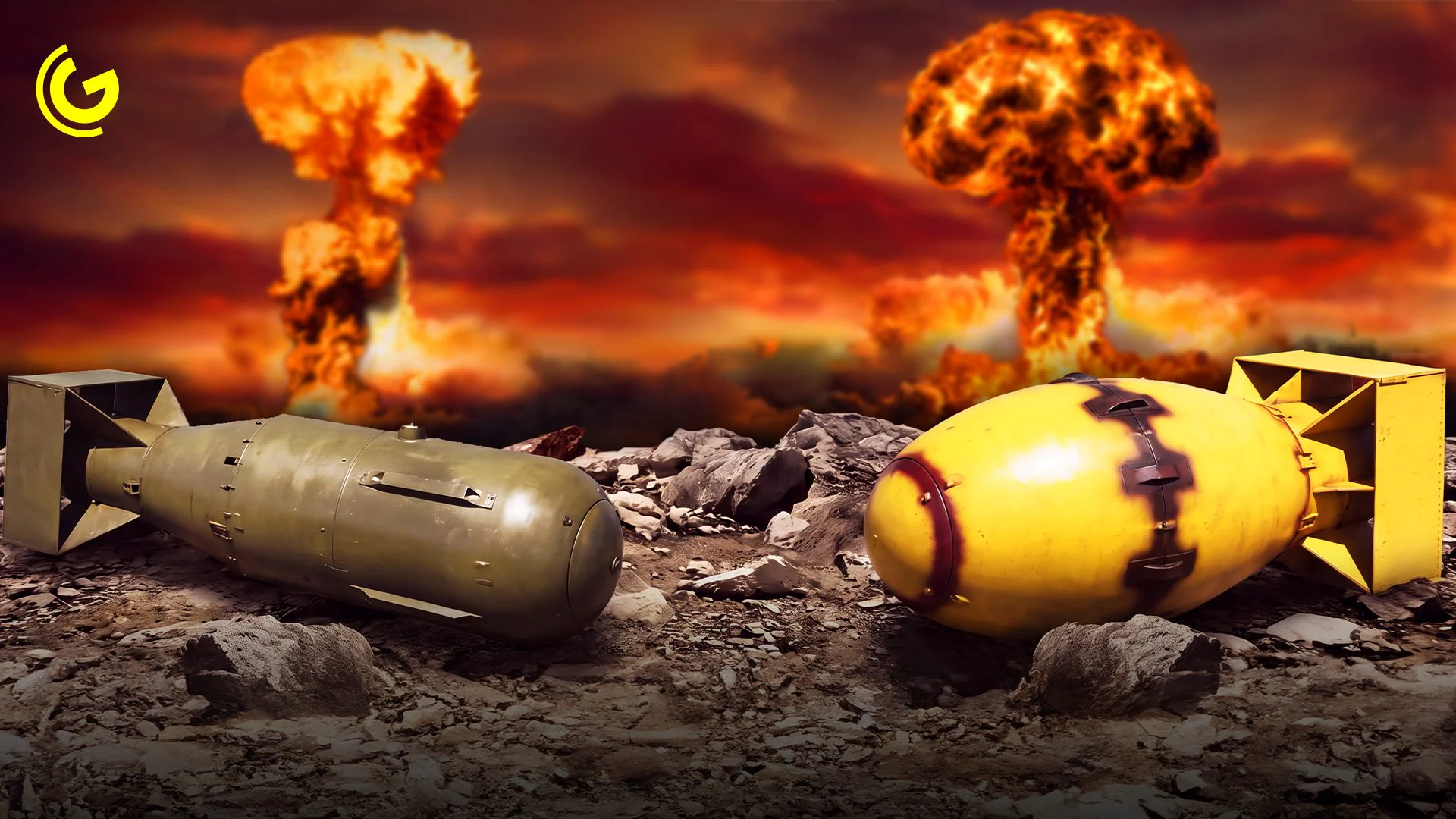
On August 6, 1945, the United States, on the orders of Harry Truman, dropped the first atomic bomb on Hiroshima, and just three days later dropped another on Nagasaki, causing a total of more than 214 thousand victims. This tragic choice – responsible for over 214 thousand victims – was made to force Japan to immediately surrender, avoid a bloody land invasion and demonstrate its supremacy of power at the end of the Second World War. But what exactly happened in those hours, during the first nuclear attack in history? Today we retrace step by step the sequence of events which, from the take-off of the B-29 Superfortresses, led to the destruction of two entire cities.
Hiroshima, August 6, 1945
2.45 am. From North Field airport, on the island of Tinian in the middle of the Pacific Ocean, the B-29 Superfortress bomber renamed “Enola Gay” – which was the name of the mother of the commander, Colonel Paul Tibbets – takes off. In the belly of the plane there is Little Boy, a uranium atomic bomb, and together with the Enola Gay two other scientific observation B-29s called “the great artist” and “the necessary evil” take off, both loaded with measuring instruments and photographers.
3.10am. Captain William Parsons, technical manager of the armament, descends into the bomb bay in flight and completes the arming of the bomb by inserting the propelling charges. The choice to do it in flight – instead of on the ground before take-off – was a precaution: if the plane had crashed on take-off, as had already happened in the past with other B-29s, an already armed bomb would have caused a catastrophe on the island itself.
7.30am. About two hours from the target, Tibbets takes the intercom microphone and speaks to the crew for the first time about the true nature of the mission. It says “We are carrying the world’s first atomic bomb.”
8:09 Hiroshima time. The air raid alarm sounds in the city. People take refuge in shelters. A few minutes later, however, the alarm goes back: the radars detect only three planes, interpreted as routine meteorological reconnaissance. People return to the streets, to the factories, to the schools. Meanwhile, the Enola Gay flies at 9,600 meters above sea level.
8:14 and 30 seconds. The bomber opens the bomb bay. The aimer identifies the target: the Aioi bridge, in the center of the city, recognizable by its characteristic T shape.
8:15 and 15 seconds. The radio link screams “Bomb away.” Little Boy is unhooked. The Enola Gay, lightened by nearly five tons, shoots upward and immediately makes a full-power 155-degree evasive turn to get away as quickly as possible.
8:16 and 02 seconds. Forty-three seconds of free fall. At about 600 meters above the hospital – slightly offset from the Aioi bridge due to the wind – the bomb’s barometric sensors detect the pre-established altitude and trigger the detonation. In a tenth of a second, a fireball almost 300 meters in diameter is formed. The temperature on the ground instantly reaches 4,000 degrees Celsius – enough to melt granite. People within a radius of half a kilometer from the hypocenter are literally vaporised: only a shadow remains of them imprinted on the asphalt or concrete walls. Then comes the shock wave at over 1,500 kilometers per hour, which razes almost all of the city’s wooden buildings. The mushroom cloud rises over the city, visible from hundreds of kilometers away.
From the Enola Gay, co-pilot Robert Lewis writes in his logbook: “My God, what have we done?“.
Three days later, however, the Americans demonstrated that this was not an isolated event. They were ready to drop Fat Man too. And this is also why, on that 9th August, Nagasaki was also razed to the ground.
Nagasaki, August 9, 1945
3:47 am. Another B-29, the “Bockscar”, commanded by Major Charles Sweeney, takes off from the same military base as the Enola Gay with Fat Man on board – the second atomic bomb, plutonium. The primary target, unlike what we might think, is not Nagasaki but Kokura, an important arsenal city in the northern part of the island of Kyushu.
Local time 9:44. The Bockscar arrives at Kokura after a flight complicated by technical problems with the reserve fuel pump. But the city is shrouded in haze and smoke from an incendiary bombing carried out the day before on a nearby city. The pilot makes three passes over the city without being able to see the target visually, as required by the protocol. Meanwhile, the Japanese anti-aircraft guns begin firing and the first enemy fighters appear.
10.32am. The Bockscar is dangerously low on fuel – it only has enough to reach one alternative objective. The decision is dramatic: we turn towards Nagasaki, the only achievable secondary objective, 150 kilometers further south. Kokura is saved by a cloud, so much so that even today the Japanese say “Kokura’s luck” to describe an escape from danger.
10.58 am. Nagasaki is also partially covered in clouds. However, a few seconds into the available time window, a hole opens in the sky.
11.02am. Fat Man is dropped, more than 2 kilometers from the ideal aiming point. It explodes at about 500 meters above sea level in the Urakami industrial valley. The 21 kilotons are released. The valley’s hilly topography partially contains the devastation, preventing the shock wave from spreading freely across the entire city… But half of Nagasaki is still wiped out.
The historical consequences of the attacks
Describing what happened in the hours and days following the attacks on Hiroshima and Nagasaki is the most difficult part. In Hiroshima, at the moment of the explosion, between 70,000 and 80,000 people died instantly. In Nagasaki about 40,000. By the end of 1945, considering those who died of wounds, burns and radiation, the death toll rose to approximately 140,000 in Hiroshima and 74,000 in Nagasaki. More than 90% were civilians. In total, over 214,000 deaths.
The doctors in the few hospitals left standing operated without medicines, without equipment, in makeshift tent cities. And they began to see something they had never seen before: crazy symptoms in the survivors. People who from the outside seemed unharmed – far from the hypocenter, without visible burns – began to become seriously ill within hours or days. Violent nausea, continuous vomiting, high fever, spontaneous bleeding in the gums, collapse of white blood cells. And then that symptom that terrified people more than any other: massive hair loss, in entire strands, in a few days. That was acute radiation syndrome, caused by exposure to ionizing radiation, capable of penetrating tissues and damaging the DNA of cells.
Whoever survived all this was called Hibakushawhich in Japanese literally means “person affected by the explosion”. For decades they continued to pay the price: an enormously higher incidence of leukemia in the following 5-10 years, then of solid tumors – thyroid, lung, breast – throughout their lives. And then a very heavy social stigma: many Hibakusha hid their condition for fear of being discriminated against in work or marriage. On August 15, 1945, Emperor Hirohito spoke to the nation by radio for the first time in history, in a speech broadcast in Japanese so formal and archaic that many citizens struggled to understand it. It declared acceptance of unconditional surrender, and on September 2, 1945, Japanese delegates signed the surrender documents on the battleship USS Missouri, anchored in Tokyo Bay.
World War II was officially over.