Pick up packages in the warehouse, answer the phone for a call center, manage a team in the office, select resumes or deliver food to your home. They are very different jobs, with different levels of education and income, however, today they have one element in common: in all these sectors, a part of the decisions that concern workers is taken by an automated system. A faceless system, without an office and whose logic often escapes direct understanding. Is called algorithmic management – algorithmic management in English – and, most likely, it is already influencing your workplace too.
We are not here to crusade against technology. A human manager is not automatically better than an algorithmic system: people are influenced by likes, unconscious biases (gender, age or origin) and passing moods. Often, a software can evaluate much more fairly, reduce discrimination in personnel selections or distribute shifts more efficiently. The problem is not the challenge between man and machine, but the difference between a power exercised with transparency and one practiced in absolute opacity.
The numbers in Italy and the 5 levers of control: 76% of companies are managed by algorithms
If you think that having an algorithm as “boss” is an exclusive prerogative of riders or logistics, you are wrong. According to an OECD survey of more than 6,000 managers published in 2025, algorithmic management is widespread everywhere. In Europe the adoption average is 79%, and in Italy we are at 76%. Three out of four companies in our country already use personnel management software: 64% use them to assign tasks, 67% to monitor employee activity and 27% to evaluate actual performance.
Despite the great variety of uses, the structure of this software is almost always based on a five-lever mechanism. It starts with theassignmentin which the system decides who does what, when and for how long. Then someone takes over monitoring constant, where every digital breath, click or pause produces recorded data. All this data comes together in one assessmenti.e. a score that is often not entirely transparent to the employee. To boost productivity we use gamificationusing logic similar to that of video games (badges, challenges, levels). Finally, the last step is the automatic sanction: suspensions or reductions applied directly from a notification, without listening to a human counterpart.
Sectors and jobs most affected by algorithmic management: how it works from logistics to HR
But who is already working under the lens of an automated system? The map is larger than expected:
- Logistics and warehouses: this is the best known case. The system tracks package picking speed, breaks and production quotas. Those who do not keep up receive automatic notifications which, in the most extreme cases (as emerged from various documentary investigations), can lead to dismissals without any real human intervention.
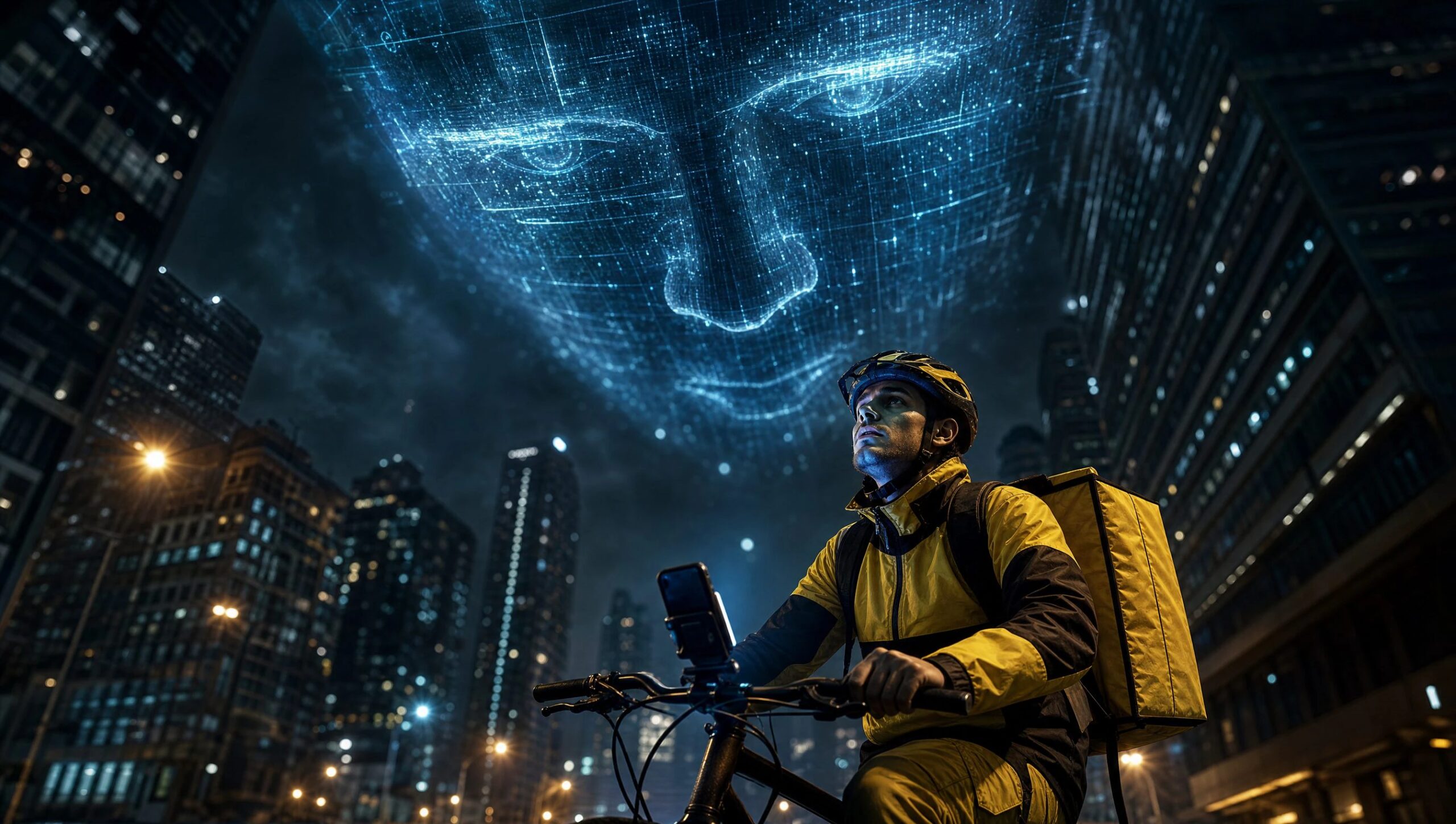
- Delivery and transport (riders and drivers): the algorithm assigns rides, sets fares, calculates an invisible score and decides to deactivate the account, often for reasons beyond human control (such as traffic or closed gates).
- Call centers: the software transcribes conversations in real time, analyzes the tone of voice and calculates a customer sentiment score. The system evaluates the operator’s “empathy”, but completely ignores the context of a particularly difficult call.
- Human Resources (HR): CV selection is now automatically filtered. The risk? Sensational biases. In 2018, a tech giant had to withdraw its algorithm because it systematically rejected women: the software had trained on historical archives in which the candidates hired in the past were almost all men, learning and amplifying human prejudice.
- Management and office work: The algorithm also checks who it should check. The systems of workforce analyticss monitor emails, meetings and collaboration rhythms, returning data dashboards to managers. The risk is that an employee who sends a lot of emails appears “active”, while one who produces excellent quality work without continuous digital interactions appears “not very involved”.
- Healthcare: Systems assign shifts or priorities in waiting lists. In 2019, the magazine Science revealed how an American hospital algorithm tended to underestimate the needs of African-American patients, having trained on healthcare spending histories that reflected unequal access to care.
- Journalism and publishing: It’s not just AIs that write articles. The algorithm of social networks or sites analyzes metrics in real time and effectively dictates the editorial line, rewarding the contents that generate traffic and burying the others.
What the law says in Italy and Europe to protect workers
Regulations struggle to keep up with technology. At a European level, the new Platform Work Directive (in force from December 2024 and to be implemented by the end of 2026) introduces the presumption of employment for those subject to strong algorithmic management. In Italy, the Transparency Decree of 2022 obliges companies to inform employees about the use of automated systems that concern them. However, this is only an information requirement. There is still no real right to obtain an understandable explanation as to why the algorithm made a certain decision; there is no requirement for human supervision for serious sanctions and, above all, there is a lack of controls (audit) independent on the codes of these software.
In conclusion, algorithmic management is not science fiction, but the present of millions of workers. The problem is not the software itself, but the opacity with which it is used. The big question we must find an answer to, before it is too late, is only one: Who has the right to understand how the system works, and who has the power to change the rules when it becomes unfair? Of course, the algorithm won’t tell us.