
The oldest geometric decorations created by have been identified Homo sapiens known to date, dating back to between 64,000 and 59,000 years ago. As reported by the new study conducted by the University of Bologna in collaboration with La Sapienza University of Rome, these are some engravings found on fragments of ostrich egg shells, found in three different sites in Southern Africa – between South Africa and Namibia – and characterized by crossed lines and lattices, organized in coherent patterns.
The finds belong to the so-called Howiesons Poort Culture, an expression of the populations who lived in Southern Africa at the end of the Middle Paleolithic, around 60,000 years ago. At three sites, two in South Africa and one in Namibia, 112 fragments of ostrich eggshells were found, featuring different sets of incisions. The study, led by Valentina Decembrini of the University of Bologna, demonstrated that these were not random. The incisions would have been made deliberately, marking them as the first Homo sapiens already possessed cognitive abilities capable of leading to the creation of geometrically and spatially complex shapes and patterns.
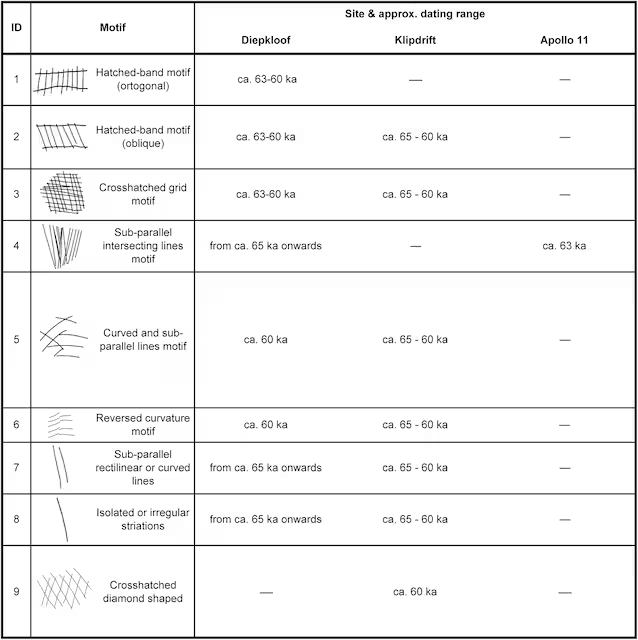
The fragments of the shells (in Africa ostrich eggs have been used as containers for water since the Middle Paleolithic, and some communities still use them for this purpose) were first subjected to digital tracing of all the motifs, and then to scrupulous geometric, spatial and statistical analyses, which allowed the identification of shapes and patterns recurring, as well as their incidence in the sample analyzed. Curves and angles were taken into account, but also elements such as parallelism, the spacing between incisions, repetitions and variations of a certain pattern.
Statistically, approximately 79% of the engravings analyzed are made up of straight lines, characterized by a strong presence of parallel signs. Furthermore, 90° angles are much more frequent than they would be if the incisions were random. Considering these elements, it is very unlikely that the engravings on the shells were not made intentionally. The decorations would therefore have been carried out deliberately, by individuals who already possessed advanced cognitive abilities, capable of generating complex geometric and spatial thought, already 60,000 years ago.