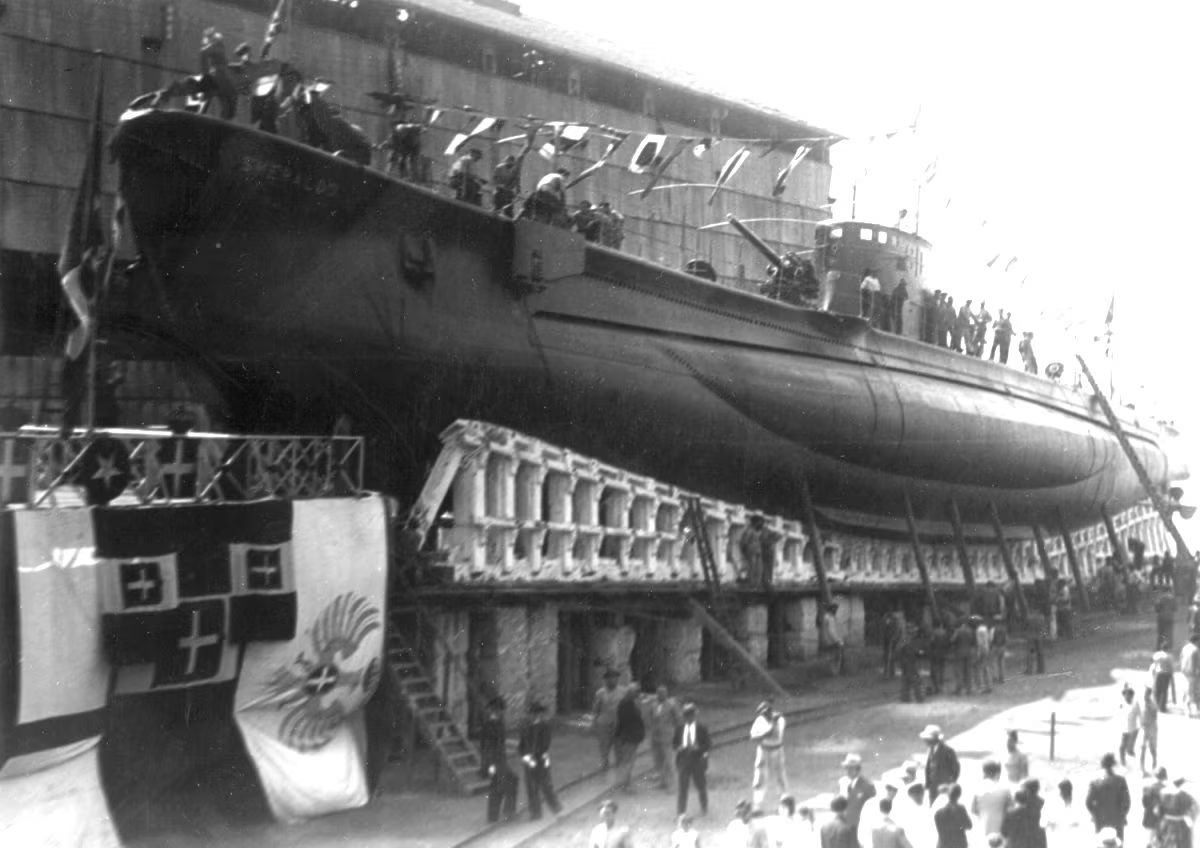
Among the wrecks of the submarine cemetery discovered off the coast of Tunisia there could also be the Emerald submarinean Italian Royal Navy vessel that vanished into thin air during the Second World War.
The Smeraldo, a Sirena class submarine launched in Taranto in 1933, sank in September 1941 with 45 men on board, for reasons still unknown. During that last mission it was supposed to attack a British convoy, but never returned to base. Yet, Royal Navy records do not report any sinking of an Italian submarine in that period, which is why historians believe the submarine disappeared due to a mine.
How the Emerald of the Royal Navy was made
The Emerald belonged to the “600” class (Siren class, specifically) and almost 60 examples of this type were built. They were in fact an important underwater component for the Royal Navy in the Mediterranean Sea. It should be specified that this was a coastal submarine, therefore designed for rapid ambushes and maneuvers in the Mediterranean basin, but not for long ocean cruises.
It was just over 60 meters long and less than 6 and a half meters wide, and used two Tosi diesel engines which allowed it to reach a maximum speed of 14 knots (about 26 km per hour). Underwater, however, it used two Magneti Marelli electric motors with a total of around 800 horsepower, which pushed it up to 7.5 knots (around 14 km per hour).
Its strong point lay in its 6 533 mm torpedo tubes (4 at the bow and 2 at the stern), supported by a reserve of torpedoes on board. But not only that: the Smeraldo also had a 100/47 mm cannon and twin 13.2 mm machine guns for air defense on the main deck.
The 45 men on board certainly did not lead an easy life, given that they had to share narrow spaces, with the air spoiled by combustion fumes. But however inconvenient it was, it was an essential means for Italian military history: in fact, it was from the Emerald that the first torpedo launched by an Italian submarine of the Second World War was launched.
The history of the submarine and the last mission: the bottleneck of the Sicilian Channel
After the launch in 1933 and the training period, the Smeraldo was stationed in Taranto and, from 1935, passed to the submarine squadrons based in Messina.
Even before the Second World War, however, he clandestinely took part in the Spanish civil war, with a single mission between 25 August and 6 September 1937 in the waters of Cape Palos (south-eastern coast of Spain) which ended without results.
When Italy entered the war, on 10 June 1940, the Smeraldo was in Tobruk, Libya, and set sail on its first mission: on the night of 11 June it was the first Italian submarine to launch a torpedo in the conflict, even if the shot missed due to the rough sea.
A few weeks later it was located by some British destroyers, and it was then that it survived one of the toughest hunts ever suffered by an Italian submarine: it was hit by around 200 depth charges, suffering serious damage. Yet, it didn’t sink.
The attack forced the submarine to continue at a deep altitude and at minimum speed, to escape the Allied sonars. Finally, it resurfaced and, despite serious damage, continued towards Tobruk.
Having arrived at the Libyan base, the damage to the hull and equipment soon proved to be too extensive for the local shipyards, and so the Emerald was transferred to Sicily, to the Augusta Arsenal, where it would spend the next five months carrying out all the necessary repairs.
Once recovered, he returned to sea for other missions between Egypt, Malta and Crete, all without results.
Finally, the Emerald cast off the city of Augusta for its sixteenth (and, unfortunately, last) mission on September 15, 1941. The destination? The sea along the Tunisian coast (west of Malta), where he would have ambushed British convoys.
The Strait of Sicily was then a very dangerous place to cross, given that it was guarded by Allied anti-submarine fighters and dotted with extensive mine barrages.
To escape enemy radio direction finding, strict radio silence was necessary: the Italian Supermarina therefore did not receive any signals, so as not to betray the position.
On September 26, however, the submarine was supposed to return, and did not reappear at the base. It was therefore clear that something had happened, and the Emerald was officially declared lost at sea, and with him the commander Bartolomeo La Penna and the entire crew of sailors.
How it could have sunk and the alleged discovery after 80 years in Tunisia
Having no source or SOS to refer to, the end of the Emerald was reconstructed through the hypotheses of naval historians by comparing theoretical routes and war bulletins of that era.
According to the most accredited hypothesis, the submarine would have hit a naval mine. The waters through which he had passed, in fact, were dotted with defensive mine barriers laid by the British and French. It didn’t take much to blow up: if the submersible hit a mine moored under the water, in fact, the shock wave would tear it apart instantly, and flooding was a matter of a matter of seconds.
In 2018 the Belgian diver Jean-Pierre Misson, who has been conducting explorations of the southern Mediterranean seabed for years using sonar and acoustic systems, announced the discovery of a series of military submarine wrecks at around 70-90 meters of depth off the coast of Tabarka.
On 1 November 2026, a TG1 report returned to this very story: among the carcasses, in fact, there was also that of the Emerald, together with eight British submarines. The identification, however, is not yet confirmed, and a direct inspection of the wrecks will be needed to know for sure whether the unforgotten submarine is among the wrecks.