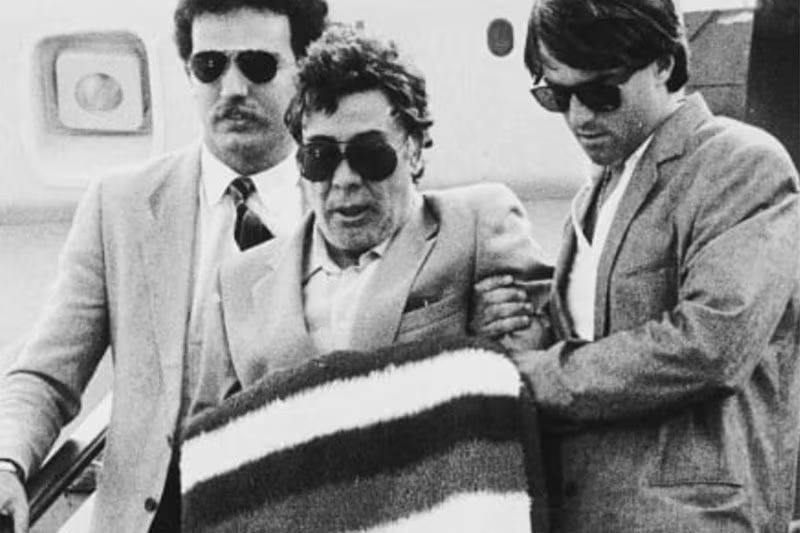
Tommaso Buscetta, born in Palermo in 1928 and died in Miami in 2000, was a mafia boss and collaborator of justice. He began his criminal career as a young man, alternating periods of stay in Sicily with experiences in Argentina, Brazil and the United States. He therefore earned the nickname “boss of two worlds”. Close to the defeated faction in the second mafia war, he suffered heavy retaliation from the Corleonesi, who killed numerous of his relatives. The boss took revenge, they became the first and most important justice collaborator of Cosa Nostra, revealing to the judiciary how the organization worked. His statements allowed numerous arrests to be made and were the basis of the Palermo maxi-trial. Buscetta lived in a protected location in the United States until 2000, when he died of cancer at the age of 71, under an assumed name.
Who was Tommaso Buscetta: the beginning of his criminal career
Tommaso Buscetta was born in Palermo on 13 July 1928. He belonged to a family of glassmakers and was the last of 17 brothers.
From a young age he showed a propensity for crime. During the Second World War (when the sale of many products was rationed), he was involved in crimes related to the black market and the counterfeiting of ration cards. In 1943, however, he fought against the Germans in Naples. Returning to Palermo, he got married at just 17 years old after a “fuitina” with his girlfriend, Melchiorra Cavallo. The following year he was “officially” affiliated with Cosa Nostra. He began to be called “Don Masino” and treated with deference. However, he also tried to work as a glassmaker and was first employed in a company in Turin and later, upon returning to Palermo, in his father and brothers’ company. Between 1948 and 1952 he lived in Argentina and Brazil, where he opened successful crystal factories.
The rise in Cosa Nostra, the fugitive and the arrest
In 1952 Buscetta returned to Palermo and opened a glass factory in Termini Imerese together with one of his brothers. However, he also resumed his place in Cosa Nostra, dealing with cigarette smuggling in the service of the boss Gaetano Filippone. Buscetta was also one of the main supporters of the foundation of the commission, that is, the body, composed of the main bosses, responsible for coordinating illegal activities. The commission was established in 1957, but “Don Masino” did not become part of it. Instead, he came to light as a ruthless killer and was involved in the first mafia war, which took place between 1962 and 1963.
Having become a fugitive, he took refuge abroad: first in Switzerland, then in Canada and the United States, where he opened a pizzeria. His main occupation, however, was drug trafficking. He found himself in a complicated position also from a personal point of view, because he had two families, one unaware of the existence of the other: one with his lover Vera Girotti, with whom he had had a daughter, and the other with his wife, who had given him four children. At the end of the 1960s he also began a relationship with another woman, Maria Cristina de Almeida Guimaraes, who would become his third wife and be by his side until his death.
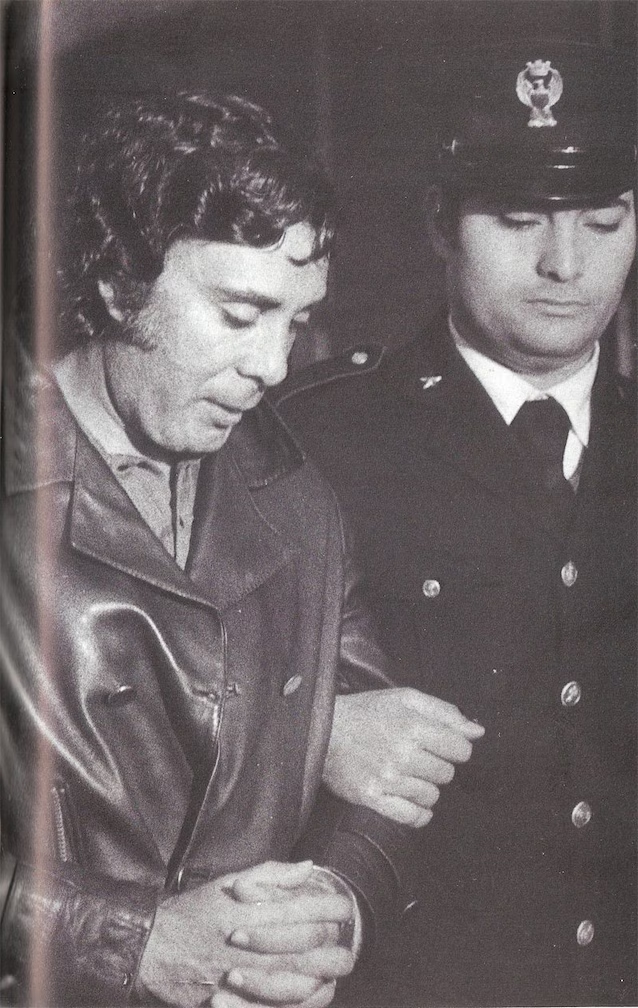
In 1968 Buscetta was sentenced in absentia to 10 years’ imprisonment in the trial against the mafia held in Catanzaro (he was one of the few defendants convicted). Nonetheless, he continued to manage his trade and stayed in Sicily several times under a false name. In 1972 he was arrested in Brazil and extradited to Italy, where he served eight of the ten years in prison that had been imposed on him.
The second mafia war and the extermination of relatives
Buscetta was released from prison in 1980. In the same period the second mafia war began, during which the Corleonesi, led by Totò Riina, exterminated the rival families. Buscetta did not personally participate in the war, but, being very close to the defeated factions, in particular the Bontade and Inzerillo families, he came into the sights of the Corleonesi. They were unable to eliminate him because he was in Brazil, but between 1982 and 1984 they killed numerous of his relatives: two sons (who disappeared and were never found), a brother, a son-in-law, a brother-in-law and four nephews.
In 1983 the Brazilian police managed to arrest Buscetta. Taken to Brasilia prison, the boss was joined by Giovanni Falcone, who intended to convince him to collaborate with justice. The boss was hesitant and, while he was being extradited to Italy, he attempted suicide by ingesting poison. Once in Italy, Buscetta decided to collaborate: it was the only way to take revenge on the Corleonesi. The boss did not consider himself a repentant and believed he was still a “man of honor”; according to him, it was Riina who betrayed Cosa Nostra, transforming it into an organism at his personal service, very different from what it originally was. Also for this reason, it would be more correct to speak of a “collaborator of justice”, given that Buscetta decided to collaborate with the judiciary without actually regretting his criminal life.
The revelations to Falcone and the maxi-trial that began in 1986
Starting from July 1984, Buscetta was repeatedly interrogated by Falcone, to whom he revealed in detail the functioning of the Sicilian mafia. At the time, the judiciary and the police knew very little about the mafia and were even unaware of the name, Cosa Nostra, with which the members called the organization. Buscetta explained how the organization was structured, what the families were, how the dome worked; it also shed light on the main murders committed up to that point and on the role of the Corleonesi in the mafia war. According to Falcone, the repentant provided the judiciary with a language to understand a then unknown world. Buscetta, however, refused to make revelations about the relationship between the mafia and politics, claiming that he would not be believed.
His revelations, although partial, constituted a turning point in the fight against the mafia. The judiciary was able to issue hundreds of arrest warrants. Furthermore, on the basis of the revelations of Buscetta and other repentants, the maxi trial was held between 1986 and 1992, which allowed the conviction of numerous mafiosi. Buscetta was called to testify during the first instance hearing and, in a climate of great tension, confirmed the statements made to Falcone during the preliminary investigation phase.
The last years and death of Buscetta
After the maxi trial, Buscetta lived in a protected location in the United States. In 1992, after the Capaci and Via D’Amelio massacres, he decided to also make revelations of a political nature and accused Salvo Lima and Giulio Andreotti of collusion with the mafia (Andreotti was tried and acquitted, but it was ascertained that he had had relations with mafia members). Buscetta also made headlines for an interview he gave in 1994 to the journalist Ennio Remondino and because in 1995 he took part in a cruise in the Mediterranean, which he was forced to interrupt when he was recognized by a journalist. He lived in the United States until 2000, when he died due to cancer.
His character appears in numerous films and television series dedicated to Cosa Nostra. Furthermore, the 2019 film is dedicated to his life The traitordirected by Marco Bellocchio, in which the boss is played by Pierfrancesco Favino.