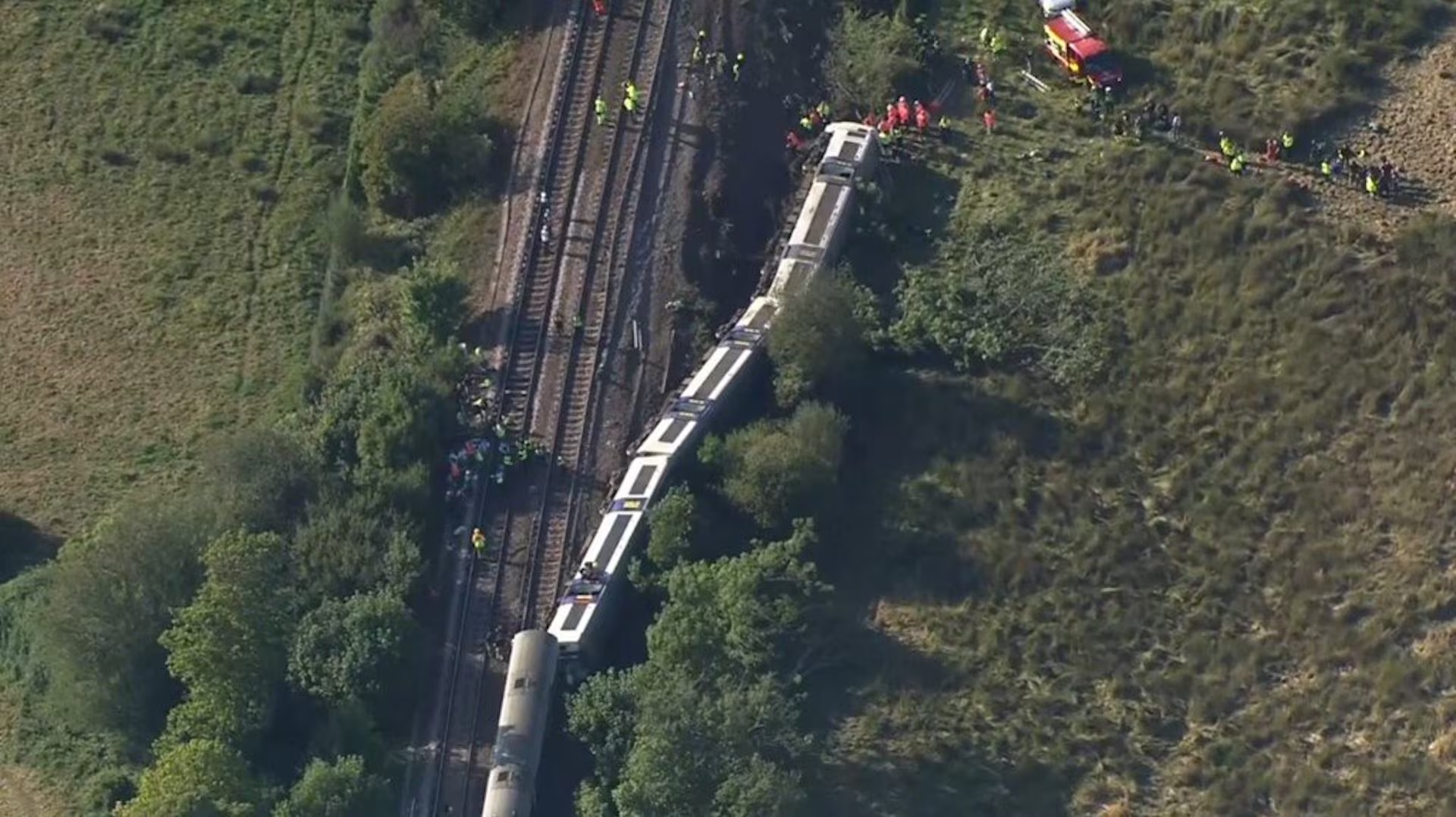
A passenger train, carrying 150 people, has derailed near Lewes, East Sussex, southern England. The convoy, which left Victoria station in London, headed for Eastbourne, on Thursday 13 August, went off the tracks just before 4pm. The last three carriages of the convoy, made up of eight carriages, overturned on their side on the side of the line, just north of Lewes station. For now, the causes of the derailment are still uncertain and, according to the South East Coast Ambulance Service, the emergency health service that responded to the scene, 20 injured passengers were transported to hospital. Two people suffered serious injuries and are now in serious condition, while the others suffered more minor injuries.
The dynamics of the train derailment in Lewes, England
According to initial hypotheses, the cause of the accident was a track defect, although at the moment there is still no official confirmation on the causes of the derailment. At 3.51pm the driver contacted the operations center to report the anomaly. In some images and photos circulating online you can see the last three tail carriages overturned on their side at the side of the tracks, off the tracks and partly fallen into a ditch, with some passengers on the carriages waiting for help. Dozens of people were stuck inside for a short time before emergency crews intervened.
In the meantime, the Rail Accident Investigation Branch sent a team of inspectors to the site with the task of collecting the first elements useful for the investigation. Rail transport expert Christian Wolmar commented on the incident, according to which it is an “extremely rare” event, and stated that today’s particular conditions may have played a role in the accident; in this heat the rails reach very high temperatures. He explained that warnings had already been issued in the past about the risk that the tracks could deform, the so-called buckling, and it is not excluded that this is precisely the origin of the derailment.
What Could Have Caused the Train Crash: The Hot Hypothesis
As CNN explains, the derailment occurred at the height of a heatwave in the UK, with several trains being canceled and others traveling at reduced speed due to the extreme heat. In fact, on Thursday, some areas of southern England reached 35 degrees, temperatures that made Thursday the hottest day of the year in the United Kingdom, with a peak of 38.1 °C recorded in Kew Gardens, London.
Furthermore, a note from the official Network Rail website, which had already warned in the past that high temperatures can cause expansion of the tracks and their possible deformation. “Steel absorbs heat easily and the track can reach a temperature up to 20 degrees higher than the air. When the steel heats up, it expands. The rails stretch and start to push against adjacent sections of track. If there is no room for expansion, the rail can deform and we have to close the line to repair it before trains can run again,” explains Network Rail. Thursday’s accident is the second major rail crash in the UK in two months. In June, two passenger trains collided in south-central England, near the town of Bedford, causing one death and dozens of injuries.
All trains between Lewes and Brighton, Eastbourne, Haywards Heath and Seaford have been canceled and Southern Railway has issued a warning not to travel in the area, saying the disruption will continue until further notice. According to local press reports, a safety inspection along the same stretch of railway line had been carried out the day before the derailment. The investigation by the Rail Accident Investigation Branch will establish whether the record heat, a defect in the track or a combination of the two factors caused the train to go off the tracks.