The regicide of Umberto I of Savoy, then King of Italy, was carried out on 29 July 1900 in Monza by an anarchist originally from Prato, Gaetano Bresci, who killed the sovereign with three shots from a revolver. The attack was one of numerous attacks against sovereigns and rulers carried out by the anarchist movement between the end of the nineteenth century and the beginning of the twentieth century.
More specifically, Bresci wanted to attack Umberto I because he had approved the violent repression of the bread riots that broke out in Milan in 1898. The regicide, however, did not unleash popular indignation against the monarchy, as Bresci expected. After the death of Umberto I, son of the first king of Italy Vittorio Emanuele II, his son, Vittorio Emanuele III, ascended to the throne.
Tyrannicide and the age of anarchist attacks
Since the ancient world there have been cases of “tyrannicide”, that is, the killing of sovereigns and other political leaders considered, rightly or wrongly, harmful to public well-being. The most famous case is certainly that of Julius Caesar, murdered following a conspiracy in 44 BC. C.
The anarchist movement, for much of its history, has waged its battles through rebellions, street demonstrations and other forms of propaganda. However, in the period between the end of the 19th century and the beginning of the 20th century, a current of the movement developed the belief that attacks against sovereigns and rulers could constitute a particularly effective form of “propaganda by deed” and push the population to revolt. For this reason, anarchists carried out numerous attacks against rulers and politicians, killing, among others, the French president Sadi Carnot in 1894, the Empress of Austria Elizabeth (the famous Sissi of Bavaria) in 1898, the president of the United States William McKinley in 1901. The attacks did not derive from a common plan and the perpetrators often acted in isolation.
Who was the anarchist Gaetano Bresci
Umberto I was killed by Gaetano Bresci, an anarchist born in Coiano, a hamlet of Prato, in 1869. Bresci began working as a textile worker as a teenager and soon developed libertarian political beliefs. Already at the age of fifteen he joined the anarchist circle of his city. In 1895 he was sentenced to confinement on the island of Lampedusa, where he remained for about a year. Once released from prison, he had a son with a woman with whom he was having an affair and in 1898 he decided to emigrate to the United States. He settled in Paterson, New Jersey, where a large Italian community lived, in which various exponents of the anarchist movement were present. In Paterson Bresci found work as a worker and stood out as a brilliant young man, also because, unlike the other Italians, he spoke English well and was able to interact with the locals.
The repression of the bread riots and the planning of the attack
In 1898, while he was in Paterson, Bresci learned of the ferocious repression carried out in Milan on the occasion of the bread riots: on 7 May the army, commanded by General Fiorenzo Bava Beccaris, opened fire with rifles and even cannons on the crowd protesting because the price of bread was too high, killing around a hundred people (over three hundred according to other reconstructions). The event was one of the most dramatic moments of the crisis at the end of the century, that is, the political and social crisis that developed in Italy in the last years of the nineteenth century. After the repression of the riots, the king not only did not stigmatize Bava Beccaris’ behavior, but even wanted to reward the general, awarding him with a decoration and naming him senator of the Kingdom.
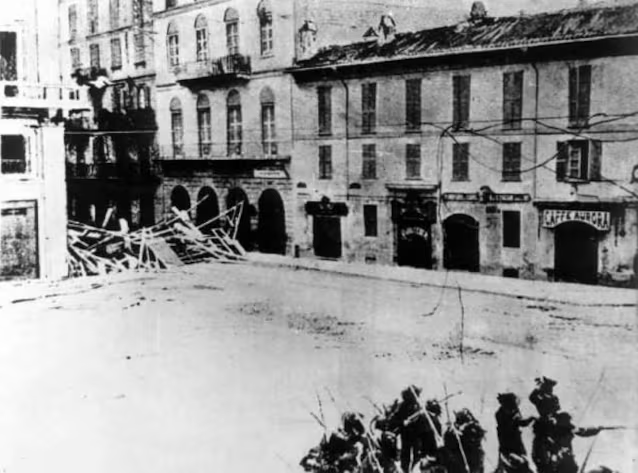
Bresci, shocked by the news, decided to take revenge. In February 1900 he purchased a 5-shot Harrington & Richardson revolver and in May he embarked for Italy, determined to kill Umberto. It is not known on what terms other Paterson anarchists were involved: the hypothesis that the regicide was an organized plot has never been proven. The hypothesis has even been put forward that a draw had been carried out among the Paterson anarchists to decide who should shoot Umberto: in this case too, there has been no confirmation.
The regicide: Monza, 29 July 1900
Having arrived in Italy, Bresci stayed in various cities and in July he settled first in Milan and then in Monza, where, from the 21st, King Umberto, who was on holiday in the Villa Reale, was also staying. The sovereign had suffered two attacks in the previous years – that of Giovanni Passannante in 1878 and that of Pietro Acciarito in 1897 – but had remained unharmed. The attack in 1900 was fatal to him.
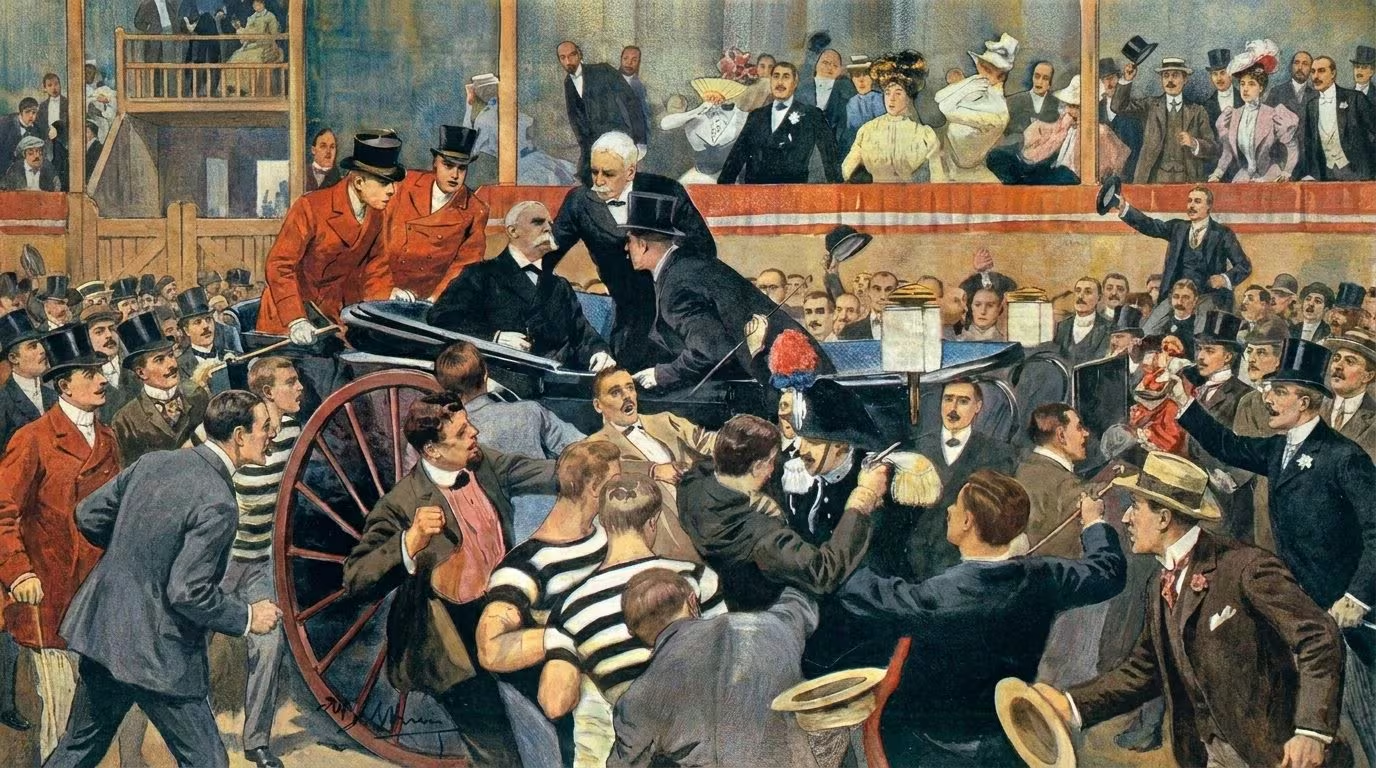
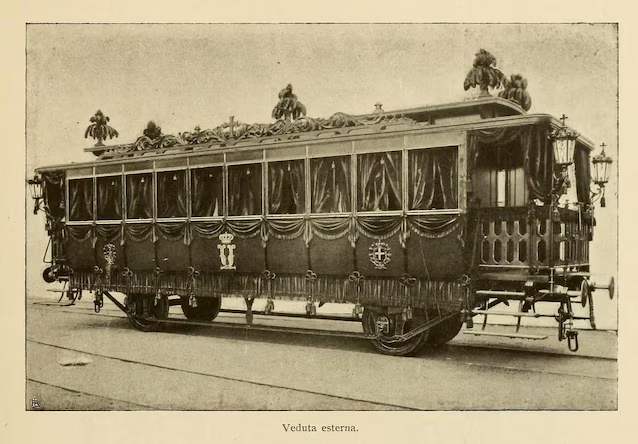
On July 29th around 9.30pm Bresci mixed with the crowd awaiting Umberto’s passage near the Villa Reale. The king was returning in a carriage after attending a gymnastics competition at the headquarters of a sports club. As soon as the carriage approached, Bresci fired four shots, three of which hit. Umberto, hit in the shoulder, a lung and the heart, was immediately transported to the Villa Reale, but died shortly afterwards. The body was taken to Rome on a special carriage and buried in the Pantheon.
The consequences of the killing of Umberto I
After the attack, Bresci allowed himself to be captured by a Carabinieri marshal, escaping being lynched by the crowd. When questioned about the reasons for his action, he declared: «I didn’t kill Umberto. I killed the King. I killed a principle.” He was tried on 29 August and sentenced to life imprisonment in Santo Stefano Penitentiary (as the death penalty had been abolished). On May 22, 1901, less than a year after the regicide, he was found hanging in his cell. The death was dismissed as a suicide, but over the years the suspicion has been raised that the anarchist had been eliminated on purpose by prison officers.
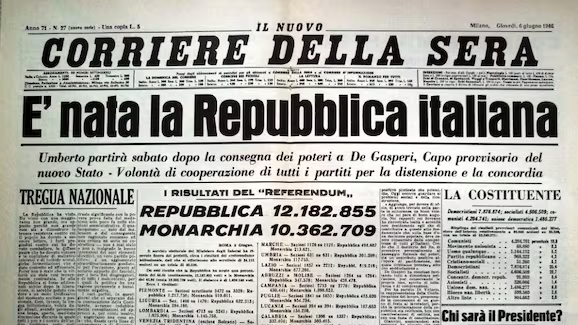
What is certain is that the attack aroused indignant reactions and, contrary to what Bresci expected, consolidated the consensus and popularity of the monarchy. In place of Umberto I, moreover, his son Vittorio Emanuele III ascended to the throne, who would reign in the country until the end of the Second World War, becoming complicit in the rise of the fascist dictatorship and its crimes.
However, the Bresci attack was appreciated in some anarchist circles and served as a source of inspiration for the American Leon Czolgosz, who killed President McKinley in 1901.