
On November 3rd the so-called midterms 2026, the mid-term elections in which Americans are called to vote to renew all 435 deputies of the House of Representatives and 35 senators (about a third, out of a total of 100 seats), as well as the governors of 36 states.
The elections – which take place halfway through the presidential term, as the name itself explains – will not directly concern the figure of President Donald Trump: however, they will be fundamental in measuring the approval rating of his administration after two years in office.
At the moment, the latest NBC polls give the Democratic Party the advantage, with 52%, against 45% for the Republican Party (that of Donald Trump). It must be said, however, that historically mid-term elections tend not to reward the party of the President in office: many analysts, however, point out that Trump’s popularity rating has dropped considerably (standing at 38-40%, one of the lowest rates in recent US history), thanks to inflation, the high cost of living and the high cost of fuel that the United States also experienced after the outbreak of the war in Iran.
The outcome of this electoral round, however, will also have repercussions on us Europeans: in these two years the US President has governed with a majority of his party in both the House and the Senate, but the results of the midterms could overturn these balances (especially in the House of Representatives).
This will clearly have an impact on the Trump administration’s decisions, especially those concerning foreign policy, including negotiations on Russia and Ukraine, the American role in NATO and the war in Iran, with Netanyahu reportedly putting pressure on Trump for the US to strike Tehran again immediately after the midterms.
How midterm elections work and what is at stake
To better understand the significance of these mid-term elections, we must first start from a simple but fundamental point: these are elections that concern the members of Congress, the equivalent of our Parliament, an expression of the legislative power, which functions as a counterweight to the executive power (i.e. the government, now led by President Trump).
The US Congress is made up of 435 members of the House of Representatives and 100 members of the Senate. The difference between the two chambers helps to understand what is really at stake. In the House, all 435 seats are renewed every two years, because deputies have two-year mandates and the number of representatives for each state depends on its population, with each district corresponding to approximately 761,000 people.
The Senate, however, follows a different logic. Each of the 50 states has the right to 2 senators, whose mandates last 6 years and are staggered, so that in each election only a third of the available seats are renewed (with senators from the same state never voting in the same year).
Today the balance in Congress leans towards the Republicans: Trump’s party controls both chambers, with the Senate divided 53 to 47 and the House 219 to 214 with two vacant seats, and also holds the majority of governors, 26 against 24.
The point is that overturning these majorities is not so easy for both chambers. As for the House of Representatives, the Democrats only need a net gain of a handful of seats to win the majority and independent forecasters, such as the Cook Political Report, now see them as favourites.
In the Senate the game is more uncertain: the Democratic Party would need a net four seats and the Cook Political Report estimates a Democratic gain of between 1 and 6 seats, with hotly contested races in Maine, Michigan, Texas, Alaska, Iowa and Ohio.
According to polls, in fact, the Democrats are doing well in states where the Republicans are usually the favourites: states like Texas, Kansas and South Carolina are now swing states, where both parties are playing the game.
It must be said, however, that in 20 of the last 22 midterm elections the president’s party has lost ground, with the incumbent administration almost always arriving at this appointment on the defensive.
In summary, the possible scenarios include:
- Majority of the Republican Party in both the House of Representatives and the Senate;
- Majority of the Republican Party in the House of Representatives and the Democratic Party in the Senate;
- Majority of the Democratic Party in the House of Representatives and the Republican Party in the Senate;
- Democratic Party majority in both the House of Representatives and the Senate.
According to experts, the most likely outcome is number 3, with the Democratic Party likely to obtain a majority in the House, while the Senate would remain in the hands of the Republican Party.
Congressional control, however, is not a trivial detail. The party that wins gains control of the legislature, which has the authority to pass laws: a solid majority in both houses, therefore, implies faster and more efficient approval of the President’s political agenda.
Voting participation also needs to be read carefully. On the eve of the vote, more than 32 million Americans have already voted by mail (including Pope Leo XIV) or in person, with more than 59 million postal ballots requested or sent. In general, however, turnout in midterms is usually lower than in presidential elections, and, crucially, early voters tend to be older than average, so early voting data does not reliably predict who will win.
Because the outcomes will also have consequences for Europe and Italy
If the president is not elected in the midterms and Donald Trump will remain in the White House for another 2 years, why should Europe worry about it?
As ISPI underlines, a reversal of the balance a Capitol Hill it would reshape relations between Congress and the White House precisely on international issues, from the war against Iran to the sanctions against Moscow, up to the commitments towards NATO: the opposition party would have in its hands the budget of the armed forces and diplomacy, the power to summon and investigate members of the administration and, with control of the Senate, also the possibility of blocking appointments and treaties.
More specifically, as highlighted by the European Council on Foreign Relations, a Democratic majority in Congress would make it more difficult for Trump to advance claims on European territory such as those towards Greenland. Many Democratic candidates, in view of the presidential elections in 2 years, aim to unmask corruption, malfeasance and abuses of power and a majority of them would most likely open investigations and possible prosecutions impeachmentfor example against Secretary of War Pete Hegseth, already under fire for how he handled military operations in the Caribbean and the war against Iran.
Democrats would also be best positioned to expose the links between the Trump family’s expanding economic interests, foreign capital flows, regulatory decisions and foreign policy outcomes, making future deals with countries like Russia less attractive.
It must be said, however, that a Democratic victory would hardly slow down the foreign policy of Trump, who has often ignored his own Republican majority and who enjoys a presidential veto (overcome only by 2/3 in both chambers), which could block any relevant law.
Hence ISPI’s observation: for Trump’s foreign policy, the vote could prove to be both a barrier and an accelerator, because a president defeated mid-term, no longer able to count on Congress for his internal agenda, tends to dedicate himself even more to the rest of the world.
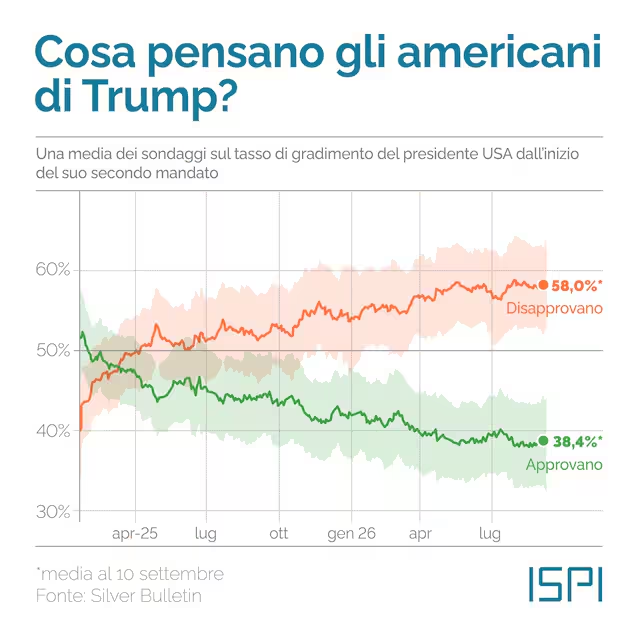
In other words, faced with the defeat of his party, Trump could push even harder on foreign policy to gain visibility: meetings with world leaders in front of cameras, economic benefits for his allies, initiatives designed above all to give the appearance of success, particularly in Europe, the Middle East, the Americas and Greenland.
The mechanism, experts point out, is always the same: if he fails in one area, Trump immediately looks for another in which to show strength and the recent “agreement” on Greenland served to shift attention away from Iran for a while. And at the moment even more risky moves cannot be ruled out, such as an attempt to overthrow the Cuban regime, following the capture of Maduro in Venezuela at the beginning of the year.
So what might a Democratic Congress be relevant to? According to ISPI experts, in the budget: with the majority in both Houses, the Democrats could restore the aid to Ukraine frozen by the administration and, on Iran, deny new funds to the point of tying the entire defense budget to the end of the conflict, barring a presidential veto. Something could also move on the trade front: after the Supreme Court ruled out the duties imposed by the tycoon with emergency powers in February, the new majority would have the last word on part of the tariffs affecting European goods.
In short, a Democratic Congress could make the president’s every move more costly, on Ukraine, Iran and NATO, without however being able to prevent it, also because, even in the event of defeat, Trump will remain in the White House for another two years with all the powers of the office.
According to experts at the European Council on Foreign Relations, however, a democratic victory at midterms it could count a lot in the medium term (with the presidential elections scheduled in 2 years) and change very little in the short term. And it is precisely for this reason that, for Europe, following the vote on November 3 means above all starting to understand what America will have to deal with in the years to come.