There is a question that crosses cultures and centuries without ever losing urgency and without finding a single answer: what makes a life “worth living”? And how do you achieve happiness? In this scenario, some notions coming from other cultural traditions and distant philosophies become new and disruptive points of reference, such as the Japanese method of ikigai (literally “reason for living”, “reason for living”) aimed at finding one’s purpose in life, through the performance of voluntary actions capable of bringing together what one loves, what one is capable of, what one can receive compensation for and what can be useful to the world.
In contemporary Western societies, where the question of one’s reason for living is often intertwined with a widespread feeling of disorientation, between fragmented identities and a social time that seems to accelerate faster and more frenetically than the individual ability to give meaning to everyday experiences, it is a method that can provide tools to better understand one’s direction.
The meaning of Ikigai and the Japanese collective imagination of the meaning of life
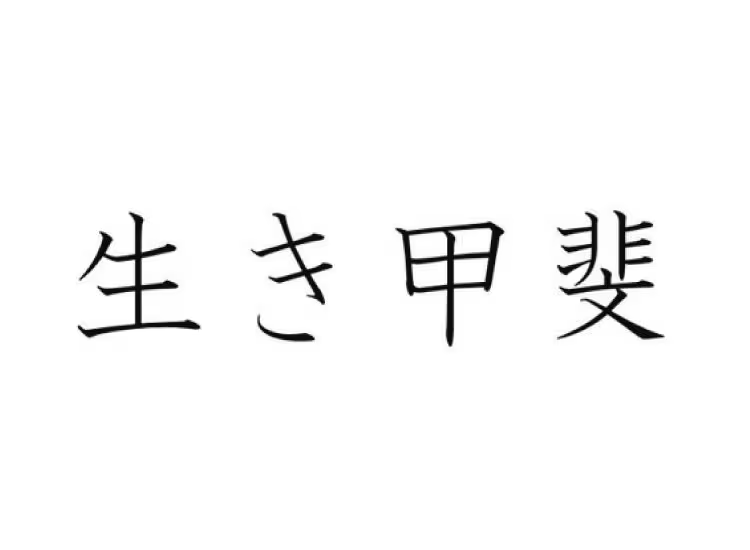
The term Ikigai (生き甲斐) is composed of the union of iki (live) e gai (value, meaning). It literally means “reason for living” or “meaning of life”, but more specifically indicates a way of living, intertwined with Japanese culture and history.
THE’ikigai it is an abstract concept that indicates, in a very general way, the “reason for living” or what makes life worth living. However, for a Japanese person this implies both adherence to a specific philosophical system and the daily application of some practices that this system implies: a specific routine, life practices defined as “slow and conscientious” and a series of exercises to remain anchored to the present, to the here and now. Pursuing theikigaithe ultimate goal is to remain earthly, anchored to reality, to essential goods such as health, relationships and well-being.
Its peculiarity lies precisely in the innovative positioning: the meaning ofIkigai in fact it is not placed “outside” life, but inside its materiality and concreteness. You just need to be able to train your gaze and recognize how many ikigai our life is made up.
Contemporary interpretations and individual Western visions
Many Western interpretations of this concept tend to read the meaning of life as something to be “found” or “realized” individually. From this perspective, the self is often conceived as an autonomous project. THE’ikigaiinstead, arises in a cultural context in which identity is intrinsically relational.
The sociologist Chikako Ozawa-de Silva has shown in her studies how theikigai is closely linked to forms of social belonging and the ability to find meaning in the most everyday relationships. In fact, it is not necessarily linked to great vocations or exceptional achievements, it can reside in ordinary gestures, stable relationships, repeated daily practices and rituals that give continuity and peace to existence.
The value of life would not be limited to individual self-realization, but would be rooted in the ability to contribute to a community and shared social fabric. The meaning of life would not be sought within the self, but would emerge between people, in the formation of groups.
In contemporary global diffusion, ikigai has often been reinterpreted through simplifying models, such as the well-known four-circle scheme, divided into: what you love, what you can do, what the world needs, what you can get paid for.
Although useful as a dissemination tool, this model tends to transform a cultural concept located in a personal optimization technique, in a utilitarian vision oriented towards business rather than the search for meaning. In this reading, theikigai it becomes a sort of “perfect point” to be identified, losing its procedural and real nature.
How to recognize theikigai in your life and cultivate it
Rather than a point of arrival, according to Japanese schools of thought, theikigai it should be recognized and identified through small recurring signals in one’s experience.
It does not necessarily manifest itself as constant enthusiasm or absolute passion, but as a form of gradual involvement that tends to repeat itself over time.
- A first indicator is continuity: often theikigai starts from an activity or relationship to which one returns spontaneously or which is repeated over time, which becomes a hobbies or an important relationship in our life.
- A second element is the feeling of meaning that resides in the effort of carrying out a certain activity. According to Japanese philosophy, in fact, what is not always easy but appears “right” in its execution is a source of ikigaias it trains our resilience and resistance to adversity.
- A third element is resonance with others: that which, even in a simple way, generates value or recognition in the social context, creating shared well-being.
In this sense, theikigai it is not “discovered” suddenly, but it is recognized by observing what already happens in one’s life with a certain regularity and spontaneity. Train atikigai it doesn’t mean looking for a definitive answer, but developing a different sensitivity towards one’s experience, through five pillars: starting small; forget oneself; seek harmony and sustainability; take joy in the little things; stay in the here and now.
A first exercise is active observation: writing down daily activities that generate involvement, even minimal, without immediately judging them in terms of usefulness or success. A further exercise is retrospective reflection, that is, observing the moments – even the most ordinary ones – in which time seemed to “make sense”. A final method is exposure to different contexts, since theikigai they would not emerge by isolating themselves, but by entering new social or professional spaces that activate unexpected aspects of themselves.
In this perspective, theikigai it is not a destination to reach, but a practice of continuous attention to the way we live.