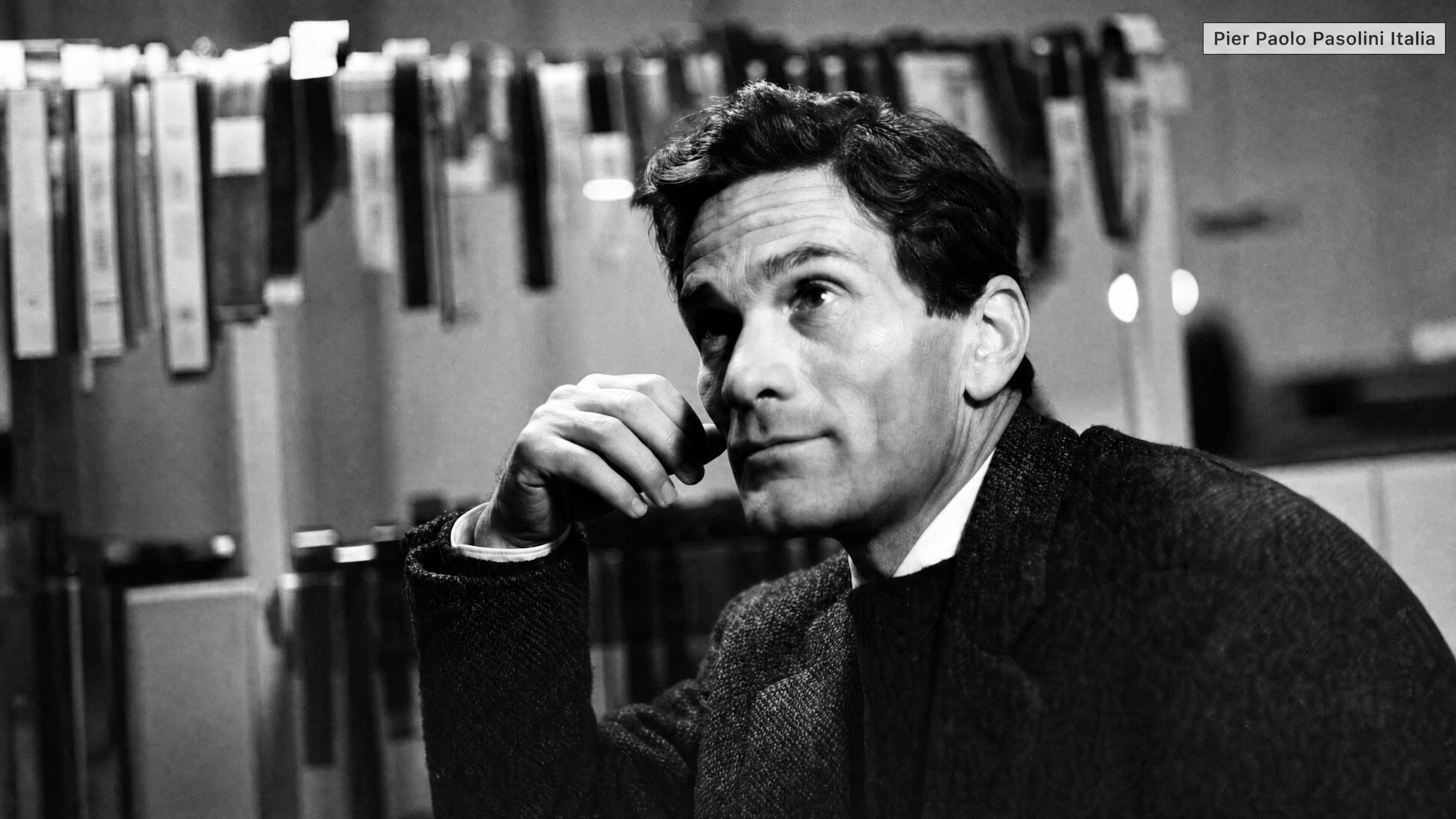
When we talk about the theft of Salò’s “pizzas”, we don’t mean the theft of food, but of the reels of the most well-known and controversial film by the writer and director Pier Paolo Pasolini. Precisely this theft, according to the Parliamentary Anti-Mafia Commission, was the beginning of the end, and led to his death.
It was November 2, 1975, and although 51 years have now passed since the assassination of the Bolognese director, the Rome Prosecutor’s Office has just opened a new investigation file about his murder. The proceeding was opened following a exposed filed last few weeks in Piazzale Clodio by the lawyer Stefano Maccioniwho had already assisted one of the writer’s cousins, Guido Mazzon, in the past.
In fact, family members maintain that Giuseppe Pelosi, the only one definitively convicted for the writer’s murder, did not act alone. Their request aims to reopen the case by exploiting the potential of modern forensic genetics to give a name to the three unknown DNA profiles isolated by the RIS at the crime scene, deposited between 2014 and 2015 and then archived only due to the impossibility of comparing them with the databases of the time.
What they are and why they stole the “pizzas” from the film Salò
Today an entire 4K film travels on a USB stick or on a cloud server. But in 1975, things were quite different: cinema was pure chemistry and mechanics, and it traveled on film.
Specifically, we are talking about a 35 mm film which was a strip of cellulose triacetate perforated on the sides, a few tenths of a millimeter thick and kilometers long. To protect it from dust, scratches and light, it was wrapped around a plastic core (called “the flange”) and sealed in round metal containers.
In movie jargon, these cylindrical boxes were called “pizzas”. But why steal them?
Stealing films meant keeping a production in control: there was no backup of the shots, and if the original negative was burned, lost or stolen before editing, the actors, crew, workers had to be called back and everything had to be reshot, spending billions of lire.
The underworld knew well that remaking a film from scratch was not feasible, and stealing the films and demanding ransom became an attractive prospect.
The mid-August coup of 1975 and the demand for the ransom of the reels
On the night between 14 and 15 August 1975, a gang of criminals broke into the company’s factories. Technicolor in via Tiburtina, in Rome.
The gang didn’t steal money, but the reels of the most expensive and eagerly awaited projects of the season: in addition to Pasolini’s “Salò or the 120 Days of Sodom”, in fact, they also took away the reels of Federico Fellini’s “Il Casanova”. and Damiano Damiani’s parodistic western “A genius, two cronies, a chicken”.
The objective was clear right from the start: it was not an artistic prank, but an industrial racketeering operation.
In fact, just a few hours after the robbery the ransom request arrived. The criminals called Alberto Grimaldi’s production demanding astronomical figures (hundreds of millions of lire, although at the time there was even talk of two billion), otherwise they would have been destroyed. Grimaldi, however, refused to pay.
For Pasolini, however, Salò was his most radical and important film, and the mere thought of knowing those reels were being pulped was unbearable. According to the Parliamentary Anti-Mafia Commission, the director was contacted by a man from the suburbs with the promise of regaining the lost treasure (this lead was initially supported by Pasolini’s friend, the director Sergio Citti), and on his way to the meeting he fell into a trap with no way out.
The Idroscalo bait: Pasolini’s murder on November 2nd
On the evening of November 1st, seventeen-year-old Giuseppe Pelosi (known as “Pino the Frog”) acted as bait: he picked up the director at Termini Station, they had dinner together and then headed towards the Idroscalo of Ostia – which at the time was nothing more than a dark and isolated dirt clearing – to officially separate themselves.
There, however, there was no exchange: Pasolini was beaten bloody and finally run over by his own Alfa Romeo GT.
Although the investigations initially overlooked several details – bloody pieces of the stick abandoned near the football pitch and a witness ignored by the official investigation who had seen five men drag Pasolini out of the car – it was soon understood that this murder, so heinous, ferocious and brutal, had been carried out by multiple men. But what could the reasons be? Although Pelosi has never explained them, according to some experts the reasons for this murder have origins in a deeper context than herd effect violence.
The first is the homophobia rampant in criminal and sub-proletarian culture. Pasolini was openly homosexual, and such a person was highly despised in the underworld circles of the time. Although Pelosi did not admit it, that attack seemed to all intents and purposes to be a punitive expedition, which first and foremost wanted to humiliate before killing. The destruction of the body – and, in particular, of the face of such an influential figure, was an act of erasing the dignity of the person, which found a reason explained in a profound hatred of identity.
But homophobic hatred, however visceral, was not enough: Pasolini was an uncomfortable voice, who had repeatedly condemned mass murderer fascism and organized crime. For young reactionaries, neo-fascists and criminals, he was nothing more than an enemy who needed to be “put back in his place”. Furthermore, let’s not forget that this crime took place in an era, that of the Years of Lead, in which human life was worth very little, weapons and beatings were the order of the day and political extremism had led to a series of unfortunate resurgences.
The motive for the crime of passion therefore ended up acting as a screen for a full-blown ambush, of which only Pino the Frog was finally convicted (although he actually served only seven years in prison).
The discovery of the films and the release of the film
After the Ostia massacre, blackmail lost all contractual value for the gang: keeping those reels meant preserving the material evidence of a murder that had shaken the whole of Italy.
The criminals, however, did not burn them, but abandoned them in the spring of 1976 in a warehouse in the Cinecittà area, without having collected any ransom.
Despite this, according to historical reconstructions these reels were not used for editing the film.
The editor Nino Baragli and the production, in fact, had already managed to reconstruct and complete the film in the previous months using the “doubles” of the scenes (the same scenes as the reels, but shot from a different shot), which were the director’s processing waste, and the “intermediate” films, which were used to reconstruct the contact negatives using an innovative technique.
The film, although not with the shots chosen by the director, had its world premiere in Paris on November 22, 1975 and arrived in Italian cinemas on 10 January 1976, only to be seized by the judiciary a few days later for obscenity (but that’s another story).
Because the Pasolini case is never closed
Fifty years after the Idroscalo crime, the new investigation by the Rome Prosecutor’s Office calls everything into question.
The objective is to finally give a name and a face to the three unknown DNA profiles (isolated by the RIS between 2014 and 2015) present on the murder evidence: traces which have so far remained without culprits, but which today, thanks to the evolution of forensic genetics and access to modern databases, can be compared with greater precision than in the past.
Because if cinema has found a way to reconstruct his work, Italian history is still waiting to know all the culprits of one of the most heinous crimes of republican Italy.