Two people lost their lives after being struck by lightning: the victims are an American tourist, who was hiking on Etna (according to initial reconstructions, in an area closed to access due to the ongoing eruption) and a 42-year-old hiker from South Tyrol, probably struck during the descent, at 2,600 meters on Piz Starlex, in Alto Adige. The news has reignited attention on the topic and, above all, on the correct behavior to adopt in the event of a storm, particularly in mountainous areas, but not only.
As the Civil Protection underlines, no place is safe outdoors: in these cases, the first thing to do is to try to quickly reach an enclosed place. Even at home, however, you must avoid using equipment connected to the electricity grid and landline telephones and electrically powered appliances, in particular televisions, computers and household appliances, must be kept turned off.
Finally, there is an essential element to know that can make the difference in rescue operations: if a person is struck by lightning, their body does not remain electrically charged. This means that she can be helped immediately, without any risk to those providing help.
Where lightning is most dangerous
As reported by the Civil Protection, the vast majority of accidents caused by lightning occur outdoors. The place most at risk of all is the mountain, but so are all large and exposed spaces (such as a lawn or a football pitch), which become even more dangerous in the presence of water: sea, beaches, piers, piers and outdoor swimming pools. Even indoors, however, there remains a residual risk, albeit much lower.
Contrary to popular belief, to understand where lightning will strike most frequently, you need to consider the shape of objects, not the material they are made of. The preferred targets of lightning are high points, such as trees, poles and pylons, or anything that protrudes from a lower environment, including a single person in the middle of a meadow or on a beach. Sharp objects, such as an umbrella or a fishing rod, are also at risk.
Then there is an aspect that we often ignore: lightning can strike even several kilometers away from the center of the storm and a storm cloud can land on the ground even without rain. As a result, even if the storm seems far away and is not raining directly above us, we could be affected.
Among other things, in a study published in Journal of Geophysical Research the data collected over about 10 years in Catalonia (in the north-east of Spain) and Barrancabermeja (in Colombia), two very different areas in terms of climate, but similar in terms of land conformation, were analysed: the researchers thus identified the so-called recurrent lightning spotsthat is, points struck by cloud-to-ground lightning every year, one after the other.
Specifically, 148 were identified recurrent lightning spots in Catalonia and 916 in the Barrancabermeja area. What do all these places have in common? They are almost always tall structures, mountain tops and steep slopes: in Catalonia, for example, 13% are represented by high towers and some are even found in the open sea. In other words, lightning does not strike so randomly: certain places, due to their shape and position, are destined to be struck over and over again.
How to protect yourself outdoors: the Civil Protection guidelines
Knowing where the risk is highest is half the battle. The other half is knowing how to behave and, in this case, we return to the guidelines provided by the Civil Protection.
Prevention starts before the storm even arrives. If we are planning an outdoor activity, it is always a good idea to check the weather reports, which indicate whether the day will be favorable for the development of thunderstorms. But be careful: these phenomena are often difficult to locate precisely in advance, so the bulletin picture must always be integrated with direct observation of the sky and a check for updates even while we are on the move.
When the storm approaches, there are two signs to keep in mind: if we see lightning, the storm may still be far away and it is therefore time to move away, trying to anticipate the storm’s arrival. If, however, we hear thunder, even if it seems far away, it means that the storm is now a few kilometers away: at that point we are in danger and must reach shelter as soon as possible.
As mentioned, outdoors the rule is as simple as it is uncomfortable: nowhere is truly safe. The best thing is to reach an enclosed area quickly and wait at least 30 minutes after the last thunder before resuming activities. If there is no building, a car is fine, with doors and windows closed and, if possible, the radio antenna lowered. If we are forced to stay outside, we must move away from points that protrude (poles, isolated trees) and try not to be the tallest presence in the surrounding area.
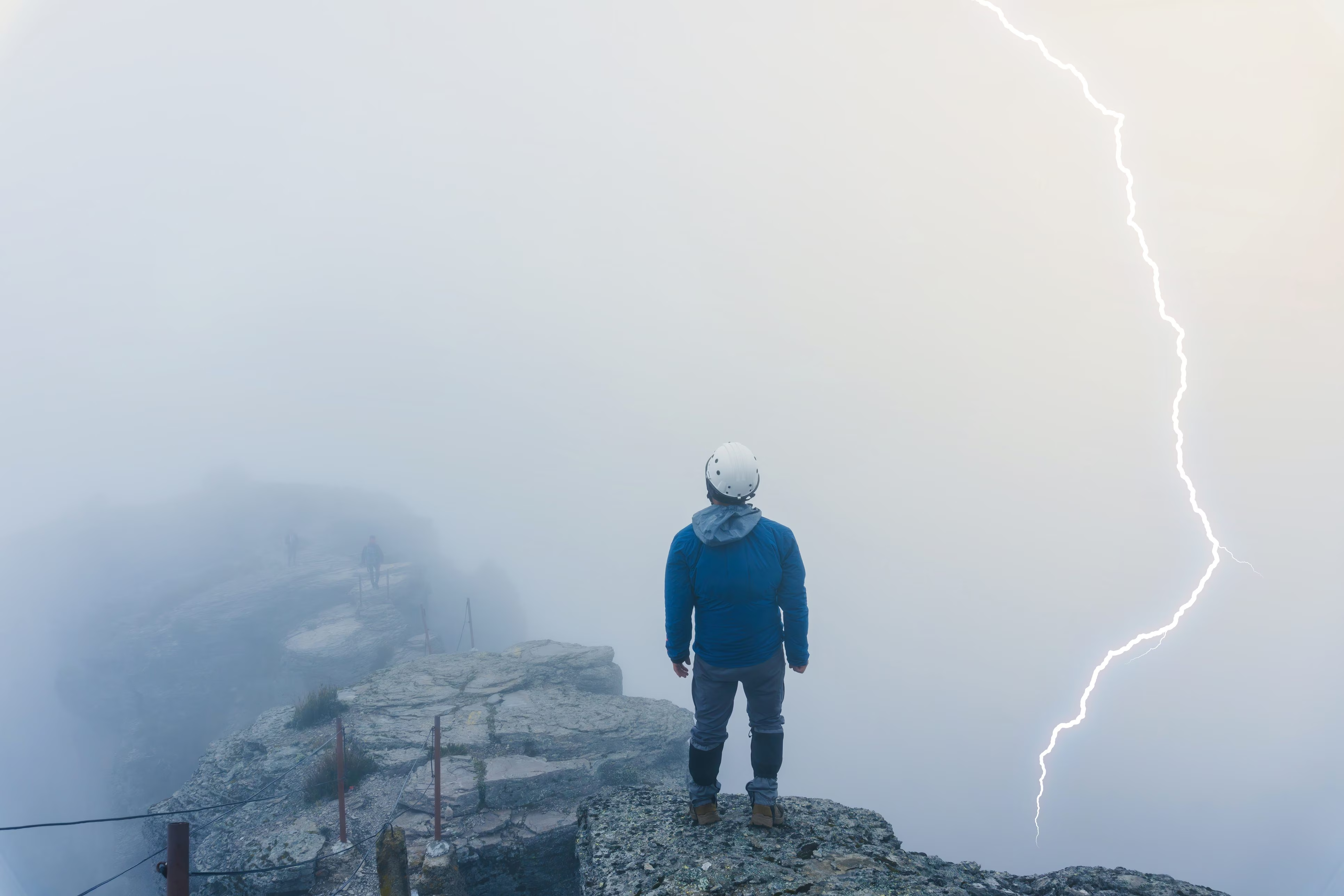
The directions then change depending on the place where we are. In the mountains you must immediately descend, avoid ridges, peaks and via ferratas with cables and metal ladders and stop any climbing; if we are in a group, it is better not to hold hands and walk at least 10 meters apart from each other.
Once sheltered, or if we are forced to stay outside, it is best to keep our feet together to reduce the point of contact with the ground and thus cancel the potential difference between the two supports (the so-called step voltage), reducing the intensity of the current capable of passing through our body. For the same reason, you should avoid sitting or lying on the floor. Always with your feet together, you can assume a crouched position, preferably placing any insulating material between you and the ground.
At the seaside or lake, any contact with water should be avoided, because lightning can also cause damage through indirect electrocution and umbrellas, fishing rods and any sharp objects should be abandoned.
When camping it is better to take shelter in a brick structure or in a car, avoiding caravans and campers that are not made of sheet metal.
Recommended behaviors at home during a storm
Even if the lightning risk is lower at home, there are still some precautions, including:
- Avoid using equipment connected to the electricity grid and landline telephone;
- Keep electrically powered appliances turned off (even better by unplugging them), especially televisions, computers and household appliances;
- Do not touch metal elements connected to the outside, such as ducts, cables, pipes and electrical systems;
- Avoid contact with water (postpone operations such as washing the dishes or taking a shower until the end of the storm; in most cases you just need to be patient for an hour or two);
- Do not stay under canopies, balconies, sheds, pavilions, gazebos and verandas which are not safe places. It is better to take shelter inside the building instead, keeping your distance from doors and windows, which must be closed.
Finally, an important clarification concerns the metal, because there is a lot of confusion circulating here too. Small metal objects (such as watches, keys, necklaces) do not attract lightning and are not dangerous. However, metal is an excellent conductor, so you need to stay away from very large metal objects such as nets, fences, railings, steps, ropes and ladders: if they are hit, they can transmit the current to those in contact with them or in the immediate vicinity. For the same reason it is good to keep away from water.